








By Yomna Ehab, Federico Maccioni and Linda Pasquini
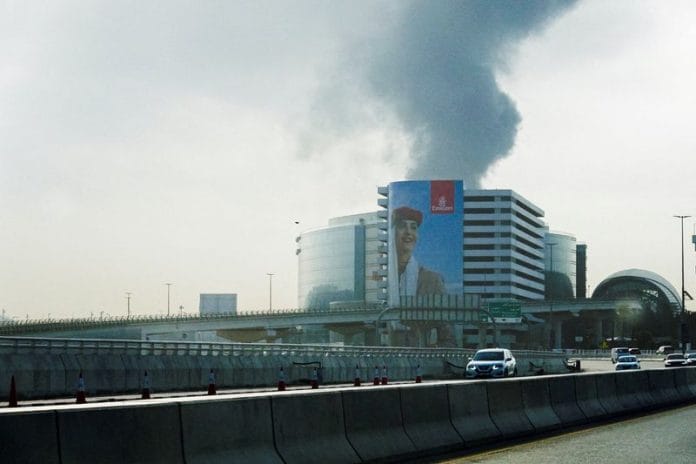
DUBAI, March 16 (Reuters) – Dubai’s international airport was gradually resuming flights on Monday after a fuel tank fire caused by a drone attack forced a temporary closure and flights to reroute, spotlighting the challenge for airlines grappling with the Middle East crisis.
The U.S.-Israeli war against Iran, now in its third week, has thrown global aviation into turmoil, with flights cancelled, rescheduled and rerouted, as most Middle East airspace stays shut over fears of missile and drone attacks.
With the Gulf a global crossroads for commercial aviation, the war has disrupted travel, sent fuel charges and ticket prices surging, hit flows of goods such as critical medicines and thrown holiday plans into disarray.
Monday’s incident, causing a fuel tank blaze but no injuries, is the third attack on the Dubai airport since Iran launched assaults on Gulf nations on February 28, with strikes Tehran says aim at the U.S. presence in the region.
While the United Arab Emirates and other Gulf countries host U.S. military facilities, Iran has used missiles and drones to target civilian facilities such as airports, hotels and ports.
Flights in the region are at about half their usual level, though their number has risen from just after the start of the war.
ATTACKS PROMPT DIVERSIONS
Drone and missile fire has regularly kept aircraft circling Dubai’s busy airport, heavily affecting Middle East tourism worth about $367 billion a year. Air freight rates have also surged as much as 70% on some routes.
In a statement on X posted by the Dubai Media Office earlier on Monday, the Dubai Civil Aviation Authority flagged a “gradual resumption” of some flights to selected destinations.
Reuters could not immediately establish how many scheduled commercial flights were due to depart from the hub, which last year handled over 1,000 flights per day.
“Civil Defense teams have confirmed that the fire in a fuel tank in the vicinity of Dubai International Airport has been extinguished. Cooling operations are now underway,” the media office said in a separate post.
Emirates airline said it expected to partially resume operations at 0600 GMT after the attack, which prompted authorities to divert some flights to the smaller Al Maktoum international airport.
A Reuters reporter on board an Emirates plane from Rome to Dubai observed the disruption, as security concerns forced the aircraft to divert abruptly when it came in to land early on Monday, going instead to the inland city of Al Ain.
The airline told passengers it planned to fly them back to Dubai as the airspace had re-opened. At one point it said it would arrange a bus for the 130-km (81-mile) road trip back to the coastal city.
FLIGHT CANCELLATIONS EXTENDED
On its website, Emirates said it had cancelled some flights scheduled for Monday. Flightradar24 tracking showed some flights to Dubai turning back to their departure airports. Sister airline flydubai said it was restarting flights.
Air India and Air India Express said in a statement flights with Dubai had been cancelled for the day. Polish carrier LOT said it was extending cancellations of flights to Dubai, Riyadh, Tel Aviv and Beirut to dates later in March and April.
“We are acting in accordance with the recommendations of the European Union Aviation Safety Agency (EASA) – safety remains our priority,” LOT said in a statement.
Gulf Arab states have faced more than 2,000 missile and drone attacks since February 28, with targets including U.S. diplomatic missions and military bases but also key oil infrastructure as well as homes and offices.
The UAE, which normalised relations with Iran’s arch-foe Israel in 2020, has faced the brunt of the attacks.
(Reporting by Yomna Ehab and Menna Alaa El Din in Cairo; Linda Pasquini, Maha El Dahan and Jana Choukeir in Dubai; Writing by Adam Jourdan; Editing by Lincoln Feast, Clarence Fernandez and Emelia Sithole-Matarise)
Disclaimer: This report is auto generated from the Reuters news service. ThePrint holds no responsibility for its content.