








By Luis Jaime Acosta
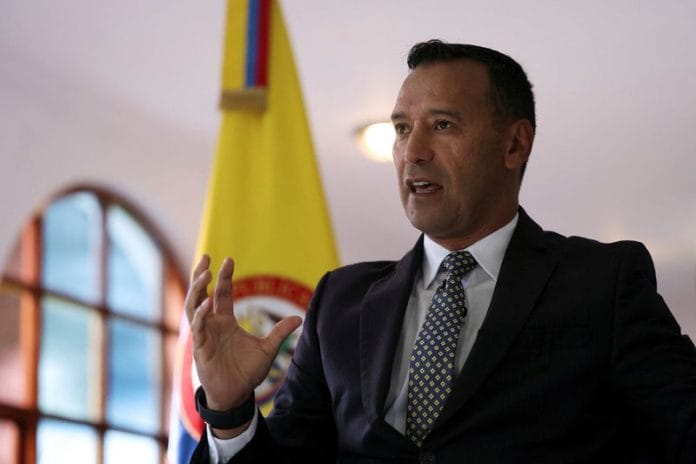
BOGOTA, March 18 (Reuters) – Explosions in cocaine labs near the border with Ecuador killed 14 people in January, Colombia’s Defense Minister Pedro Sanchez said on Wednesday, when asked to clarify accusations by Colombian President Gustavo Petro that an Ecuadorean security operation resulted in more than two dozen deaths in the area.
Sanchez said Colombian and Ecuadorean authorities are together examining whether sovereignty has been violated and that a bomb found in Colombia seemed likely to belong to Ecuador’s armed forces.
Petro earlier this week had suggested Ecuador had bombed Colombian territory, leaving behind 27 “charred” bodies, though he provided no further evidence or information.
Ecuadorean President Daniel Noboa flatly denied the accusation, saying his country had bombed drug traffickers within its own territory and the locations were hideouts for narco-terrorism groups of mostly Colombian origin. Ecuador’s defense ministry did not immediately respond to a request for comment on Wednesday.
Twelve people in the border province Narino were killed on January 22 and two others died days later, Sanchez said, when asked by journalists about the figure of 27 dead given by Petro.
“The information we have at this moment is that those people died after being burned alive. The site where they died was a cocaine laboratory, and the causes and who was behind it are under investigation. Two other people died under similar conditions at another site on January 24,” he said.
Petro on Tuesday reposted an image from Colombian state-run television station RTVC that it said showed one of the bombs, a dark green cylinder lying in foliage. On Wednesday he added in a new post the bomb, which Sanchez said had been disarmed, was found just over the border near a site bombed by Ecuador and was fired from a low-flying plane.
Ecuador on Sunday launched a two-week-long security operation in four provinces on or near the Pacific coast in a bid to beat back gang violence. It has repeatedly held operations on its Colombian border, a major hub for trafficking of drugs that are then smuggled north to the U.S. by sea.
Ecuador has said its anti-drug trafficking operations are supported by allied countries, including the United States. Noboa had repeatedly courted the backing of U.S. President Donald Trump for his anti-crime initiatives.
Noboa raised duties on Colombian goods to 50% last month, claiming the neighbor was not doing enough to fight drug trafficking, and Colombia said it was considering a reciprocal measure.
(Reporting by Luis Jaime Acosta, writing by Julia Symmes Cobb, editing by Chris Reese)
Disclaimer: This report is auto generated from the Reuters news service. ThePrint holds no responsibility for its content.