





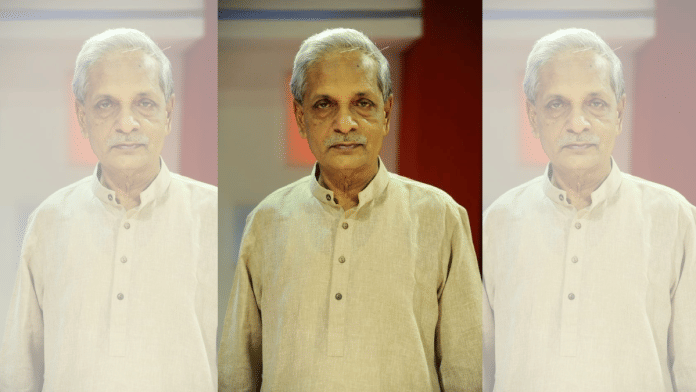



Kolkata: As the only Hindu minister in the newly-formed cabinet under Prime Minister Tarique Rahman, Nitai Roy Chowdhury has his job cut out: to restore the rich cultural heritage of Bangladesh.
Chowdhury, 78, said that Bangladesh should not be known to the world for mob violence and communal flare-ups, but its song and dance, movies and literature.
“It is not just the well-known cultural hotspots of Dhaka; if you go to the countryside, you will find how rich our cultural heritage is. We have our indigenous Bengali traditions, which have been informed by a wide range of Islamic, Hindu, Buddhist, and tribal influences,” he told ThePrint.
“Be it in Jamdani weaving from the interiors of the country, or the colourful rickshaw paintings on Dhaka streets, our Baul songs or our OTT offerings, we need to put forth what is best in us.”
Chowdhury accepted that, of late, there had been a lot of bad press about the state of affairs in the country leading to the elections, but did not wish to dwell on the subject “on a day when Bangladesh has woken up to a new dawn.”
The Daily Star columnist Tasneem Tayeb wrote that if there was one unsettling thread running through Bangladesh’s civic space in 2025, it was not confined to uncertain politics, mob outbursts or economic troubles.
“It runs — often violently — through our cultural scene. Through vandalised music stages, silenced folk singers, cancelled festivals, and burned institutions, audiences are learning — gradually — that culture, too, can become a site of violence and fear,” Tayeb wrote in December 2025.
She wrote that if 2025 witnessed a shrinking of the cultural space, 2026 will test whether Bangladeshis have the restraint — and the will — to stop that thinning from becoming permanent.
“This government will actively promote art and culture and ensure that our talented women do not get pushed away from public and cultural spaces. We will encourage and promote creativity from every section of society,” Chowdhury said.
Also Read: Not pro-anyone, pro-economy—Bangladesh PM-elect Tarique Rahman sends clear global signal
Other minority leaders
A seasoned politician and a senior advocate at the Supreme Court
He was first elected to the Jatiya Sangsad from Magura-2 constituency in 1988. In the 12 February polls, he decisively defeated Jamaat-e-Islami’s Mustarshid Billah. Chowdhury had served as Minister of Youth and Sports under Hussain Muhammad Ershad in 1990 before joining the BNP.
Three other candidates from minority communities also won in the elections. All of them are from the BNP. Goyeswar Chandra Roy, who is a member of the BNP’s highest policy-making standing committee. Saching Prue, a senior BNP leader and a practising Buddhist, and Dipen Dewan from the Chakma ethnic minority group, is also part of the recently formed cabinet.
Chowdhury said that Rahman has positioned himself as a champion of an inclusive and safe Bangladesh for all religious and ethnic groups.
“He often says religion is personal, but the state belongs to everyone. He embodies the spirit of Martin Luther King Jr.’s ‘I Have a Dream’ by saying ‘I have a plan’. And that plan is an inclusive, progressive Bangladesh,” Chowdhury said.
“The BNP does not recognise the notion of religious minorities or majorities. We believe in equal rights for all in Bangladesh. The rights of a Muslim are no different from those of a Hindu,” he added.
Chowdhury said ties with India will be of utmost importance. “India and Bangladesh share historic and cultural ties. The agenda of our government, though, is Bangladesh First. We will stick to that.”
The 2026 election has shown that language and culture bind Bangladeshis more than religion, according to Chowdhury.
“People were fearful that Bangladesh would take a turn towards religious extremism. But the people have voted for a decisive and progressive government. The very birth of Bangladesh happened because we shunned extremism for language and culture. We will uphold that,” he said.
(Edited by Insha Jalil Waziri)