





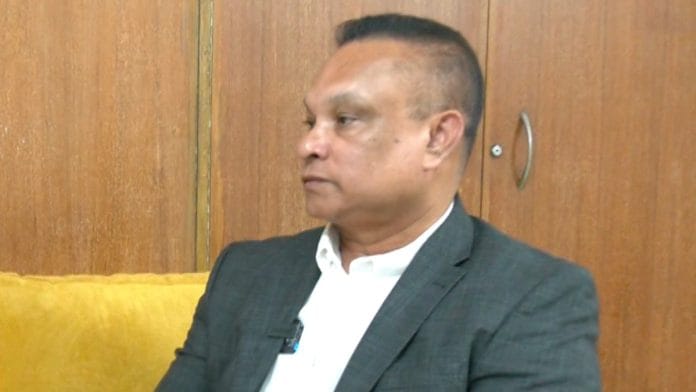



Dhaka: As Bangladesh approaches one of the most consequential elections in decades, the Bangladesh Nationalist Party (BNP) is framing its campaign around sovereignty tempered by regional pragmatism, particularly when it comes to bilateral ties with India.
In an exclusive interview, Dr Ziauddin Hyder, adviser to BNP chairman Tarique Rahman, told ThePrint in Dhaka, “Our major focus even during the election campaign is ‘Bangladesh First’ but we need to expand the horizon of our collaboration and relationship so that people, across the country, you know, they feel comfortable.”
“…the trust has to be regained,” Dr Hyder said, adding, “That means we would like to build a Bangladesh where we provide healthcare to everyone, we provide the right to education, food security, environmental protection, water management.”
But the slogan, he stressed, does not imply isolation.
“Whatever we need from other countries, we will get them,” he said. “We will have bilateral talks. We will use our regional platforms or global platforms to make sure we cater to our citizens.” India, Bangladesh’s most influential neighbour, looms large in that calculus.
According to Dr Hyder, relations between the two countries have long been shaped by trade imbalances and unresolved disputes over transboundary rivers.
The BNP, he said, intends to engage India through diplomacy while strengthening Bangladesh’s own capacity to manage water resources.
“There are a number of unresolved issues, a number of unmet needs,” he said. “So we have to continue our bilateral talks and use all the diplomatic instruments that we have.”
At the same time, the BNP is proposing massive investments in domestic water infrastructure. “We have identified 20,000 kilometer canals,” Dr Hyder said.
“The rivers will be excavated. There is a big plan on our part to modernise, and utilise our waters for agriculture, fisheries and other purposes,” he added.
Water diplomacy with India, he acknowledged, remains asymmetrical. “But we have so many other forms of diplomacy,” he said. “We are neighbours. Our trade imbalance is a big issue. We need to see how we can reduce that and benefit from each other.”
BNP leaders have also floated the idea of developing Bangladesh as a regional hub for health tourism, particularly along the Cox’s Bazar-Chattogram belt. “We expect that there will be many patients from across the border, from India, from Myanmar,” Dr Hyder said.
Adding, “They could come, enjoy our sea beach and get treated.”
Also Read: ‘Yes’ or ‘no’? Referendum vote will define Bangladesh’s future, but for many it’s a ‘don’t know’
‘It’s not about being Muslim or Hindu’
Concerns about the safety of religious minorities in Bangladesh, fueled by repeated instances of mob violence since August 2024, have also emerged as a sensitive election issue. Dr Hyder rejected claims that a change in government would embolden radicalism, arguing instead that violence thrives where democratic norms collapse.
“If we can build a democratic society where all people have equal right to speak,” he said, “then you can approach the solution pretty quickly.”
He argued that under past governments, democratic values were systematically eroded. “We didn’t have any democratic culture in the society or in the state system,” he said. “That was one of the reasons why we have seen more and more violence.”
Victims of hate crimes, he stressed, extend beyond religious minorities. “Whenever there is violence, marginalized populations suffer—not just religious minorities, but other minorities, even poor Muslim people living in slums or hard-to-reach areas.”
The BNP’s vision, he said, is grounded in what it calls inclusive Bangladeshi nationalism.
“It’s not about being a Muslim or a Hindu or a Christian or a Buddhist,” he said. “It’s about being a Bangladeshi. Living in this land should be enough to access all sorts of facilities equally.” The party, he said, claims a historical record of countering extremism.
“BNP has a track record in the past to prevent extremism, to prevent violence against all types of population,” he said, adding that restoring law and order and curbing corruption is central to protecting minorities.
‘Our banking system has collapsed’
On the economy, Dr Hyder described a system hollowed out by favouritism and institutional decay. “Over the last one and a half decade, our banking system has collapsed,” he said, terming efforts by the interim government to merge banks as a corrective measure.
Another challenge, he said, is Bangladesh’s debt profile. “Our debt-to-GDP ratio is like 7 percent. It should be 15 percent or above in a country like ours,” he said, arguing for better debt management to support growth.
Foreign direct investment remains weak, he said, requiring improved governance and deregulation. The BNP says it plans to work with export-oriented industries—garments, leather, pharmaceuticals and information technology—while removing “policy bottlenecks”.
But the party’s broader economic vision centers on what it calls the “democratisation of the economy”.
“For many years, the economy has basically been an oligarchic economy,” Dr Hyder explained. “The benefit of growth reached only people who were close to power.”
The BNP wants to spread growth evenly through small and medium enterprises, particularly artisanal industries. “We’ve been popularising one concept called ‘one village, one product’,” he said. He added that in his home district in southern Bangladesh, entire villages depend on traditional handicrafts. “Today a woman is earning 2,000 taka per month,” he said. “If we upskill her and connect her to the market, she will earn 20,000 taka per month.”
BNP leaders say they are exploring partnerships with global platforms like Amazon and Alibaba to connect artisans to international markets.
‘Important we bring women into mainstream’
How does the BNP view concerns over attacks on women’s rights given that its opponent Jaamaat is caught in the crossfire? “It’s extremely important that we bring women into the mainstream of development, politics and business,” replied Dr Hyder.
The BNP has been critical of Jamaat’s stance on women. “They talk about reducing working hours from eight to five,” Dr Hyder said. “But quickly everyone realised that the intention is to push women out of work.”
By contrast, BNP leaders have proposed workplace reforms, including mandatory daycare centers and breastfeeding facilities. “That will help tremendously to empower women in the workplace,” Dr Hyder told ThePrint.
The party’s flagship welfare plank is the “family card” proposed to be issued to one adult woman per household.
“Each family card will allow women to receive either food or cash equivalent to 2,500 taka,” he said. “The intention is to allow the household to save from food expenditures.”
Over time, Dr Hyder said, those savings could finance small businesses. “If we can make our women self-reliant, more self-confident,” he said, “that will have an enormous impact on our national economy.”
The BNP has also pledged to increase women’s political representation. “Pipeline is a big issue,” he said. “We need to attract women into grassroots politics.”
As Bangladesh heads to the polls, the BNP is presenting itself as a reformist force, nationalist but outward-looking, socially conservative yet advocating inclusivity, arguing that democratic restoration is the prerequisite for stability at home and credibility abroad.
“Trust will not come back just by saying it,” the adviser to the BNP chairman said. “We have to do it. We have to prove it.”
(Edited by Amrtansh Arora)
Also Read: BNP’s Tarique Rahman a crowd favourite on Dhaka’s streets. But there’s also the ‘third’ front