





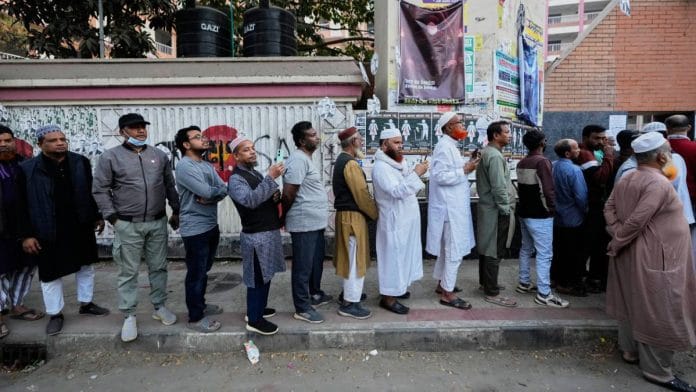



Dhaka: Bangladesh Thursday began voting in its 13th parliamentary election and a simultaneous national referendum on institutional reforms, in what is being seen as a decisive moment for the country’s democratic trajectory. Polling started at 7.30 am and will continue until 4.30 pm across 299 constituencies nationwide.
For decades, an unwritten political equation has shaped Bangladesh’s electoral landscape: the party that secures a majority in the capital, Dhaka, often goes on to form the government. Since the mass uprising of the 1990s, the national mandate has closely mirrored Dhaka’s electoral outcome.
In the 5th National Parliamentary Election in 1991, the Bangladesh Nationalist Party (BNP) swept all 13 constituencies in Dhaka district and subsequently formed the government. In June 1996, the Awami League captured eight of the capital’s 13 seats, while the BNP won five—a result that marked the former’s return to power after 21 years. In 2001, the BNP-led four-party alliance again dominated Dhaka, winning all 13 seats before forming the government.
Following constituency delimitation in 2008, Dhaka’s seats increased from 13 to 20. In the 9th national election that year, the Awami League secured 18 of the 20 seats, paving the way for its alliance to assume power.
This year’s contest presents a markedly different political scenario.
In the absence of the Awami League, the main electoral battle in Dhaka is between the BNP and the Jamaat-e-Islami-led 11-party alliance. The National Citizen Party (NCP) and Bangladesh Khelafat Majlis are also fielding candidates in several constituencies.
The BNP is seeking to reassert its dominance in the capital, while the Jamaat and its allies are aiming to erode the party’s traditional vote-base. In many constituencies, the primary contest is between the BNP’s “Sheaf of Paddy” symbol and rivals, including Jamaat’s “Scale”, NCP’s “Water Lily Bud”, and the “Rickshaw” symbol of Bangladesh Khelafat Majlis.
Two constituencies, in particular, have drawn significant attention.
In Dhaka-10 Dhanmondi, often considered a bellwether seat, BNP candidate Sheikh Rabiul Alam is contesting against Jamaat’s Jasim Uddin Sarkar. ThePrint spoke to voters earlier in the area and the BNP may hold a slight edge here.
In Dhaka-17 (Gulshan–Banani), BNP chairperson Tarique Rahman is facing Jamaat’s Dr S.M. Khaliduzzaman in a closely watched race. Early indications suggest the BNP is performing strongly in this constituency.
Prominent political leaders cast their ballots early in the day. Bangladesh Jamaat-e-Islami Ameer Shafiqur Rahman voted around 8.30 am at the Manipur High School centre in Dhaka. BNP secretary general Mirza Fakhrul Islam Alamgir also cast his vote at Thakurgaon Government Girls’ High School in the morning.
After casting his voting in Badda, NCP leader Nahid Islam asked everyone to participate without fear.
“There was no opportunity for a fair vote over the last 16 years. Now, the chance has come to return to democracy by casting your votes,” he told the media, expressing confidence that the 11-party alliance of which the NCP is part, would secure victory if polling remained free and fair.
“We are on the verge of forming the government if people are allowed to cast their votes freely and fairly. We will accept the people’s mandate.”
After casting his vote Thursday, Tarique Rahman said he was yet to receive reports from all corners of the country and that reports had come about some unexpected incidents in various parts of Bangladesh Wednesday night.
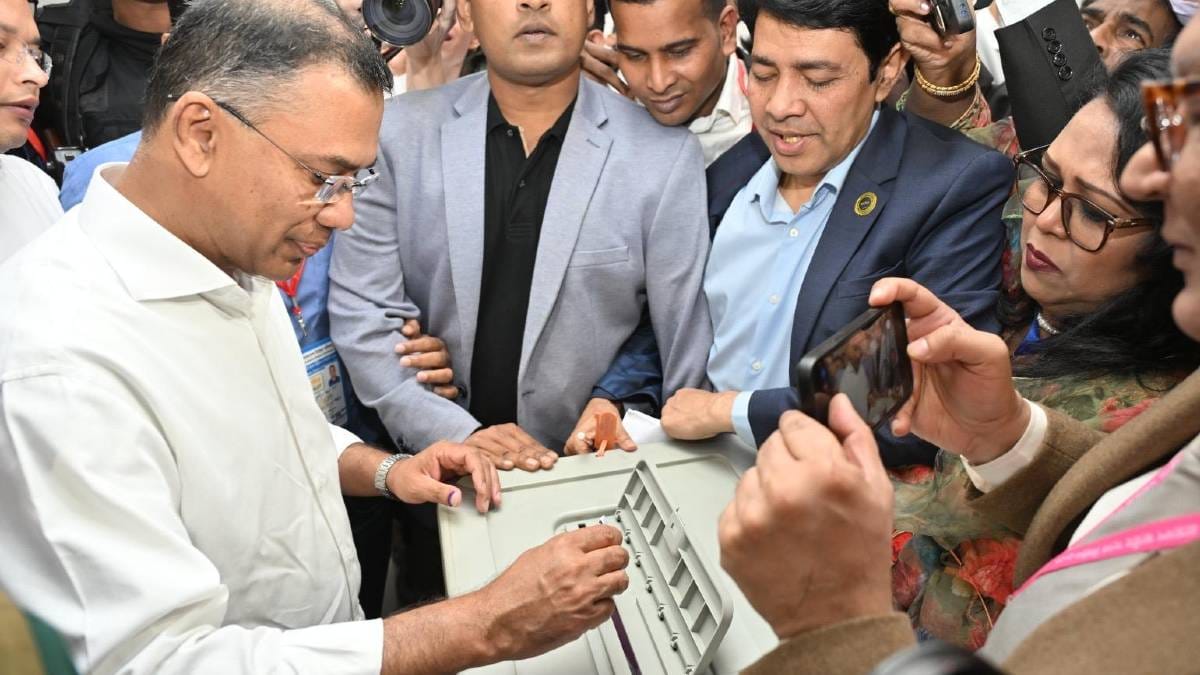
“We received some unexpected reports last night, which are not desirable at all. However, we have seen that the law enforcement agencies have dealt with every situation very strictly. I believe that if people come to the polling centres in large numbers today and cast their votes, any conspiracy can be thwarted,” he told the media.
In response to a question about what the election results might be, the BNP chairman expressed a positive attitude. “Voting has just begun. It would not be right to comment on the outcome just yet. But I am, Insha Allah, very optimistic. We have full faith in the people’s verdict.”
The eve of the election saw reports of violence, alleged attempts at vote manipulation, arrests, and the recovery of arms in several parts of the country.
In Dhaka, the police arrested Md Habib, nayeb-e-ameer of Jamaat’s Sutrapur thana unit, on allegations of buying votes. Earlier, a scuffle between female activists of the BNP and Jamaat in Korail slum under Banani police station left a Jamaat activist injured. In Narayanganj’s Sonargaon, Iqbal Hossain Bhuiyan, the Jamaat nominee for Narayanganj-3, alleged that BNP activists vandalised the home of ward-level Jamaat leader Osman Gani in Sonmandi Union.
(Edited by Nida Fatima Siddiqui)
Also Read: Nationalism the centrepiece, rivals Jamaat & BNP make final push on eve of Bangladesh polls