








By Alasdair Pal and Christine Chen
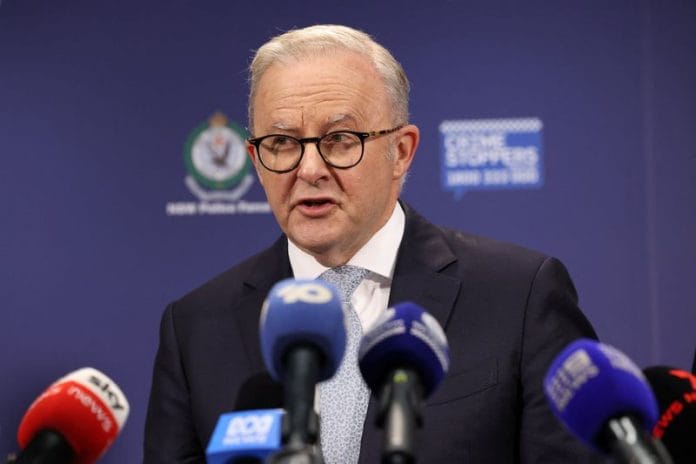
SYDNEY, April 1 (Reuters) – Australian Prime Minister Anthony Albanese warned the economic shocks of the war in the Middle East would be felt for months and encouraged citizens to take public transport in a rare address to the nation on Wednesday.
The address was broadcast simultaneously across major television and radio networks at 7 p.m. (0800 GMT). Similar addresses were made by previous prime ministers during the COVID-19 pandemic and the 2008 global financial crisis.
Australia, which imports about 90% of its fuel, has seen petrol prices surge and experienced localised shortages as a result of the U.S.-Israeli war on Iran and the blockade of the Strait of Hormuz.
“I understand that right now it’s hard to be positive,” Albanese said. “The war in the Middle East has caused the biggest spike in petrol and diesel prices in history. Australia is not an active participant in this war. But all Australians are paying higher prices because of it.
“The economic shocks caused by this war will be with us for months.”
Albanese encouraged citizens to “do their bit” to ease pressure on fuel supplies, such as not stockpiling fuel ahead of the Easter holidays, which begin this week, and taking public transport.
“If you’re hitting the road, don’t take more fuel than you need – just fill up like you normally would. Think of others in your community, in the bush and in critical industries,” he said.
“And over coming weeks, if you can switch to catching the train or bus or tram to work, do so.”
The message came as a relief to some who were bracing for more drastic measures to be announced.
“I drive for work so I’m really happy he didn’t say ‘work from home only’,” said Patrick Connelly, 24, a swimming pool technician who watched the address from a Sydney pub.
“He said to just drive as much as you usually do. Don’t take more than you need.”
FUEL STOCKS BELOW RECOMMENDED LEVEL
The month-long conflict has spread across the Middle East, killing thousands, disrupting energy supplies and threatening to send the global economy into a tailspin.
Albanese said the coming months “may not be easy” but said the government would do everything it could to help Australians.
Earlier this week, the government announced it would halve the excise on petrol and diesel and remove the heavy-road-user charge for three months to help households cope with a surge in costs driven by the war, at a cost to the government of around A$2.55 billion ($1.75 billion).
Australia has its highest fuel stocks in 15 years, but they are still far below the International Energy Agency recommendation of 90 days. To boost supply, the government has temporarily relaxed fuel standards and also released petrol and diesel from its domestic reserves.
Treasurer Jim Chalmers said on Wednesday small businesses affected by the war would be given easier access to credit.
“We know that the fallout is affecting everyone, but we believe that by working together, if everybody does their bit, we can get through this difficult period,” Chalmers told reporters.
(Reporting by Alasdair Pal, Christine Chen and Hollie Adams in Sydney; Editing by Kate Mayberry and Raju Gopalakrishnan)
Disclaimer: This report is auto generated from the Reuters news service. ThePrint holds no responsibility for its content.