








By Daniel Flynn, Yuliia Dysa and Lili Bayer
KYIV/BUDAPEST, April 13 (Reuters) – Ukraine welcomed with relief on Monday the defeat of its harshest EU foe, Hungary’s Prime Minister Viktor Orban nL8N40V07J, an outcome which paves the way for a 90 billion euro ($105 billion) loan that Kyiv urgently needs to fund the war with Russia https://www.reuters.com/world/ukraine-russia-war/. But the winner of Hungary’s election https://www.reuters.com/world/hungary/elections/, Peter Magyar nL8N40V06U, is no outspoken ally of Ukraine and some other leaders in the European Union remain sceptical about stronger backing for Kyiv, particularly its efforts to join the EU, analysts said.
Magyar’s centre-right Tisza party won a landslide victory nL8N40W0GT on Sunday, ending Orban’s 16-year rule and winning the two-thirds majority it needs to enact constitutional reforms.
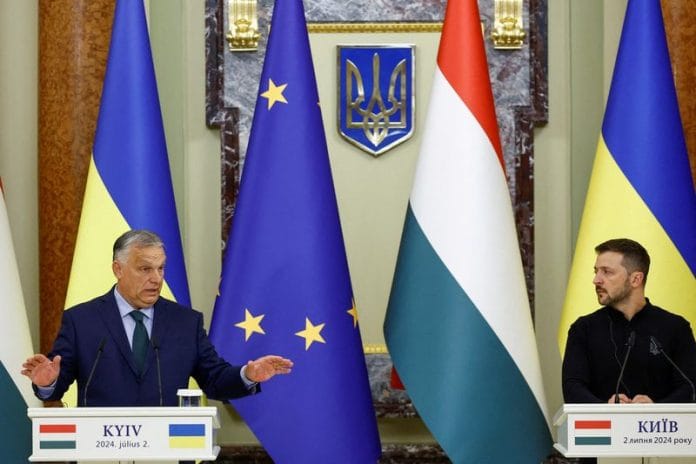
Orban – a nationalist who maintained warm ties with Russian President Vladimir Putin – systematically opposed Brussels’ efforts to support Ukraine, most recently obstructing the two-year EU loan over accusations that Kyiv had deliberately halted Russian oil flows across its territory via the Druzhba pipeline.
President Volodymyr Zelenskiy says Druzhba was damaged by a Russian strike in January and that repairs should be completed in the spring nL8N40S11K – though he has urged Europe to stop buying Russian oil.
“One should not call Magyar pro-Ukrainian – he isn’t – but he is not anti-Ukrainian, unlike Orban, and that’s already great,” said Oleksiy Honcharenko, a Ukrainian lawmaker with the European Solidarity Party.
“Putin has lost his main ally in Europe.”
In his first news conference nL1N40W0F3 after the election, Magyar said on Monday Ukraine was the victim in the war with Russia and he pledged to diversify Hungary’s energy sources.
But he also said Budapest would maintain “pragmatic” ties with Moscow and that repairing relations with Kyiv depended on the restoration of the rights of the Hungarian ethnic minority in western Ukraine – a long-running source of tension.
LIFTING HUNGARY’S VETO
EU officials nL8N40W0L3 and analysts expect Magyar to drop Hungary’s veto on the loan and on a 20th round of sanctions against Russia after he takes office, probably in mid-May. Magyar is keen to unlock EU funds earmarked for Hungary that were suspended amid accusations of democratic backsliding by Orban’s government.
But the timeframe is tight. Ukraine is reliant on Western financial support, four years into the war. It needs $52 billion this year and economists say it could start to run out of money nL8N40M0DE next month.
“Hungary’s vetoes on EU financial support for Ukraine will likely cease, improving EU decision-making capacity,” said Zsuzsanna Vegh, analyst at the German Marshall Fund think tank, adding Hungary itself would still not provide funding. “Tisza is unlikely to embrace expansive military support.”
In Kyiv, residents greeted Hungary’s election outcome with cautious optimism.
“This is very positive because it gives us a chance to improve relations with Hungary,” said Yehor Vasylchencko, a 33-year-old IT specialist.
But, noting that Magyar is a former member of Orban’s nationalist Fidesz party, he added: “I have some doubts about whether Magyar will be an improvement. Time will tell.”
Ukraine’s Foreign Minister Andrii Sybiha said “meticulous, pragmatic, and calm work” was needed to find common ground with Hungary’s new leadership.
Volodymyr Fesenko, director of the Penta think tank, said that, as Ukraine looks to reset relations with Hungary, restarting Druzhba could be an olive branch.
WARY OF CLOSER TIES
After years of anti-Ukraine rhetoric in Hungarian media, however, much of the Hungarian population is wary of closer ties with Kyiv. In Monday’s news conference, Magyar restated his opposition to fast-track EU entry for Ukraine.
Elsewhere in central and eastern Europe, Slovak Prime Minister Robert Fico, a critic of EU sanctions on Russia, and Czech Prime Minister Andrej Babis are Ukraine-sceptics. Both publicly backed Orban ahead of Sunday’s vote.
In Bulgaria, another proponent of improving relations with Moscow – former President Rumen Radev – leads in polls ahead of a parliamentary election next Sunday.
Oleksandr Merezhko, chairman of Ukraine’s parliamentary foreign affairs committee, said Slovakia’s Fico would likely be more cautious without Orban’s political cover.
But Yehor Cherniev, a lawmaker for Ukraine’s ruling Servant of the People party and deputy chair of the national security, defence and intelligence committee, said any dramatic shift in European support was unlikely.
“A miracle isn’t going to happen,” Cherniev said.
Analysts expect Orban’s departure to end the shrill tone of EU discussion around Ukraine and stop Hungary’s obstructionist position. Budapest will likely drop its veto of discussions on technical issues of Ukraine’s EU membership.
But broad concerns remain nL6N3ZN0TT in several EU capitals – including Paris and Berlin – that proposals to shorten Ukraine’s path to membership might remove the incentive to enact promised reforms reuters://realtime/verb=NewsStory/ric=nL5N3VK0FX, such as tackling corruption.
“Magyar will be obviously less hostile than Orban was,” said Orsolya Raczova, analyst at Eurasia Group. “But, with Magyar as prime minister, Hungary will basically join the mainstream opposition to speedy EU accession for Ukraine.”
($1 = 0.8557 euros)
(Additional reporting by Pavel Pulityuk in Kyiv, Anna Pruchnicka in Gdansk, and Lili Bayer in Budapest; Writing by Daniel Flynn; Editing by Gareth Jones)
Disclaimer: This report is auto generated from the Reuters news service. ThePrint holds no responsibility for its content.