





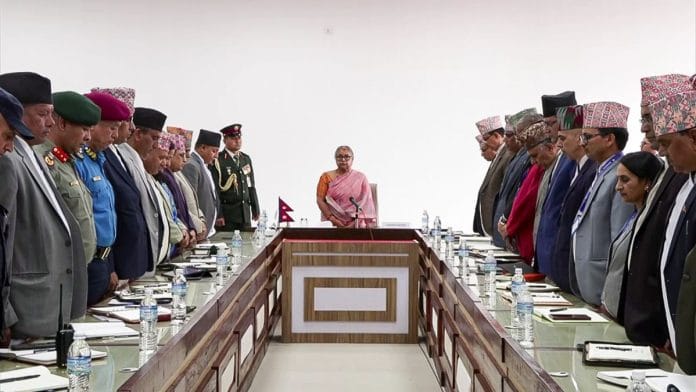



Kathmandu: In the six months since Nepal’s Gen Z-led street uprising upended the political order, the interim government led by former chief justice Sushila Karki has walked a precarious line.
It was tasked primarily with conducting elections, but was also propelled into office by public demand for accountability and an end to corruption. Now, as the Himalayan nation gears up for a general election on 5 March, the question many are asking is: Has the caretaker administration delivered on the demands?
Analysts say the government’s report card is mixed: on the one hand, it has succeeded in organising elections and maintaining day-to-day governance, but, on the other hand, it has faltered on accountability, the very issue that fuelled the protests.
“The President had given the administration a single-point mandate to conduct elections in a free and fair manner, and I would credit Karki for being able to do that on time,” Govinda Bandi, the former minister for law, justice and parliamentary affairs, told ThePrint.
Under Nepal’s constitutional framework, the Election Commission formally conducts the vote, but the government is responsible for creating the environment to facilitate the election.
“Initially, they couldn’t do that. People were not trusting political parties, and they were skeptical. There was a communication gap between mainly the major political parties and the government, and even between the government and the Election Commission. But I would give this government fairly reasonable marks in creating an environment for the election,” Bandi added.
It was after roughly three months, he said, that the interim administration began engaging more actively with parties and stakeholders.
“Finally, all parties agreed to take part in the election. No party is boycotting the election, which is good, despite the fact that this government didn’t have any constitutional backing. It’s kind of under the principle of necessity,” he said.
Karki’s appointment as interim prime minister on 12 September marked a series of firsts.
For one, Karki, once the first female to be chief justice, also became the first female prime minister in Nepal’s history.
Moreover, this was the first time since a new constitution was formed in 2015 that a government wasn’t formed under Article 76 of the Constitution, which specifically outlines procedures for appointing a prime minister.
Instead, President Ramchandra Paudel appointed her under Article 61, which defines the role of the President as head of state but does not explicitly mention the post or powers of the prime minister.
Also Read: How did Nepal become a ‘Hindu Rashtra’?
Karki govt’s report card
The interim government came to power with a millstone around its neck.
It inherited a system riddled with corruption as a governing culture, a rigid patronage driven bureaucracy, and a lack of legitimacy. It had a cabinet of four ministers, and Karki mostly asked ministers to act decisively, remain frugal, prioritise rebuilding damage from the protests, address youth demands, and prepare for elections.
In December 2025, after months of negotiations, Karki and Gen Z representatives signed a 10-point accord recognising the September uprising as a “People’s Movement” (jana andolan), outlining constitutional, electoral, judicial and anti-corruption reforms, justice for victims, and a commitment to free and fair elections on 5 March.
While some Gen Z leaders endorsed the deal, others publicly rejected it, arguing it diluted the movement’s spirit and demanding stronger accountability and immediate release of detained activists.
Despite the challenges, Bandi said the administration’s day-to-day management was steady.
“I would give fairly reasonable marks to the government in terms of carrying out some of the development and its stand on issues of governance. There were a couple of debates and controversies. However, that was very nominal,” he said.
He noted that, unlike previous governments that “kept themselves occupied with controversial issues,” this one was “fairly reasonable in terms of conducting day-to-day administration”.
Even development work continued. “For example, they made streets, bridges, and even cancelled dozens of contracts with bad contractors,” he added.
However, analysts added that the interim government did not attempt sweeping structural reform, particularly of the bureaucracy.
“Institutional reform is not possible” in six months, Bandi said. “What they did was continue with traditional practice. But the question of bureaucratic hurdles still looms large and that requires a lot of institutional reform.”
Also, analysts said the administration failed to fight corruption, one of the main triggers of the street protests.
“This government was formed on the force of this street uprising,” Awasthi Dixit, co-founder of Civic Space Nepal, who worked closely with the interim administration, told ThePrint. “So it also had this pressure to work against corruption.”
But corruption, he noted, is structural. “Working against corruption sounds very easy, but again, it is very minute and time-consuming work. It is something that can only be decreased.”
“Unless we identify and address the systemic problems that cause corruption, these are all going to be very popular agendas—popular things to say that sound very nice, but again, are impossible to do.”
Political commentator Sanjeev Satgainya was more blunt. “In terms of holding the elections—they are going to happen—so I will call it a success on Karki’s part. Regarding ending corruption, it is not an object that you just pick it up and throw it out or a stain you just wipe out,” he told ThePrint. “When corruption becomes a system and a culture, it takes a long time. You can minimise corruption but it’s very difficult to eradicate corruption the way parties have done it here through decades.”
He added that he had not expected dramatic results on corruption but had hoped the interim administration would lay the groundwork for reform.
“I was not expecting her to do anything with regard to ending corruption or trying to minimise it,” he said. “What she could have done and what she was supposed to do was to set the ground for the new government to follow and act on corruption. However, that was an aspect she could not focus much on.”
Part of the reason, he said, was political uncertainty. “There was lots of confusion on whether elections would happen or not. Karki was so engrossed and got bogged down by issues like talking to the parties, which were not very ready to participate in the elections. So in that sense, she could not do much.”
Also Read: After being toppled by Gen Z, Nepal’s old guard is now chasing the youth vote
The question of accountability
All analysts were unanimous on one point: the government had failed to deliver on accountability for the violence during the September protests.
“As far as accountability is concerned, I will give them a zero on it,” Bandi said.
On 21 September, the interim administration formed a judicial commission under the Commission of Inquiry Act to investigate the violence.
The commission was headed by former judge Gauri Bahadur Karki, along with former assistant inspector general (AIG) of Nepal Police Bigyan Raj Sharma and legal expert Bishweshwor Prasad Bhandari as members.
It was given three months to examine allegations of excesses and was expected to make its report public before the elections. However, its findings have not been released.
“They were supposed to bring this report before the election so that people would know who was involved,” Bandi said.
“Many candidates who were seen on social media burning the Parliament building, Supreme Court, and other government offices are candidates from different political parties,” he added.
“If the report was there, at least people could judge whom to vote for, and whom not to,” he said.
He described the appointment of the members as “flawed” and alleged that the interim administration colluded with former prime minister K.P. Sharma Oli’s Communist Party of Nepal (Unified Marxist–Leninist) (UML) and the Nepali Congress and did not release the commission’s report before the elections.
On 9 February, the deadline was pushed past Election Day amid concerns that releasing its findings earlier might provoke resistance from security forces or political actors and create “friction” in the electoral environment.
Satgainya agreed that this was the interim government’s clearest failure. “They had already interviewed and summoned all those suspects,” he added.
“If the report had been published before the election, the BBC documentary would not have created this mess,” he said.
He was referring to a BBC World Service documentary released on 26 February in English and Nepali, based on a forensic analysis of the shooting on Day 1 of the protests. The film directly named the head of police as culpable in the killings, leading to widespread debate and further dividing the country.
Dixit, however, framed the stakes beyond this single report. The previous government, he said, “lost their game because they couldn’t actively work on the aspect of accountability or they couldn’t actually assure people that they’re accountable to the citizens.”
Now, six months after a Gen Z-led uprising brought down Oli’s government, Nepal is heading into a national election widely seen as a referendum not only on political parties but on the promise of “change” itself.
On 5 March, nearly 19 million eligible voters, including around 800,000 first-time voters, are set to elect a new Lower House of Parliament. The vote follows the deadly September protests that left at least 77 people dead and more than 2,000 injured, ultimately forcing Oli’s resignation.
While the immediate grievances centred on unemployment, youth migration and entrenched corruption, analysts argue the election has evolved into a test of whether public anger can be translated into durable institutional reform.
Nepal, a federal democratic republic since abolishing the monarchy in 2008, will elect 165 lawmakers through direct contests and 110 through proportional representation in the 275-member House of Representatives, with two-thirds of outgoing MPs opting not to seek re-election.
Six major parties are in the fray, but the spotlight is on three prime ministerial candidates who represent contrasting visions.
Balendra Shah, the 35-year-old rapper-turned-mayor of Kathmandu and candidate of the Rastriya Swatantra Party, has built a reputation by his anti-establishment appeal after resigning as mayor to join the party led by former journalist Rabi Lamichhane.
Gagan Thapa of the Nepali Congress campaigns on institutional reform and economic restructuring, positioning himself as a bridge between protest energy and policy change.
Meanwhile, Oli, leader of the Communist Party of Nepal (Unified Marxist-Leninist), stands for experience and centralised authority, despite past controversies, including parliament dissolutions later overturned by the Supreme Court.
At its core, the election is being framed as a corrective moment, but whether it can truly disrupt Nepal’s cycle of political instability remains uncertain.
Dixit warned that if the next government fails on accountability, it “is yet again not going to be able to address the questions that these people were shouting on the streets.”
(Edited by Sugita Katyal)
Also Read: China’s long shadow over the upcoming Nepal elections—Red Lines and regional rivalries