





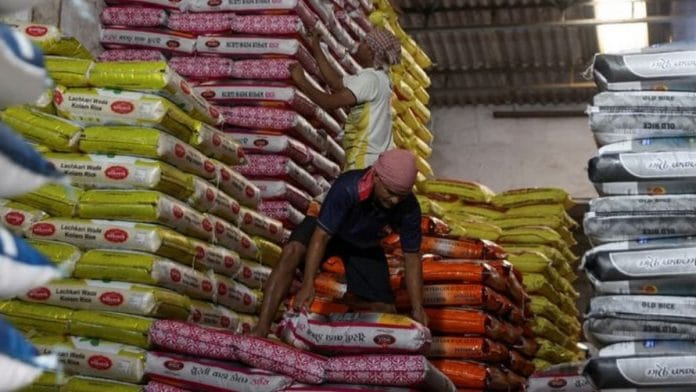



New Delhi: First it was oil, now it’s Indian rice in the firing line of US President Donald Trump. At a White House meeting on 8 December, he promised to “take care of” India’s alleged dumping of rice in the US, with tariffs of course. This threat, which comes at a time trade talks between the two countries are stalled, adds a fresh layer of doubt over India’s rice shipments to the US, a small but high-value export.
The subject of Indian rice came up as Trump hosted a White House roundtable discussion with US farmers, agricultural lawmakers, and Agriculture Secretary Brooke Rollins, where he also announced a 12 billion dollar aid package for the farm sector. During the meeting, US farmers expressed their frustration, accusing India, Vietnam, and Thailand of “dumping” cheap rice into American markets and undercutting their domestic crop prices.
Here’s a look at the potential fallout and how Indian exporters have reacted so far. And why Basmati might be in less danger than cheaper rice.
Also Read: 172 countries & counting, India looks to hit new record in rice exports. But there’s a flip side
What did Trump say about Indian rice?
Responding to the dumping complaints from farmers, a key political support base, Trump reportedly turned to Treasury Secretary Scott Bessent and singled out India.
“India, tell me about India. Why is India allowed to do that? They have to pay tariffs. Do they have an exemption on rice?” he asked. “They shouldn’t be dumping. I mean, I heard that, I heard that from others. You can’t do that.”
‘Dumping’ refers to exporting goods at prices lower than in the home market to gain a price advantage in foreign markets.
Trump also offered up the “easy” solution: “Tariffs, again. It solves the problem in two minutes.”
A prominent voice in the discussion was Meryl Kennedy, the CEO of the Louisiana-based Kennedy Rice Mill, who told Trump that rice farmers in the southern belt were “struggling” due to the dumping of cheap rice.
She praised existing tariffs and urged the administration to “double down” on them. When asked by the President, “Do you want more?” she nodded.
What could be the fallout?
This latest threat comes amid ongoing, difficult trade negotiations between the US and India.
Earlier this year, the Trump administration had imposed tariffs of up to 50 per cent on several Indian goods, including jewellery, ceramics, iron, and steel.
Rice duties have already increased as part of those broader trade actions, and there is now a specific threat of additional anti-dumping duties targeted specifically at rice.
The immediate reaction to the threat was a sharp drop in the share prices of major Indian rice exporters. LT Foods, whose flagship Basmati brands Royal and Daawat have a strong presence in North America, saw its share price fall by 6.5 per cent. Kohinoor Foods plunged 9.9 per cent. For KRBL, the company behind India Gate Basmati rice, the share price drop ranged between 1.14 per cent and 2.7 per cent, reflecting its more limited exposure to the US market as a percentage of its total business.
For US consumers, any increase in tariffs is typically passed on directly to them. In effect this means that rice consumers, including the large South Asian diaspora, will have to pay more for the staple.
However, the current focus on new anti-dumping duties suggests the US is targeting the lower-priced non-Basmati segment, but the resulting trade friction and higher costs are likely to affect all Indian rice products.
Also Read: The problem with India’s exports isn’t just Trump tariff. It’s the PCI
India’s rice exports
India is the world’s largest rice exporter, accounting for over 40 per cent of global trade. The US is a relatively small, though important, market for high-value Indian rice like Basmati. It makes up just 2 per cent of India’s global rice exports by volume. However, it is the fourth-largest market for Basmati rice, which accounts for about 85 per cent of the value of India’s rice exports to the US.
The main destinations for Indian rice are concentrated in the Middle East and Africa, with Saudi Arabia and Iran among the biggest buyers. In the fiscal year 2024-25, India exported 20.1 million metric tonnes (MMT) of rice globally, with the US market accounting for 3.34 lakh metric tonnes of that export.
In a statement, the Indian Rice Exporter Federation (IREF) called India’s rice exports industry resilient and globally competitive.
“While the US is an important destination, India’s rice exports are well-diversified,” said its vice-president Dev Garg.
During FY25, India exported Basmati rice worth $337.10 million to the US. This makes the US the fourth largest market for Basmati exports. Non-Basmati exports to the US stood at $54.64 million.
The IREF added that “rice grown in US is not like-for-like substitute for Indian rice. US varieties do not meet the requirements from traditional dishes from Gulf and South Asian regions.”
(Edited by Asavari Singh)