





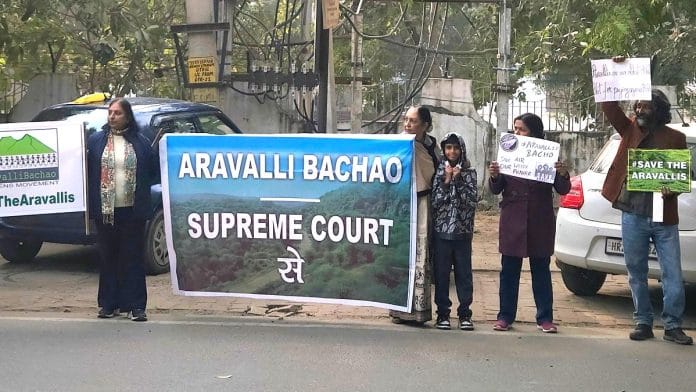



New Delhi: The height of the Aravallis has turned into an existential question. Union Environment Minister Bhupender Yadav on Sunday rejected claims that the Supreme Court’s latest order on the Aravalli ranges weakens their protection, even as citizen groups across Delhi, Haryana and Rajasthan took out protests with slogans such as “No Aravallis, No Life”.
The agitations follow an apex court ruling that accepted a committee-backed, uniform definition of the millennia-old Aravalli hills and ranges. What does the new definition say, and why do environmental groups say it is a threat to the Aravallis?
New definition and the conflict over it
Based on the new order passed on 20 November, the Aravalli hills are defined as any landform in an Aravalli district “rising 100 m above local relief”, while any two hills within 500 m of each other would be considered Aravalli ranges.
However, citizen groups such as Aravalli Bachao and People for Aravallis, along with activists across Delhi, Haryana and Rajasthan, erupted in protest against this definition, saying it effectively ‘removes protection’ for 90 per cent of the Aravalli ranges.
In statements to the media and press releases, activist groups said the new definition would not consider hills below 100 m as part of the Aravallis, thus opening up a large chunk of previously protected areas to mining and other non-forestry activities.
There is also confusion over how many districts fall within the Aravalli ranges. While Union minister Bhupender Yadav has said there are 39 Aravalli districts, an official MOEFCC document lists only 37, and another government document only noted down 29 districts. Without clarity on districts and boundaries, defining the Aravallis based on elevation raises the risk of certain areas being left out of protection.
“First the government and the Supreme Court need to clarify what they mean by 100 m. Will hills below 100 m not be counted as Aravalli? Is it 100 m from the base or does it go underground too?” said Vaishali Rana, an environmental activist based in Gurugram. “There’s no clarification by either the MOEFCC or the SC.”
Along with conducting social media campaigns on the significance of the Aravalli ranges to the environment, water and ecology of North India, citizens also protested outside Haryana Environment Minister Rao Narbir Singh’s residence on Saturday, holding placards reading ‘Save Aravallis’. They demanded protection for the entire range, and called for doing away with the elevation-based definition.
On X, Yadav posted that most of the “1.44 lakh sq km” of the Aravallis remain protected, with only 0.19 per cent of the area eligible for mining. However, in an apparent contradiction, he also said to the press on the same day that “the total Aravalli area is about 1.47 lakh sq km” and that “217 sq km, nearly 2 per cent, is eligible for mining”. These numbers are not found in the MOEFCC committee’s report on Aravallis or in the Supreme Court’s order on 20 November.
भ्रम फैलाना बंद करें!
अरावली के कुल 1.44 लाख वर्ग किलोमीटर क्षेत्र में मात्र 0.19% हिस्से में ही खनन की पात्रता हो सकती है।
बाकी पूरी अरावली संरक्षित और सुरक्षित है।#AravalliIsSafe pic.twitter.com/ojbaqtlniG
— Bhupender Yadav (@byadavbjp) December 21, 2025
“Some YouTube channels and some people have created confusion about the Aravallis’ new definition,” Yadav said in the press interaction. “But let me tell you that there has been no relaxation in [protection]. Even after this new definition, 90 per cent of the Aravalli remain protected.”
The MOEFCC also released a factsheet on Sunday, stating that it would “be wrong to conclude that mining is permitted in all landforms below 100 metre height.” The factsheet, however, did not specify the total extent of the Aravallis, and there is still no official record of how many sq km the range spans.
Why Aravalli definition matters
The case of defining and protecting the Aravallis has been ongoing in the country’s courts since 1992, when the Union Ministry of Environment and Forests first released a notification protecting some sections of the Aravalli forests from environmental degradation.
As one of the oldest mountain ranges in the world, far predating the Himalayas, the Aravalli hills play a key role in maintaining the ecological and climate balance of northern India and protecting Delhi and north-west India from desertification.
However, for decades, the Aravalli hills and their associated forests have remained ill-defined. Each of the four states — Rajasthan, Haryana, Delhi, and Gujarat —have different definitions of what counts as the Aravalli ranges. At the same time, mining abounded in parts of the region, leading to harmful effects on both the ecology and the people living nearby.
Taking this into account, in 1996, the Supreme Court passed the first order in the MC Mehta vs Union of India case restricting mining in the Aravallis. This was the first of several SC orders aimed at curbing illegal mining and strengthening environmental protection in the region. One recurring issue before the court was the lack of a uniform definition and mapping of the Aravallis across Haryana, Rajasthan, Delhi, and Gujarat. To this day, there is no single official definition of the extent of the Aravallis, with estimates varying from 1.47 lakh sq km to 1.44 lakh sq km, or even less.
Earlier this year, the Supreme Court asked a committee constituted by the MOEFCC to propose a uniform definition. The committee decided to go with the definition currently being used by the Rajasthan government—”100 m above local relief”. This is the definition the court accepted on 20 November, while also directing the committee to prepare a Management Plan for Sustainable Mining (MPSM) to ensure mining is restricted to permissible areas.
Also Read: Faridabad farmhouses vs Aravallis isn’t over. It’s a war that has just begun
Is there an alternative?
The Rajasthan government’s definition was not the only one presented to the court. In 2010, the Supreme Court had directed the Forest Survey of India (FSI) to map and define the Aravalli hills in 15 districts of Rajasthan to assess ecological sensitivity.
The FSI defined the Aravallis in a much broader way — a slope of 3 degrees, a foothill buffer of 100 m, and a 500 m distance between two hills, court records show. It did not have an upper or lower limit on the height of the hills, thus ensuring all kinds of slopes were included in the definition.
According to reports, the FSI in 2010 identified 12,081 hills in Rajasthan’s Aravallis. Of these, only 1,048 hills, about 8 per cent, were above 100 m in height, with the rest being lower than that. Given that much of the Aravalli landscape consists of gentle slopes rather than steep, 100 m high hills, the new definition risks excluding a large part of the original range.
“Why was the FSI’s definition of Aravallis not considered by the Supreme Court? The FSI is an expert agency, and we should be given detailed notes on why their report was not accounted for in the current definition,” said Rana. “There’s absolutely no explanation provided to us, and we’re just hearing contradictions from multiple authorities.”
Rana and other members of the Aravalli Bachao Citizens’ Movement are now preparing to file a PIL in the Supreme Court challenging the new definition. Along with that, they’ve also issued a letter to Haryana forest minister Rao Narbir Singh, asking for the Forest Survey of India to undertake a comparative analysis of Aravalli areas in Haryana based on both the FSI definition and the new 100 m definition.
(Edited by Asavari Singh)