





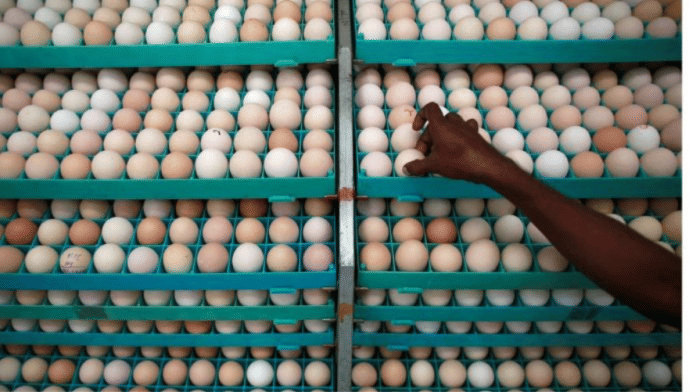



New Delhi: Consumers across Indian cities are paying Rs 8 or more for a single egg, marking a steep price increase in the staple food. Once a daily purchase associated with affordability, eggs have entered a period of what many now call an “eggflation”.
With consumers demanding a protein-rich diet, the winter season has only added to the rise in prices for eggs. An India Today article from 25 December reported that compared to August and September, prices have increased between 25 to 50 per cent in markets. Industry experts expect that prices will either remain constant or even rise further till the end of the season.
On average, eggs are sold between Rs 7 and Rs. 9, but prices have reached Rs 10 per piece in parts of New Delhi. In Hyderabad and Mumbai, prices have been reported at approximately Rs 8 per piece, while Chennai prices sit slightly lower. Home deliveries have also become more expensive, with online grocery platforms facing the demand surge and supply constraints.
Data from the National Egg Coordination Committee (NECC) show that farm to gate (direct to consumer) prices have steadily increased since August. In tier 1 cities, prices for 100 eggs increased from Rs 550 to Rs 700 over three months. According to the NECC, Namakkal in Tamil Nadu and Hospet in Karnataka offer the lowest wholesale egg prices in the country selling at about Rs 640 to Rs 645 per 100 eggs.
Also Read: Herbal eggs are India’s new health fad. Bhopal entrepreneur adds tulsi, turmeric to feed
Why are egg prices increasing
The largest driver of the price rise is the demand, which isn’t limited to just one state or city. Advocate Nawab Akbar Ali, president of the UP Poultry Association said in Uttar Pradesh, between 5.5 to 6 crore eggs are consumed daily—a demand so large that up to 4 crore eggs are sourced from other states. Eggs are selling between Rs 8 to Rs 10 per piece in the state, with wholesale rates reaching Rs 7.5 per egg.
On the supply side, factors ranging from transport costs to production issues have factored into the price rise. Disease outbreaks from sourcing states like Andhra Pradesh and Tamil Nadu caused the price spike in Maharastra.
“Poultry owners in AP and Tamil Nadu refrained from replacing infected birds immediately despite the outbreaks of bird-related diseases, which critically impacted overall production volumes. The onset of chilly weather naturally boosts the consumption and demand for eggs,” said Shitalkumar Mukane, additional commissioner at the Animal Husbandry Department, according to PTI.
Problems of production
Poultry feed—like maize and soybean— has also been getting more expensive every year. The rising costs led to many smaller farming operations shutting down, further reducing production of eggs. But industry experts say the price increase has been a long time coming, especially for farmers.
Ranpal Dhandha, president of the Poultry Federation of India, said that for years farmers have been absorbing rising feed costs. The price increase ‘merely restores the balance’. And experts say that prices in India are still among the lowest globally. In the US, UK and Germany, prices per egg range between Rs. 30 to 40. Within Asia, only Pakistan and Bangladesh’s egg prices are comparable to India.
Feed for poultry has also become more expensive because of unpredictable weather—rainfall in south India damaged maize crops, which led to fungal infections and a 7 to 10 per cent drop in the supply of eggs, reported the CSR Journal.
(Edited by Insha Jalil Waziri)