





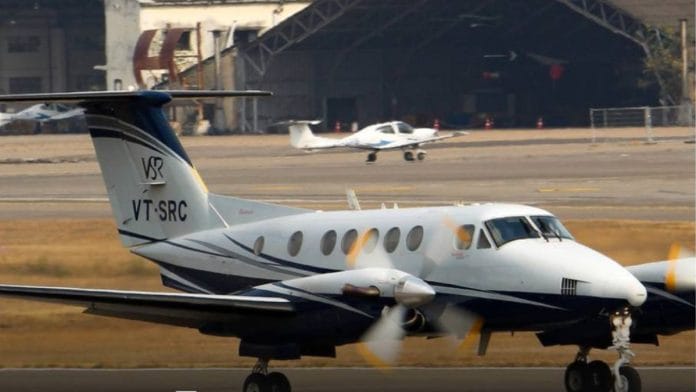



New Delhi: Maharashtra Deputy Chief Minister Ajit Pawar was travelling in a Learjet 45 business jet, which crashed, while attempting to land at Baramati airport early Wednesday morning. The jet was owned and operated by VSR Ventures Pvt Ltd, a Delhi-based private aviation company.
For decades, the country’s top businessmen and politicians have been using private air operators for travel. The Directorate General of Civil Aviation (DGCA) provides a Non-Scheduled Operator’s Permit (NSOP) to these private companies for operating air taxi services.
With private air travel becoming more popular, NSOP holders have increased. The current list has 133 companies spread across the country. This spike can also be attributed to religious travel, with pilgrims choosing helicopters to ferry them across religious sites.
“Pre-pandemic, 80 per cent of our business in religious travel was clients travelling by buses. Today, 80 per cent of our clients now travel by helicopter. The ratio completely switched,” said Neeraj Singh Dev, executive vice president at Thomas Cook & SOTC, prominent international travel agencies.
What’s a fixed-wing operator
Under DGCA rules, operators can hold a fixed-wing NSOP, a rotary-wing NSOP or both. Fixed-wing operators offer business jets, small passenger or cargo planes. Rotary-wing operators are authorised to only operate helicopters.
The website of VSR ventures, a fixed wing operator, states that the company has over 15 years of experience and more than 60 pilots. Owned by Vijay Kumar Singh, its clients include Welspun Group, Havells and Trident Group.
The company operates seven Learjet aircraft, which were originally designed by US inventor Bill Lear and inspired by a Swiss fighter aircraft. The brand was acquired by Canada’s Bombardier in 1990.
The DGCA maintains an active list of all NSOP holders. VSR Ventures, which has a license up to 20 April 2028, operates 17 aircraft according to the list. These include the Learjet 45, Beechcraft King and the Embraer EMB 135BJ, branded as the Legacy 600.
“In India, every big air taxi operator opts for lease-cum-purchase,” said Captain Sanjay Chakravarty, an ex-military aviator and helicopter test pilot. “Because if something goes wrong, they can return the aircraft to the owner. But they must own a license to even lease an aircraft.”
Also read: There’s an emerging duopoly in India’s aviation sector. 7 reforms to encourage competition
Other key players in India
Another prominent fixed-wing operator is Club One Air (AR Airways Pvt. Ltd.), with seven registered aircraft. Five of these are the Falcon 2000, a French-built business jet manufactured by Dassault Aviation.
Club One Air’s clients include Shahrukh Khan, Sachin Tendulkar, LK Advani and Amitabh Bachchan, with operational bases in Mumbai, New Delhi and Vishakhapatnam. The company is run by Rajan Mehra, who helped set up Qatar Airways, Finnair and Asiana Airlines in India.
JetSetGo Aviation Services, a New Delhi-based air taxi operator, was founded in 2014 by Kanika Tekriwal and Sudheer Perla. The company has a fleet of nine jets and one helicopter. This includes five Hawker Beechcraft, a midsize jet manufactured in the US by Beechcraft Corporation.
The company offers a variety of packages, including the Chardham Yatra by helicopter, chartered wedding travel and emergency helicopter operations.
Reliance Industries also operates their own fleet of 13 jets and helicopters under Reliance Commercial Dealers Ltd. Anil Ambani has his own fleet of four jets, operated under Reliance Transport & Travels Pvt. Ltd.
But the largest fleets belong to helicopter operators, riding on the wave of religious travel. The websites of Pawan Hans Limited and Global Vectra Helicorp Limited, operators of the Phata to Kedarnath route, have large pop-ups warning customers of fake websites and agents—indicating a ballooning but not strictly regulated sector.
Pawan Hans has 46 helicopters registered on the DGCA website, while Global Vectra has 29. Last year, a spate of crashes and accidents exposed safety lapses in this booming sector. On 15 June 2025, an accident that claimed seven lives put the spotlight on the lack of regulatory oversight and flight infrastructure such as Air Traffic Control (ATC) and real-time weather updates across pilgrimage routes.
Also read: India’s top airline just handed sarkar the keys. That’s IndiGo’s real ‘crime’
Who maintains these jets?
While a lot of these jets may not be outrightly owned by the air taxi operators, they are still required to be maintained and serviced. Under DGCA rules, an MRO (Maintenance, Repair and Overhaul) is a certified organisation authorised to maintain, repair and certify aircraft as airworthy.
Many times, the taxi operator and MRO are separate organisations. “As an owner [of an air taxi company], you may not be an aeronautical engineer. So, you hire qualified people employed by MROs,” said Chakravarty, explaining that companies outsource MRO to third-party organisations.
He went on to explain that DGCA certifies MROs separately for line maintenance, overall maintenance, fixed-wing aircraft, rotary-wing aircraft and engines. No aircraft in India can legally operate unless it is serviced by a DGCA-approved MRO.
“Airlines like Akasa, Air India—they have their own MRO systems because these are large airlines with their own fleets,” said Chakravarty. “But private taxi operators, who license the aircraft, give out contracts for maintenance.”
Whether a contract is given to a third-party MRO or if an organisation has its own MRO (like VSR Ventures), checks and balances become critical. VK Singh, the owner of VSR Ventures, stated that there was no technical failure in the aircraft.
“Why should I ground them? They are all fit aircraft. Why should I ground them? That’s not my decision,” he said, according to NDTV. Singh also added that Captain Sumit Kapur had over 16,000 hours of experience, while First Officer Shambhavi Pathak had over 1,500 hours.
This is not the first accident involving VSR Ventures. In 2023, another Learjet operated by the company crashed, while attempting to land at Mumbai’s Chhatrapati Shivaji Maharaj International Airport. There were no casualties in this incident. Both incidents were attributed to poor visibility.
(Edited by Theres Sudeep)