





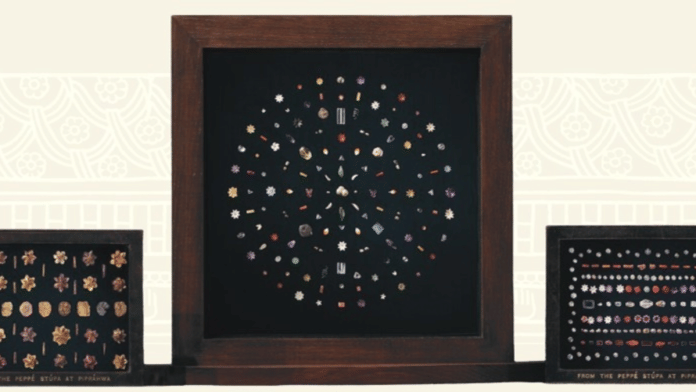



New Delhi: Nearly six months after their return to India, Prime Minister Narendra Modi will inaugurate the exposition of Piprahwa relics at Delhi’s Rai Pithora Cultural Complex on 3 January.
What are these remains that are directly connected to Buddha?
What are the Piprahwa relics?
First discovered in 1898 by British civil engineer William Claxton Peppé in Uttar Pradesh it holds significant importance vis-à-vis the archaeological study of early Buddhism.
The exposition titled ‘The Light and the Lotus: Relics of the Awakened One’ will feature the repatriated relics along with their historical, spiritual, and archaeological context.
The Ministry of Culture introduced the relics in a post on X. “For the first time since 1898, sacred artefacts are united in a grand exposition,” the post read.
A PIB from December 2025 states that the relics are widely believed to be associated with the mortal remains of Buddha.
Authentic relics and archaeological materials from Piprahwa that are preserved in the collections of the National Museum, New Delhi and at the Indian Museum, Kolkata.
The relics are preserved in collections at the National Museum in New Delhi an at the Indian Museum in Kolkata. The relics include bone fragments of Buddha, along with crystal caskets, gold ornaments, gemstones, and a sandstone coffer.
According to an inscription in Brahmi script on one of the caskets, the relics were preserved by the Shakya clan, who ruled along the south foothills of the Himalayas during the Iron Age from the 7th century BCE to the 5th century BCE.
The Ministry of Culture, in a statement, said the exposition underscores India’s enduring civilisational connection with the teachings of the Buddha and its commitment to preserving and presenting its rich spiritual heritage.
At the centre of the thematic exhibition is a reconstructed interpretive model inspired by the Sanchi stupa.
Other sections include Piprahwa Revisited, Vignettes of the Life of Buddha, Intangible in the Tangible: The Aesthetic Language of Buddhist Teachings, Expansion of Buddhist Art and Ideals Beyond Borders, and Repatriation of Cultural Artefacts: The Continuing Endeavour.
The exposition is supported by a comprehensive audio-visual component, including immersive films, digital reconstructions, interpretive projections, and multimedia presentations.
Also Read: Buddha’s gems at Sotheby’s shows Indian govt doesn’t have an eye on ‘colonial loot’
How Piprahwa relics returned to India
In April 2025, the Indian government learnt that relics of Buddha were listed for auction in Hong Kong by Sotheby’s, the world’s largest brokers of fine art.
The Modi government served a legal notice to the firm demanding the immediate cessation of the auction.
With the government’s intervention, the auction was halted and the trove sold to Godrej Industries Group, a Mumbai-based conglomerate.
The collection of 349 gemstones that came up for auction was part of a larger collection of antiquities unearthed in 1898 by Peppé, the estate manager at a Buddhist stupa in Piprahwa.
The sacred jewels were enshrined circa the 3rd century BCE and held immense spiritual value for the Buddhist community.
When Peppé unearthed these jewels, he transferred the majority of them to the Indian Museum in Kolkata in 1899. While a portion of the relics was taken out of the country by Peppé and were held by his family for more than a century.
The return of the relics was achieved through a public-private partnership between the Ministry of Culture and Godrej Industries Group.
It took two months of negotiations involving the owner, the new buyer and the Indian government.
“The Piprahwa gems are not just artefacts — they are timeless symbols of peace, compassion, and the shared heritage of humanity,” said Pirojsha Godrej, Executive Vice Chairperson of Godrej Industries Group.
When the relics were returned to India in July last year, PM Modi called it a joyous day for our cultural heritage. “These sacred relics highlight India’s close association with Bhagwan Buddha and his noble teachings. It also illustrates our commitment to preserving and protecting different aspects of our glorious culture,” he said.
Between 1971 and 1977, the Archaeological Survey of India (ASI), in an excavation, uncovered additional steatite caskets containing 22 sacred bone relics, which are now kept at the National Museum. Since then India has facilitated significant cultural exchanges by showcasing Buddhist relics in Thailand and Vietnam for public veneration.
In the last 11 years, hundreds of stolen artefacts were repatriated by the Modi government.
(Edited by Insha Jalil Waziri)