





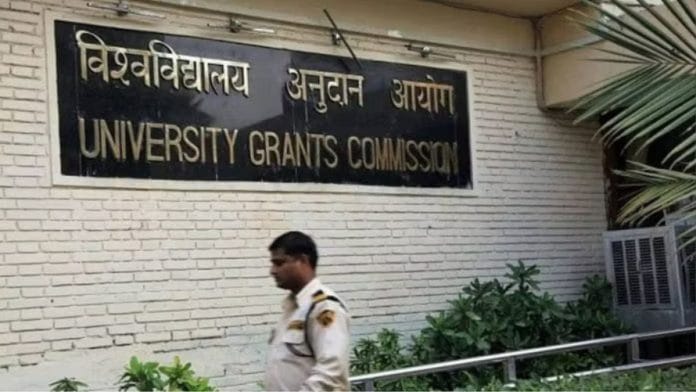



New Delhi: The University Grant Commission’s Promotion of Equity in Higher Education Institutions Regulations, 2026, expanded anti-discrimination measures, aligned with the National Education Policy 2020, and were prompted by a rise in complaints.
However, the rules have drawn sharp criticism over their broad scope and perceived bias. In Agra, BJP leader Jagdish Pachauri protested these rules by writing a letter to Prime Minister Narendra Modi using his own blood.
In Lucknow, 11 local upper-caste BJP members submitted their resignations, alleging that the framework is biased. Figures like BJP Kisan Morcha Mandal president Shyam Sundar Tripathi called the UGC rules “harmful and divisive” in his letter. Among them is Bareilly City Magistrate Alankar Agnihotri, a PCS officer, who resigned on 26 January, calling the rules “anti-Brahmin” and linking them to the Shankaracharya controversy.
BJP Yuva Morcha vice president Raju Pandit in Noida also stepped down, describing the regulations as a “black law.”
What are the new guidelines?
The new UGC guidelines’ core objective is to eliminate discrimination in higher education on the basis of caste, race, religion, gender, place of birth, disability, and related vulnerabilities. Special emphasis is placed on protecting Scheduled Castes (SC), Scheduled Tribes (ST), Other Backwards Classes (OBC), Economically Weaker Sections (EWS), and Persons with Benchmark Disabilities (PwBD).
Unlike earlier norms, these rules impose direct accountability on institutions and their leadership, signalling that equity is no longer optional or symbolic.
Higher education institutions recognised by the UGC—whether central, state, deemed, private universities, or autonomous colleges—are now required to establish an Equal Opportunity Centre (EOC). These centres are meant to promote inclusion, provide counselling, and address grievances related to discrimination. Each EOC functions under an Equity Committee chaired by the head of the institution, with compulsory representation from SC, ST, OBC, PwBD, and women members.
Institutions must operate 24/7 equity helplines, maintain online portals for anonymous complaints, and deploy equity squads to monitor hostels, laboratories, and classrooms.
Student ambassadors are also tasked with spreading awareness and encouraging reporting. A broad “human dignity” clause prohibits both direct and indirect actions that impair equality in academic, administrative, residential, or research spaces.
Failure to comply now attracts stricter penalties, ranging from warnings and financial fines to suspension of grants, exclusion from UGC schemes, loss of affiliation, removal of leadership, or even derecognition of the institution.
Higher education institutions are required to submit bi-annual EOC reports and annual equity compliance updates to the UGC. Oversight is going to be handled by a national monitoring committee comprising statutory authorities and civil society representatives, which will meet twice a year to review implementation.
How are the 2026 rules different from the past?
Earlier rules offered vague definitions of harassment and ragging, lacked enforcement mechanisms, and excluded OBCs entirely despite their significant share in reservation policies. The omission became problematic as discrimination complaints rose sharply from 173 cases in 2019-20 to 378 in 2023-24.
The new rules explicitly define discrimination to include structural disadvantage and retaliation against complainants, while expanding protection to religion, race, gender, disability, and birthplace.
The reforms align closely with the NEP 2020, which places equity at the centre of educational reforms. They also respond to troubling data, such as a 2019 IIT Delhi survey reporting that nearly three-quarters of students from disadvantaged castes had experienced bias.
Unlike the earlier advisory model, unresolved cases can now be made public. The provision for a penalty in case of false complaint has been removed from the new rules. And the protesters have objected to how the onus is now on the accused to prove their innocence.
Also read: UK, Denmark and now Andhra Pradesh. Is Australia’s under-16 social media ban becoming a trend?
What is the controversy around OBC inclusion?
As a group that constitutes nearly half of the reserved quotas alongside SC and ST categories, OBCs are now both protected and liable under the same framework. The new rules place all reserved groups under the same footing, intensifying claims of “reserve discrimination” in an already polarised quota system.
Much of the opposition centres on fear of false or frivolous complaints, driven by what some see as vague terms like “unfavourable treatment” or “impairment of dignity.”
Concerns have been raised about the absence of general category representation on equity committees, the lack of confidentiality for the accused during inquiries, and the requirements to publicise pending cases.
A public litigation before the Supreme Court challenges key provisions as violations of constitutional guarantees of equality, free speech, and personal liberty.
The backlash has spilled into the political arena, with protests, social media campaigns like #UGCRollback, and criticism from sections of upper-caste groups who describe the rules as “anti-Brahmin” or one-sided.
Even within the BJP, opinions are divided, with some leaders questioning the perceived imbalance while others defend the regulations as constitutionally necessary.
Education Minister Dharmendra Pradhan, responding on 27 January, defended the new guidelines as essential to NEP-driven inclusivity amid rising complaints. But at the same time, he promised safeguards against misuse, making it clear that while clarifications are possible, a rollback is not on the table.
(Edited by Ratan Priya)