





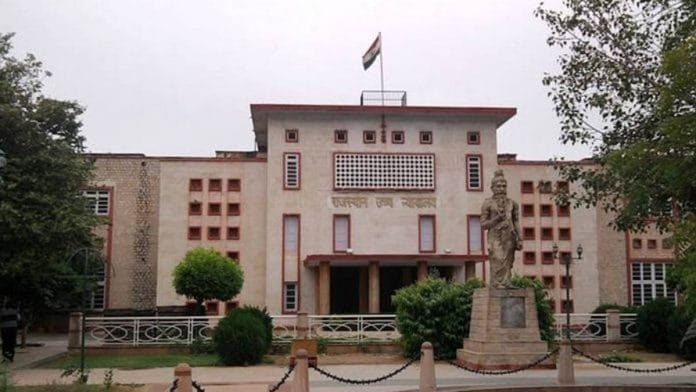



New Delhi: The Rajasthan High Court on 16 January recognised Nata Vivah and granted a woman the right to receive a family pension after the death of her husband.
Nata Vivah is a traditional, agreement-based form of marriage practised in certain communities in Rajasthan. In the present case, 60-year-old Ram Pyari Suman filed a petition before the High Court after the concerned government department her husband Pooran Lal Saini was employed with refused to grant her the pension. The department rejected Suman’s claim on the grounds that she was recorded only as a “Nata wife” in government records and was not nominated as a family member.
Suman’s counsel, Tushar Panwar, informed the court that after the death of Saini’s first wife, Saini entered into a Nata Vivah with Suman approximately 20 years ago, and the couple has a daughter.
However, due to subsequent domestic disputes, Suman applied for maintenance. During those proceedings, Saini acknowledged before the family court that Suman was his wife and accepted responsibility for providing maintenance to her and her daughter.
Following Saini’s death, Suman demanded that the state government release the family pension. However, the officials denied her request.
A single bench of Justice Ashok Kumar Jain directed the state authorities to release the pension under the Rajasthan Civil Services (Pension) Rules, 1996, recognising Suman as the legal wife of the deceased.
“It is necessary for the Court to consider Nata Vivah. It is a practice prevalent in some rural areas of Rajasthan where, after the death of or separation from an existing husband, a woman enters into a contractual type of marital relationship with a man. Thus, there is no dispute that Nata Vivah is also considered a form of marriage in rural areas of Rajasthan,” the court observed.
What is Nata Vivah?
Nata Vivah, also known as Nata Pratha, is a traditional, non-formalised custom of remarriage or cohabitation followed in rural and tribal areas of Rajasthan. It is also prevalent in some parts of Madhya Pradesh, Uttar Pradesh, and Gujarat.
Nata Vivah is not recognised under the traditional form of Hindu marriage, as it is based solely on community consent. It emerged as a customary arrangement for widows, divorced women, and abandoned women, providing them with a means to enter into a new relationship with social acceptance.
However, the practice has long been viewed as a means of misuse and exploitation of women, as it does not grant them legal rights or formal family recognition. The National Human Rights Commission (NHRC) and several non-governmental organisations working for women’s rights have urged the government to make the registration of customary marriages such as Nata Vivah mandatory.
In 2024, the NHRC took serious note of Nata Pratha, under which girls in some communities are reportedly sold—often through agreements on stamp paper or informal contracts—in the name of marriage, despite the practice having no legal sanctity. The NHRC also highlighted the misuse of this tradition, including instances of minors being married to older men.
In the past, the statutory body has called for the complete eradication and abolition of the practice and issued notices to the Union Ministry of Women and Child Development and the respective state governments.
Also read: India is home to fastest-sinking river deltas, study shows. What it means for Brahmani, Mahanadi
The problem
Women in Nata Vivah arrangements are often viewed as secondary or temporary wives.
However, in the case of Ram Pyari Suman v. the State of Rajasthan, the court noted that when Nata Vivah is conducted with customary ceremonies and in accordance with the rights and traditions of the parties’ community, it can be recognised under law pursuant to Section 7 of the Hindu Marriage Act.
The court ruled that a woman in a Nata relationship is entitled to her husband’s family pension, even if her name does not appear in the official service records. Based on the family court’s 2017 order, the court recognised Suman as the legal wife and directed that her pension be released.
(Edited by Prasanna Bachchhav)