





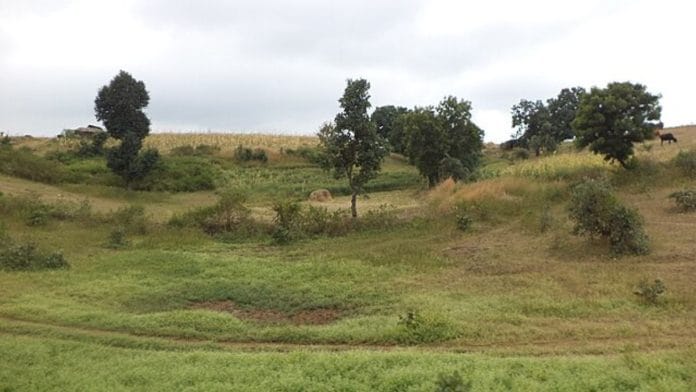



New Delhi: India’s grasslands are widely believed to be ‘wastelands’ or degraded forests. But two researchers show that these ecosystems evolved in their own right, rather than emerging from human deforestation.
A study published in the British Ecological Society’s journal, People and Nature, examined centuries-old poems, folk songs, myths, and sacred narratives from Marathi to reconstruct past vegetation.
Ashish N Nerlekar from Michigan State University and Digvijay Patil from IISER Pune systematically matched plant references in Marathi texts or performances from the 13th century to modern botanical identities. They identified 44 wild plant species, nearly two-thirds of which are characteristic of savannah and grassland ecosystems, not closed forests.
For example, a passage from the Adi Parva (16th century) describes the “empty” and “thorny” Nira River valley with abundant grass, closely resembling present-day Deccan savannahs. This suggests that the landscape has remained open for at least 750 years, long before land-use changed during the colonial era. The study shows that traditional literature is an underused archive of ecological information.
Also read: 18,000 people in UK are rushing to save Veeraswamy—100-year-old Indian restaurant
Misguided tree-planting efforts
In 2019, about 17 per cent of India’s land was officially classified as “wasteland”. But many of these are actually open natural ecosystems. They are ecologically functional landscapes and aren’t degraded.
Researchers studying India’s open natural ecosystems note that grasslands can store large amounts of carbon in soils and support livestock-based livelihoods. Some estimates suggest they support hundreds of millions of livestock, provide a significant share of fodder, and sustain more than 20 pastoral and nomadic communities, though figures vary by source. Globally, grasslands are estimated to hold roughly one-third of the world’s terrestrial carbon. Yet, the expansion of farming, tree-planting drives, invasive species, and infrastructure and renewable-energy projects over the past 200 years has reduced and fragmented these ecosystems.
Indian grasslands are also rich in biodiversity. They harbour hundreds of endemic plant species, many discovered only recently. They provide habitat for species such as the Great Indian Bustard, Indian wolf, one-horned rhinoceros, blackbuck, and swamp deer. Pastoral communities have long depended on these landscapes for grazing.
Despite this importance, grasslands have historically been treated as degraded land. Colonial-era land policies labelled them “wastelands” or “degraded forests”, making them easier to convert for agriculture, plantations, and development. This approach was institutionalised after Independence through exercises such as the Wasteland Atlas of India, first prepared by ISRO in 2000 for the Department of Land Resources. The latest atlas continues to identify vast areas as wastelands, with plans to “develop” them for irrigation, soil conservation, commercial plantations, and solar or wind energy projects.
This colonial-era perception also shaped conservation thinking. For decades, many experts believed open landscapes were once forests that had been destroyed by people. As a result, afforestation and tree-planting became part of a common “restoration” strategy, even in natural grasslands, sometimes harming native biodiversity.
A key problem is legal status. Indian environmental laws clearly define and protect forests, wildlife species, and wetlands, but grasslands do not have a distinct legal category. Protection applies only if they fall inside notified protected areas such as national parks or sanctuaries. Most grasslands lie outside these zones, meaning they do not receive direct legal recognition as ecosystems and remain vulnerable to diversion and land-use change.
While India’s recorded forest cover has increased in recent years, studies indicate that grasslands have declined sharply, in part because they are overlooked in policy and law. And planting trees that don’t belong in these fragile ecosystems is not the solution.
(Edited by Prasanna Bachchhav)