





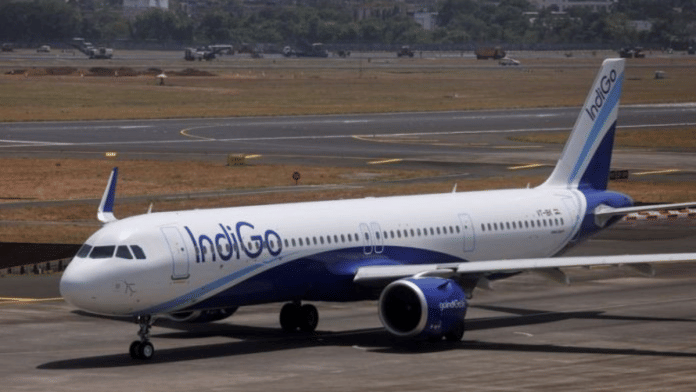



New Delhi: India’s largest airline, IndiGo, has been witnessing massive flight disruptions since 1 December. The scale of disruption worsened on 3 December, leading to the cancellation of over 150 flights. The Directorate General of Civil Aviation has stepped in to investigate the issue.
Social media posts by frustrated passengers describe how flight cancellations, one after another, created chaos at the airport. The lack of communication from the airline or support services for waiting passengers added to the anguish.
The Flight Duty Time Limitation (FDTL) norms are being seen as the primary reason behind the worsening situation. FDTL are regulations that govern the maximum duration a pilot or crew member can remain on duty—covering both flight and non-flight tasks—within a given time period. They are designed as a safeguard against fatigue-related issues, which can reduce performance by up to 50 per cent and, in extreme cases, pose serious risks to passenger safety.
According to a press release by the civil aviation ministry, 1,232 IndiGo flights were cancelled in November 2025. The main reason for these cancellations has been attributed to crew/FDTL constraints, which accounted for 755 cases.
“A large share of cancellations arose from crew/FDTL compliance and airport/airspace/ATC-related factors, many of which lie beyond the operator’s control,” read the document.
What were the changes in FDTL norms?
In January 2024, the DGCA introduced revised FDTL norms to address pilot fatigue resulting from extended duty hours. The changes were introduced in response to pilots’ long-standing demands. The implementation followed a phased approach, starting with the initial execution on 1 August 2024 and full enforcement by 1 November 2025.
Under the revised norms, the DGCA increased the weekly rest period for pilots from 36 hours to 48 hours. In addition, night duty was redefined as the period from midnight to 6 am, instead of the previous cutoff of 5 am.
“With a view to address and mitigate concerns on pilot fatigue through a data driven approach, DGCA collected and analyzed extensive numbers of pilot rosters along with pilot fatigue reports submitted by airline operators. Based on the study and analysis, some of the key areas inducing fatigue such as maximum Flight Duty Period, Night Duty, Weekly Rest Period, Flight Duty Period Extension etc. were identified,” read the press release by the civil aviation ministry.
DGCA also restricted the maximum flight time to 8 hours and the maximum flight duty period to 10 hours. And the number of landings was limited to two, as compared to six landings earlier.
“We will soon transition towards a new regime of fatigue management i.e. Fatigue Risk Management System (FRMS), which will be a data-driven approach to enhance monitoring of flight crew fatigue,” Union Civil Aviation Minister Jyotiraditya M Scindia wrote on X.
Also read: Are US kids safe? New vaccine approval process puts public health at risk, say ex-FDA officials
‘Pressure tactic’
The revised FDTL norms faced pushback from major airlines due to pilot shortages and operational challenges. It has since triggered friction between airlines and pilot unions.
Meanwhile, the Airline Pilots’ Association of India (ALPA) has called the flight cancellations a “pressure tactic” to weaken FDTL norms.
“The government gave you one year’s time, followed by a phased implementation of one more year. So, phase one was implemented in July, then the next in November. So, the government gave you adequate time. How can you come now and say that you are short of pilots when you stopped recruiting six months ago? And then you increased your flights for the winter schedule?” ALPA president Sam Thomas told ThePrint.
The pilot association is also questioning why only IndiGo is facing cancellations and not any other airlines, such as Air India, SpiceJet, and Alaska.
“How can IndiGo blame it on FDTL? Whenever a rule comes out in favour of pilots, they cause public inconvenience to build up pressure on the regulator… It is a question of public safety. How can a pilot be asked to work more? And when DCGA has come up with rules based on scientific study, why don’t you recruit more pilots and solve the issue?” Thomas added.
(Edited by Prasanna Bachchhav)