





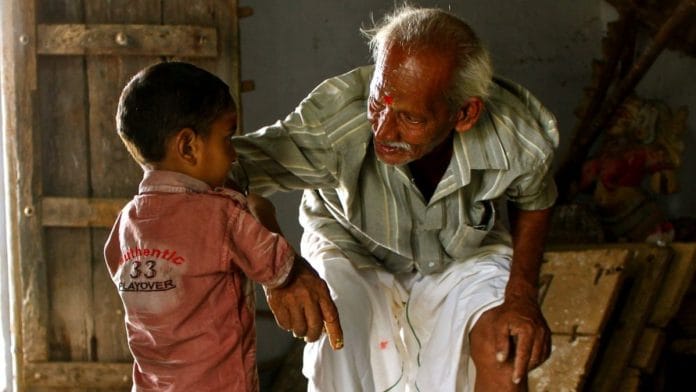



New Delhi: Being a good grandparent may be the key to good brain health, as per a new study. Research published in Psychology and Aging shows that being more involved with one’s grandkids is the antidote to cognitive decline among aging individuals.
Lead researcher Flavia Chereches of Tilburg University in the Netherlands and her team studied data from 2,887 grandparents, who were all older than age 50, with a mean age of 67. Participants answered survey questions and completed cognitive tests three times between 2016 and 2022.
Some of the questions in the study were whether participants had provided care for a grandchild at any point in the past year, and how frequently they provided care and what kinds of care they provided—including watching grandchildren overnight, caring for ill grandchildren, playing or engaging in leisure activities, among others.
The results showed that grandparents who provided childcare scored higher on tests of both memory and verbal fluency compared with those who didn’t. These held even after adjusting for age, health and other factors, and regardless of the frequency and type of care the grandparents provided.
Though the study did not find a direct link between specific activities and cognition, it found that a greater variety of caregiving activities was associated with better verbal fluency and episodic memory functioning.
Grandmothers vs grandfathers
One key initiative in the new study was to understand caregiving among grandparents based on gendered differences. Previous literature has mentioned gender differences in the frequency of involvement with grandchildren, with grandmothers providing more care than grandfathers. In the current generation, too, care work still appears to be viewed as a responsibility primarily associated with women.
Grandmothers are seen to be more involved in physical and emotional care, while grandfathers mainly engage in leisure activities with their grandchildren. Grandmothers are also more likely to provide care independently than grandfathers, who often engage in caregiving alongside their partners.
New research found that caregiving grandmothers showed higher cognitive function and a slower decline in episodic memory and verbal fluency than their non-caregiving counterparts. Grandfathers also had higher cognitive function compared with matched non-caregiving controls. However, the main analysis found no significant differences by gender.
One observation was that caring out of obligation may not evoke the same positive emotions as caregiving by choice, and can instead lead to feelings of lost autonomy over one’s time.
Also read: Born in the USA Bruce Springsteen now attacks ICE, Trump in song ‘Streets of Minneapolis’
Limitations of the study
The study has two major areas where more research is needed. The first is that it does not consider the family context in which grandchild care occurs. Parents often act as ‘gatekeepers’, influencing the extent and nature of contact and care between grandparents and grandchildren, and that could shape the types of activities grandparents engage in with their grandchildren.
Providing care within a supportive family environment may also have different cognitive effects than caregiving in a more stressful context, where grandparents might feel unsupported by the parents, spouse, or friends.
Then there’s the cultural context. Caregiving is an activity that is highly influenced by the culture, norms, and values within the family. That is why the results of the current study are completely dependent on the studied sample size and may be altered with changes in societal norms.
“More research is needed to replicate these findings, yet, if there are benefits associated with caregiving for grandparents, they might not depend on how often care is provided, or on the specific activities done with grandchildren, but rather on the broader experience of being involved with caregiving,” said Chereches.