





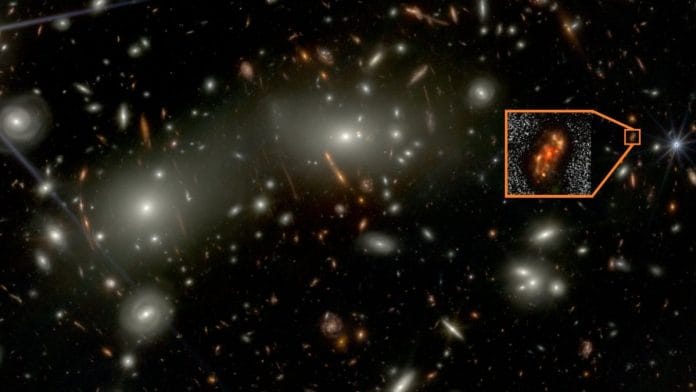



New Delhi: Astronomers in Pune have discovered an ancient galaxy that bears a resemblance to the Milky Way. While going through data from the James Webb Space Telescope, a team from the National Centre for Radio Astrophysics Tata Institute of Fundamental Research spotted the galaxy, which existed when the universe was 1.5 billion years old.
The discovery is quietly shaking up what scientists thought they knew about how galaxies formed in the early universe.
Named ‘Alaknanda’, the galaxy has well-defined spirals—much like the current structure of the Milky Way. What makes the finding remarkable is that galaxies in the early universe were expected to be disorganised and disordered—still getting into shape after the Big Bang.
Current models claim that structured spiral galaxies, with arms and a central bulge, take billions of years to form. But Alaknanda—which has a diameter of 30,000 light-years—has two well-defined spiral arms wrapping around a bright bulge.
“Finding such a well-formed spiral galaxy at this early epoch is quite unexpected. It tells us that sophisticated structures were being built in our universe much earlier than we thought possible,” Rashi Jain, a PhD student who led the research, told The Indian Express. “The galaxy looks remarkably similar to our own Milky Way despite being present when the universe was only 10 per cent of its current age.”
How Alaknanda’s spirals may have formed
The team in Pune wasn’t looking for anything this dramatic. They screened more than 70,000 galaxies captured in the James Webb Space Telescope (JWST) images, shortlisting around 2,700 of the most distant and brightest for a closer study.
Among these, Alaknanda stood out immediately. It contains stars that add up to 10 billion times the Sun’s mass. “It is like seeing a 100-storey building built in three days,” Yogesh Wadadekar, an astronomer at the National Centre for Radio Astrophysics (NCRA) who supervised the galaxy search, told The Telegraph.
What surprised researchers even more was the level of order in its structure. Spirals form when a galaxy’s disk has settled into a steady rotation, allowing density waves to create those signature arms.
For this to happen so early means Alaknanda must have accumulated matter rapidly, or that the processes shaping galaxies in the young universe were far more efficient than previously believed. The finding challenges long-standing timelines of galaxy evolution, which usually place the emergence of Milky Way–like systems much later.
Wadadekar said that unusually high gas densities might offer an explanation. Gas might allow for the “rapid formation of the spiral structure”.
Also read: Why is 15-yr-old Belgian’s PhD exciting ‘billionaires’? It has an SN Bose link
Questions remain
A significant feature of the achievement is that it comes from an entirely Indian research team working with telescope data. It underscores both the reach of JWST and the growing capability of Indian institutions in frontline astrophysics.
Pune’s NCRA, known largely for radio astronomy, has now contributed a major result using infrared observations from the most advanced space observatory ever launched.
If more galaxies like Alaknanda show up in the JWST data, scientists may have to rethink earlier ideas of how fast dark matter gathered, how quickly gas settled into flat disks, and how early stars began to shape galaxies into stable structures. Some theories say spiral shapes form when galaxies interact with their neighbours. If that is true for Alaknanda, it suggests that even the early universe had crowded regions where such interactions could have happened.
Even with many questions still open, Alaknanda has already changed how scientists look at the young universe. Thanks to a small team in Pune, the story of how galaxies like the Milky Way formed has suddenly become a lot more interesting.
(Edited by Prasanna Bachchhav)