





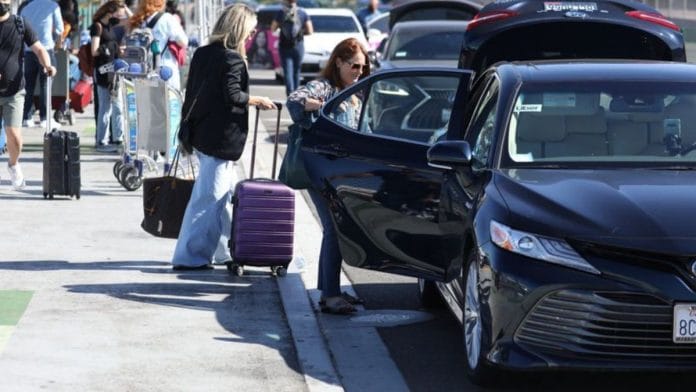



New Delhi: Millions of ride-hailing customers regularly pay more than they need to, not because the services are overpriced but because they rarely check for cheaper options before booking, a new study released by the National Bureau of Economic Research found.
The paper, ‘Leaving Money on the Dashboard: Price Dispersion and Search Frictions on Uber and Lyft,’ documents how small behavioural and technical hurdles prevent people from comparing fares, benefiting the platforms more than consumers.
The paper, authored by Jeffrey Fossett, Michael Luca, and Yejia X, was published in November. The researchers conducted an audit of Uber and Lyft prices for identical trips in New York City, then combined that with real-world usage data showing how many customers use both apps before booking.
According to the paper, the average fare gap for the same trip across Uber and Lyft is roughly 14 per cent, about $3.50 per ride. Yet only 16.1 per cent of users who open one app also open the other on the same day. That means less than one in six riders even checks for a potentially cheaper option.
When scaled up across all rides in New York City, these “modest frictions” boost gross bookings for Uber and Lyft by over $300 million per year.
Recently, Geoffrey A Fowler, in a column for The Washington Post, confirmed that the problem isn’t theoretical. Over a four-day test in San Francisco, he compared 80 identical rides across Uber and Lyft, entering the same start and end points on both apps within moments of each other. The result: the base fares differed, on average, by 14 per cent, a gap of about $4.15 per trip.
Both the ride-hailing apps denied any intentional reasoning behind the difference in the pricing. Lyft Executive Vice President Sid Patil told The Washington Post that the price differential is common where there is competition. He added that the prices of rides are decided depending on the demand for the service, where conditions change minute-to-minute.
Similarly, Uber’s head of product policy, Harry Hartfield, said, “These variations aren’t coordinated. Uber and Lyft calculate fares independently”.
Also read: What is the Sanchar Sathi app? A consumer-protection tool raising privacy concerns
Why does this happen?
Both companies rely on dynamic pricing — algorithms that continuously adjust fares based on demand, supply, traffic, and other real-time factors. Because Uber and Lyft operate independent marketplaces, their pricing rarely aligns. On top of that, the companies often layer personalised factors like promotional discounts, which vary across users. In Fowler’s test, post-discount fares diverged by as much as 25 per cent, even for the same ride.
In his column, Fowler also talks about the data used by Uber to personalise these offers. He writes that Uber said they do not use people’s ‘protected characteristics’ (including race, religion, sex, gender, sexual orientation, age and disability), device information or payment method.’ However, the company did not specify the dataset used by them for the personalised offers. Uber only said it may offer discounts to new riders, infrequent riders or people who travel at certain times.
But the bigger driver of overpayment isn’t just algorithmic complexity; it’s human behaviour. The NBER paper also examined device-level usage data and found that only 16.1 per cent of riders who open one app also open the other. That means 84 per cent of users end up booking whatever comes up first. Because of this, the study estimates that riders in New York City alone may be leaving more than US$300 million per year on the table. That’s the aggregated cost of small, unexamined price gaps adding up across millions of rides.
You might expect higher fares on one app to lead to faster pickup times, but the data doesn’t support that. The researchers did not find consistent evidence that the more expensive app delivered shorter wait times, undermining the idea of any trade-off between cost and convenience.
Researchers believe that the underlying issue is what economists call “search frictions” — the small but real barriers that keep people from comparison-shopping. Opening a second app, re-entering pickup details, switching accounts — it all takes time and effort. And in a fast-paced moment (rush hour, bad weather), many passengers simply go with the first available ride. Fossett, Luca, and Xu argue that if price-comparison tools worked well, many of these losses could be avoided.
But there’s a catch: Uber’s terms of use prohibit third-party developers from using its API to build real-time price-comparison tools that include competing services.
Michael Luca, one of the study’s authors, told The Washington Post that “the fear of price comparison” is what really drives competitive pricing.
(Edited by Saptak Datta)