





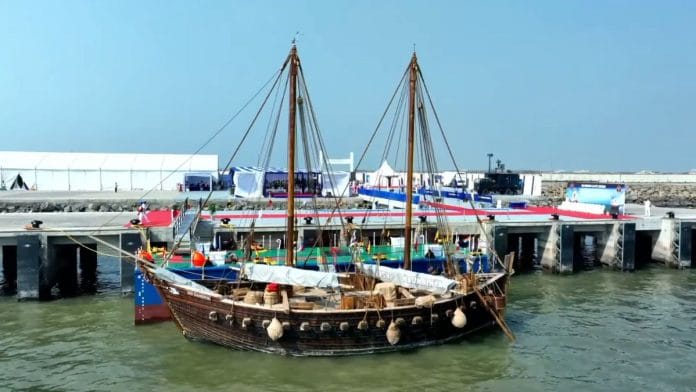



New Delhi: The Indian Navy’s return to ancient Indian seafaring tradition started today as the INSV Kaundinya set sail from Porbandar in Gujarat to Muscat in Oman.
Marking a critical step in reviving and showcasing India’s ancient and indigenous shipbuilding techniques, the INSV Kaundinya is unlike most modern-day ships. The Kaundinya has no engines, no propulsion equipment and no steel hulls.
Indian sailors are set to remap the transoceanic voyage along the ancient trade route, and reach Oman’s shore in two weeks, depending on winds, covering a distance of approximately 800 nautical miles. The non-combat vessel carries a crew of 16 sailors and symbolic Indian items. It will trace the age-old route that was once used to transport goods such as spices, ivory, and textiles.
The journey symbolises the expertise of the remaining traditional shipwrights in India and preserves the fading art for future generations.
Also read: What a deep dive taught me about discipline and teamwork in Indian Navy: Lt Cdr Hardeep Singh
How was it built?
The Kaundinya, a traditionally built ‘ancient stitched ship’, based on a 5th-century CE ship depicted in the paintings of Ajanta Caves, was inducted into the Indian Navy at the Naval Base, Karwar, on 21 May 2025.
The Tankai method of shipbuilding stitches wooden planks together with coconut fibre ropes rather than using nails or metal fasteners. In fact, the method avoids the use of metal entirely.
The stitching offers the hull flexibility and durability, making the ship less prone to damage from shoals and sandbars. The Tankai method begins with the construction of the hull before the ribs, unlike most Western shipbuilding methods.
Wood, coconut fibre and natural resin are the primary components used in its construction. INSV Kaundinya is about 19.6 metres long and 6.5 metres wide, with a draft of about 3.33 metres.
In July 2023, the Ministry of Culture and the Indian Navy signed an MoU to revive and preserve the 2000-year-old technology of shipbuilding. Its birth began with the keel laying in September 2023 and took almost two years before it was launched by Minister of Culture Gajendra Singh Shekhawat in February 2025.
Also read: Indian Navy modernisation riddled with binaries. Maritime strategy is directionless
Who built the INSV Kaundinya?
Built by artisans in Kerala, under the guidance of master shipwright Babu Sankaran, the stitched wooden planks on the ship’s hull were made using coir rope, coconut fibre and natural resin.
Each element of its craftsmanship is aimed at evoking the rich maritime traditions of ancient India. The Gandabherunda and the Sun motifs are displayed on her sail, whereas her bow is a sculpted Simha Yali (a mythical creature that has the body of a lion with elephant’s tusks and a serpent’s tail). With Harappan stone armour decorating her deck.
According to a PIB release from May, the Indian Navy played an integral part in the development of the project, from the design to the construction process. While there are no surviving blueprints of ancient Indian ships, the navy extrapolated the designs from several iconographic sources and ensured the design was authentic through hydrodynamic model testing at the Department of Ocean Engineering, IIT Madras.
Also read: India’s naval advancements will fuel its Indian Ocean ambitions. Focus on 5 key areas
Significance behind its name
Before colonial rule and long before the birth of modern transport, a merchant from India sailed across the Indian Ocean to present-day Cambodia. His journey is one of perseverance and valiance.
He was the 1st-century Indian mariner, Kaundinya, who founded the Southeast Asian kingdom of Funan. His legacy serves as a symbol of India’s maritime traditions of exploration, trade, and cultural exchange.
Sanjeev Sanyal, a member of the Prime Minister’s Economic Advisory Council who first pitched the idea, said that Kaundinya is the first Indian mariner known to have sailed into Southeast Asia. For Sanyal, the visit had a significant impact on world history.
Speaking to ANI, Sanyal said, “While INSV Kaundinya has already encountered rough weather during training runs, longer open-sea sailing will determine how effectively ancient Indian shipbuilding techniques could withstand Indian Ocean conditions.”
Sanyal added that the journey is essential to establishing India’s longstanding sea traditions. “Beyond the technical experiment, the project carries a broader historical objective. Indian history has often been portrayed as passive, overlooking centuries of maritime activity, trade, and exploration. Indians were not sitting around waiting for conquerors to give them civilization. We had adventurers, mercenaries, traders, and sailors. Long before the Phoenicians, Indians were sailing across the Indian Ocean,” he said.
(Edited by Theres Sudeep)