





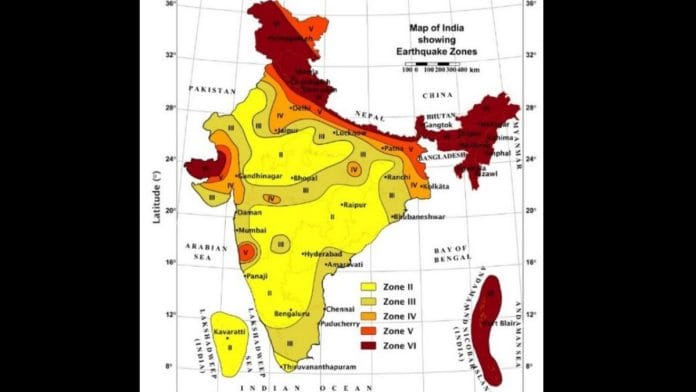



Delhi: A new seismic map has laid bare just how vulnerable to earthquakes the Himalayas in India really are, including Jammu and Kashmir, Ladakh, Himachal Pradesh, Uttarakhand, Sikkim, and Arunachal Pradesh.
Almost the country’s entire Himalayan arc has now been placed in the newly created Zone VI — the highest seismic-hazard category — in the map released last week under the Earthquake Design Code 2025 by the Bureau of Indian Standards (BIS). Not just this, it also shows that 61 per cent of the country is in moderate to high risk zones.
Since the map came out, social media has seen a rush of posts on overcrowding and over-development in the fragile hills, as well as calls to ramp up early warning systems and disaster-management mechanisms. Here’s what the new map changes about India’s understanding of earthquake risk.
Also Read: A 65-day polar night has started in an Alaska town. What it is and how people cope
What does Zone VI mean?
Zone VI is a newly introduced category in the seismic map, created specifically to mark regions of ultra-high earthquake hazard.
It is based on Probabilistic Seismic Hazard Assessment (PSHA), a modern scientific method that estimates both the likelihood and the intensity of ground shaking that an area may experience.
Earlier seismic maps split the Himalaya into Zones IV and V even though the entire belt is located on the same collision boundary between the Indian and Eurasian plates, placing steady tectonic stress beneath states such as Uttarakhand, Himachal Pradesh, and parts of Uttar Pradesh.
Some segments of the Central Himalaya — particularly between Uttarakhand and western Nepal — haven’t had a major quake in almost 200 years, a long gap that indicates strain has been building across this part of the arc.
The new zonation brings long overdue uniformity to the entire Himalayan arc, said seismologist Vineet Gahalaut, director of the Wadia Institute of Himalayan Geology. “The earlier zonation did not fully account for the behaviour of these locked segments, which continue to accumulate stress.”
The previous map, last revised in 2016, had divided India into four seismic zones, namely II (low), III (moderate), IV (high), and V (very high). The new Zone VI is the highest risk category now. Apart from the Himalayan belt, it also includes the Andaman and Nicobar Islands.
Dealing with heightened earthquake risks
The new map shows that 75 per cent of the Indian population lives in seismically active regions.
Previously, about 59 per cent of India’s landmass was classified as earthquake-prone, with roughly 11 per cent in Zone V, 18 per cent in Zone IV, 30 per cent in Zone III, and the rest in Zone II. The new map classifies 61 per cent of the country’s landmass under moderate to high hazard zones. Boundary towns located between two zones have been shifted into the higher-risk category.
For the first time, the BIS guidelines also address non-structural components of buildings, including parapets, overhead tanks, electrical lines, and lifts, which often fall and cause injuries during earthquakes. The guidelines also say that heavy non-structural elements exceeding 1 per cent of a building’s weight must be anchored to prevent dangerous internal collapses.
The revised seismic map also brings in a concept known as the “exposure window,” which takes into account population density, infrastructure, and socioeconomic vulnerability through the Probabilistic Exposure and Multi-Hazard (PEMA) methodology.
By incorporating these factors, the exposure window ensures that seismic zoning reflects not just expected ground motion but also the potential consequences for communities, particularly in densely populated urban areas where even moderate tremors can cause significant disruption.
(Edited by Asavari Singh)