





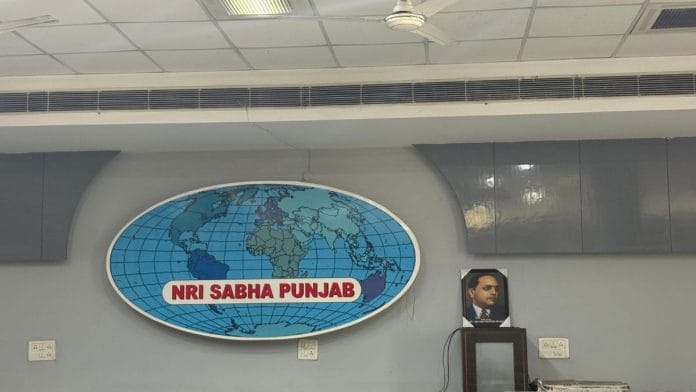



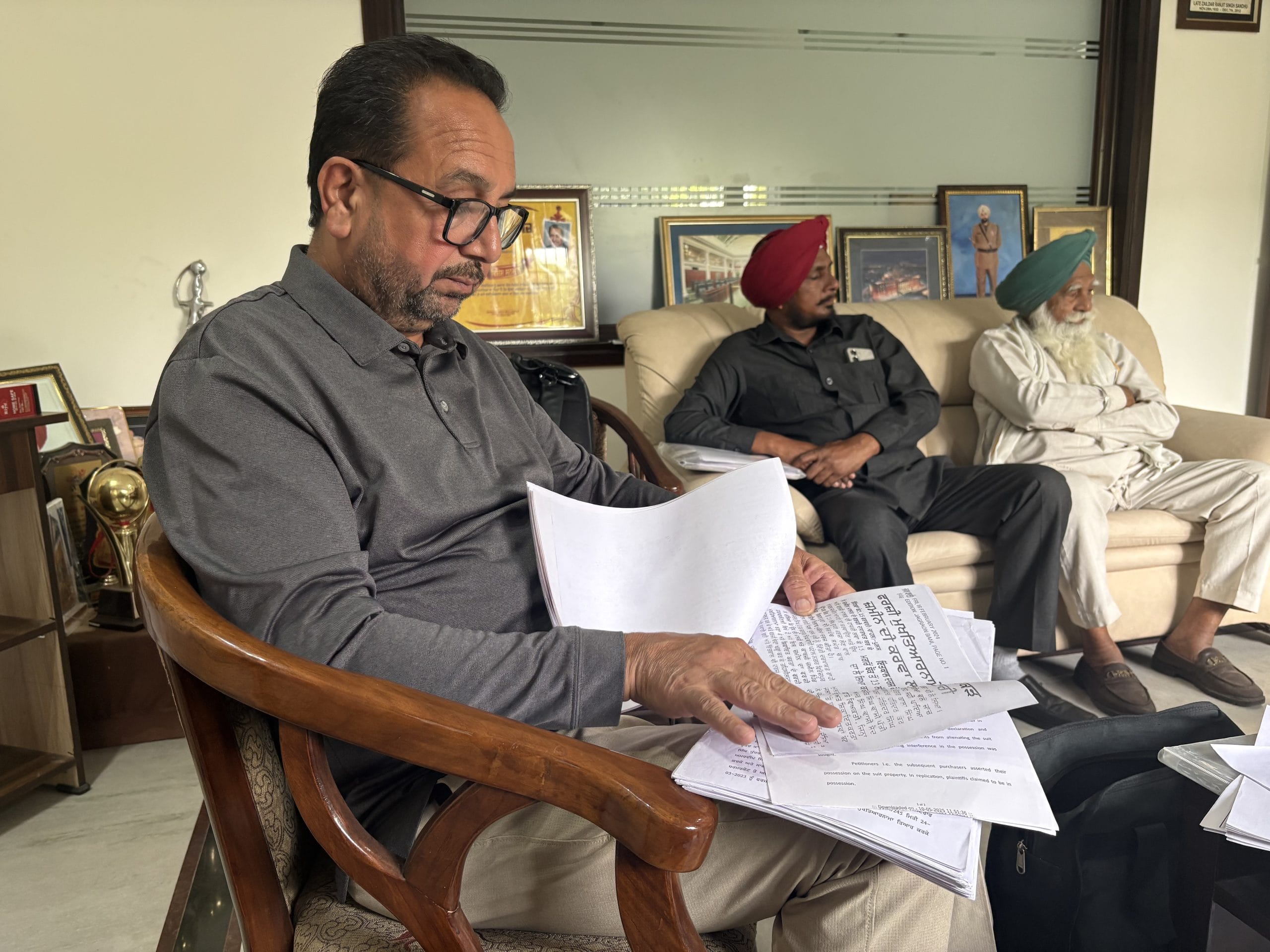
Jalandhar: Mandeep Singh, 58, carries his fight everywhere in a black bag. Wherever he sits, he empties it—land records, and letters to top officials. Flipping through them frantically, showing each page desperately. “Look at this, this is my Fard, a land records document, see this too,” he pleads, reaching out to anyone who might help him reclaim his encroached land in Ludhiana. His biggest hope was on the NRI sabha. But not anymore
“I’ve been defrauded,” he says, hands trembling, eyes heavy with two years of struggle. I’ve written to the NRI Commission, DGP, CMO, Income Tax, DC Ludhiana — even to the former NRI Sabha president, Parvinder Kaur Banga — but nothing has happened so far.”
An NRI based in California, Singh is now caught in a battle he never expected, fighting with a system that has failed hundreds of NRIs like him. Many face similar problems: ancestral lands encroached upon, and disputes related to matrimonial matters. And their biggest support, the NRI sabha, founded especially to solve the local issues of the large Punjabi diaspora, isn’t living up to its job.
For decades, the NRI Sabha was an assurance for Punjabis living thousands of miles away that their roots back home were protected. Long before Punjab’s Department of NRI Affairs or the NRI Commission even existed, the Sabha stepped in as a nodal problem-solver, a mediator, and often, the first and the last resort.
It channelled diaspora wealth into Punjab’s growth, while also doubling up as a cultural link.
Punjab’s relationship with its diaspora is unlike anything seen in the rest of the country. While states like Andhra Pradesh and Telangana have NRI policies and associations, and welfare organisations like APNRT, they operate through nominations or administrative frameworks rather than a directly elected NRI councils.
For generations, migration has shaped the Punjabi psyche. There is a constant two-way pull–the ambition to build a life abroad, and the emotional thread that draws people back to the state. NRIs send money that supports rural economies, and it is precisely why in the villages of Punjab, big mansion-like houses can be seen. They invest in local real estate and infrastructure, and Bollywood-glamorised portrayals continue to present them as aspirational figures.
It is this relationship that gives the NRI Sabha its significance.
But the trust in the Sabha has eroded over the years. And a long leadership vacuum has been at the centre of this decline.
With no president between 2015 and 2020, another stalled cycle from 2022 to 2024, and now again no leadership since January 2026 after Parvinder Kaur Banga’s term ended—have left the Sabha directionless.
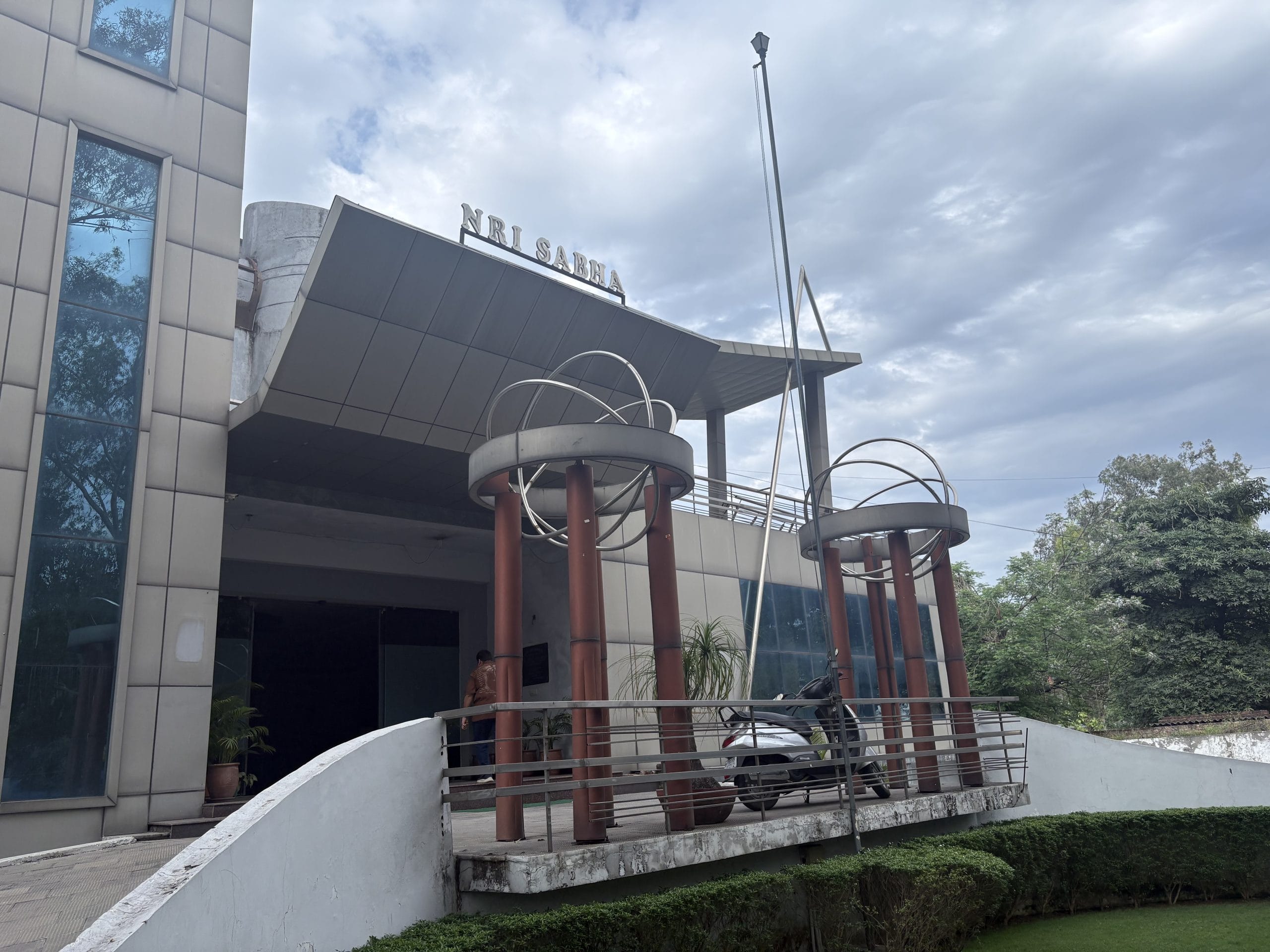
The Sabha is run from its central office in Jalandhar along with district-level units.
It offers lifetime membership to Punjabi NRIs around the world for a one-time fee of Rs 10,500. Members can take part in discussions on NRI issues and vote in presidential elections, but only if they are physically present in Punjab. Nominees are allowed to raise concerns but do not have voting rights.
The number of voters participating is symptomatic of the Sabha’s diminishing trust as the protector of the diaspora interests.
The Sabha has around 23,000 NRI members, yet only 1,600 voted in the 2013 elections. By 2023, participation had fallen drastically, with just 285 eligible voters.
Petitions filed in the Punjab and Haryana High Court, challenging election delays and the Sabha’s lack of financial transparency, have further shaken the confidence and failed to bring about timely reforms. The result is a growing sense of abandonment among over five lakh Punjabi NRIs.
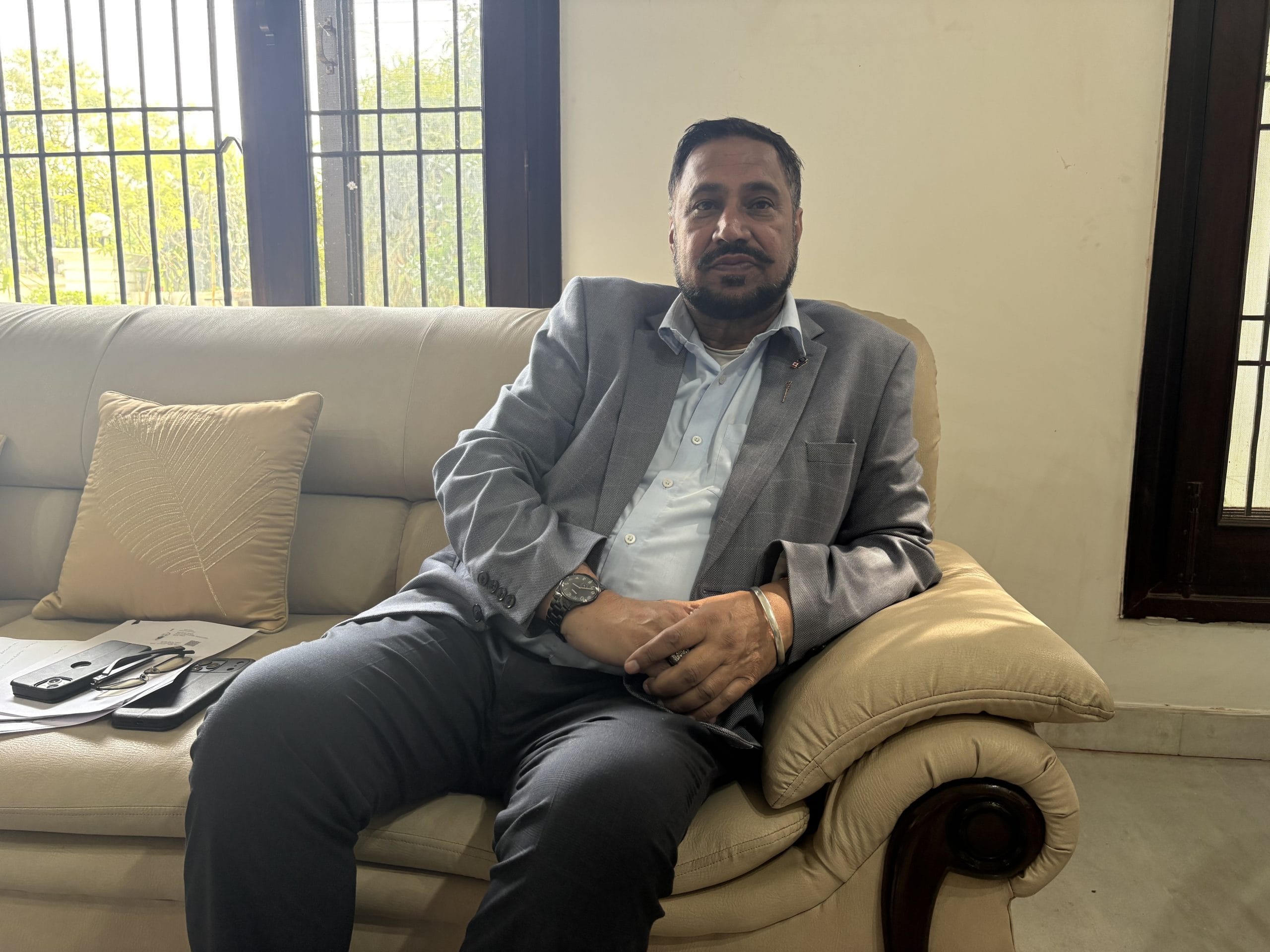
“The NRI Sabha needs a president in place, and the election must be fair. The president serves as a volunteer—earning nothing, at no cost to the government—yet this role is vital. Why should anyone stop someone willing to take on this responsibility and solve problems for the community?” said Peter Sandhu, former MLA from Edmonton-Manning, Canada.
Sandhu spent 47 years in Canada. Now he wants to return to Punjab to do ‘sewa’ and make a meaningful impact.
“The NRI Sabha is the only global body that genuinely connects NRIs with the government, and I want to play my part in that. We need a Sabha president who truly understands our challenges and can help us contribute to Punjab. The president is crucial because only they grasp the real issues NRIs face,” he said, expressing his intention to participate in the upcoming elections that are likely to be conducted at the end of July.
Also read: A rebellious Hoshiarpur cobbler that PhD students love to cite
‘A trusted space’
At the NRI Sabha headquarters in Jalandhar, Sarabjeet Singh sat surrounded by piles of complaints—emails, post, hand-delivered files and desperate pleas from Punjabi NRIs, each telling its own story of distress.
The latest to his desk is a matrimonial case.
The couple married in Punjab, after which the husband moved to Canada, leaving his wife and newborn behind. He continued to support them from abroad and sent nearly Rs 14 lakh along with expensive jewellery and gifts within a year, according to his complaint.
A year later, the wife joined him in Canada, but the marriage collapsed within a month. The husband alleged she left to live with a man she had been involved with before the marriage and claimed that the marriage was merely a route for her to relocate.
Now the woman’s parents are threatening him to file a case under Section 498 of the Bharatiya Nyaya Sanhita. The man sent his complaint through email to the NRI Sabha, hoping someone would listen. The staff forwarded the complaint to the local police station in the woman’s in-laws’ area, requesting further action.
“Cases like this are routine,” Sarabjeet Singh said. “We receive three to four complaints every day—some about matrimonial disputes, others about property conflicts.”
For thousands of NRIs, the Sabha is a trusted space where their voices are heard by those who understand NRI struggles—especially their reluctance to pursue long court battles that drag on for years, far beyond the time they can afford to stay in India.
Also read: Punjab gangsters are shooting village sarpanches now. Moving on from NRIs and pop stars
The disenfranchising
The story of NRI Sabha elections is one of rules, resistance and growing mistrust. According to the Sabha’s bye-laws, an NRI identity card remains valid for five years.
Before the 2024 Sabha elections, the Sabha authorities had announced that only those members whose identity cards had been issued or renewed within the last 5 years would be eligible to vote.
A strict by-law—requiring members to be present with a valid NRI Sabha identity card on election day—was enforced by former president Banga. That has sounded a death knell for the sabha and excluded an overwhelming majority of members out of the election process.
But this procedural requirement became the centre of a major dispute. Rival candidates Jasvir Singh Shergill and Kamaljit Singh Hayre strongly opposed the restriction. They argued that the rules would disenfranchise a large number of life members who had not renewed their cards and demanded that all life members should be allowed to vote regardless of renewal status.
Both the candidates formally approached the Chief Patron of the Sabha–CM of Punjab– and requested his help. Despite this, no relaxation was granted to them. And just two days before the January 2024 election, Kamaljit Singh Hayre withdrew his nomination for the post of President.
The tension reached its peak on the day of the election.
Members who arrived without valid identity cards were denied voting. A video shows Banga enforcing this rule. This disagreement soon escalated into allegations of manipulation in the election.
It was alleged that fake voter identity cards had been created on election day to show recent validity, and that individuals carrying such cards were allowed to vote.
And after the election, these concerns intensified. Joga Singh and Sodi Singh took the matter to the Punjab and Haryana High Court in 2024, challenging the election process and alleging irregularities.
“Out of 24,000 members, only 168 votes were cast. Of these, 147 votes went to Parvinder Kaur, while her rival received only 14 votes. She hails from Hoshiarpur. A large number of members were not allowed to vote for various reasons, while some NRIs with fake ID cards were allegedly permitted to cast their votes,” the petition stated.
But the court advised the petitioners to pursue their complaints through other appropriate authorities, leaving the allegations unresolved.
Also read: ‘Krishna played cricket first’— Sanatan Premier League gives the game a Hindu makeover
An RTI declined
The issue of voter rights resurfaced in 2025 when Karan Singh Randhawa filed an RTI application with the Sabha to uncover the truth.
“I sought information regarding the voter list to verify concerns that had been raised earlier in the High Court petition. I filed an RTI application, requesting the list of members who voted in the 2024 elections. I wanted to compare it with the list of eligible voters now published on the NRI Sabha website to verify whether those who cast their votes were actually eligible at the time of the election,” said Randhawa.
But his request was denied by the Public Information Officer, who claimed that the voter list constituted “personal information” of third parties and could not be disclosed, citing a Supreme Court judgment.
There are a total of 12 district units of the NRI Sabha in Punjab, each headed by its own president. This helps in reaching deep into rural areas where most disputes—particularly those related to land, matrimonial matters, and inheritance—arise
But Randhawa filed a First Appeal to NRI Sabha, arguing that the denial was not only unjustified but also contrary to the established principles of transparency. He pointed out that the electoral rolls and membership list had historically been displayed publicly during election periods, so this information could not be treated as private.
Despite this, the authorities remained silent. His RTI application was rejected, and his first appeal also met with the same fate.
“I had also filed an RTI to know the Sabha’s financial expenditures, but that information was never provided,” said Randhawa.
The Sabha, tired of his endless questions, now just asks him to stop and labels him a troublemaker.
Also read: A Delhi couple keeps climbing Ghazipur landfill to feed 400 dogs. Chicken, rice & dahi
The sabha and its structure
At the top of this structure is Chief Patron Bhagwant Mann, Punjab’s Chief Minister, who lends political backing to the body, alongside Kuldeep Singh Dhaliwal, Minister for NRI Affairs. The administrative control rests with the Divisional Commissioner of Jalandhar, who serves as Chairman and oversees the Sabha’s functioning and elections.
At the centre of it all is the elected President— the voice of the NRI community.
On the ground, the day-to-day operations are handled by Executive Director Mandeep Kaur (PCS), who manages the Jalandhar headquarters, coordinates complaints, and works closely with district units.
There are a total of 12 district units of the NRI Sabha in Punjab, each headed by its own president. This helps in reaching deep into rural areas where most disputes—particularly those related to land, matrimonial matters, and inheritance—arise.
In addition to these units, the government has established dedicated NRI police stations and NRI courts to address the specific concerns of non-resident Indians.
But this democratic spirit, some argue, depends heavily on active leadership.
“Running the Sabha without an elected President is not just leaving a post vacant—it creates a democratic gap,” said Karan Randhawa. “It’s like running a Parliament without elected representatives. Administrative work may continue, but the representative character is lost.”
Speaking to ThePrint, some NRI Sabha members said that the president’s tenure should be extended to four or five years instead of just two. They also proposed that NRI courts handle cases exclusively involving NRIs
He added that over the past two decades, the Sabha has remained largely dormant, weakening Punjab’s engagement with its global community. For a state with one of the largest diasporas in the world, this disconnect carries long-term consequences.
“If other states can channel their diaspora into development, Punjab can too,” he added. “But for that, NRIs need a strong and credible platform—and the NRI Sabha is the only government-backed body created for this purpose.”
Yet, despite its wide network, the Sabha operates with limited authority. It has no legal powers of its own and relies largely on pushing government departments to act on complaints. Its strength lies in influence—nudging the system, raising issues, and advocating for NRIs both in Punjab and abroad.
“In view of the rising number of complaints related to civil disputes, criminal matters, and revenue issues, we at the NRI Sabha believe it is essential to be granted limited statutory powers. This would include the authority to call for Action Taken Reports from concerned government departments such as Police, Revenue, and Civil Administration; the right to seek status updates and relevant records concerning grievances filed by NRIs; and the power to set reasonable timelines for these departments to respond,” said Karan Randhawa, a member of NRI Sabha.
Also read: Kaziranga is ready to share its rhinos. Assam doesn’t want them all in one basket
Committees not formed, AGMs skipped
Kamaljit Singh Hayre served as the president of the NRI Sabha from 2006 to 2010, and members see his tenure as a time of vision and action. Many describe him as an “ideal president” who went above and beyond to keep the Sabha active and effective.
It was under his leadership that the NRI Sabha office in Jalandhar was established, giving the organisation a permanent base. He also focused on strengthening its structure—setting up different sub-wings like the Kisan Wing and Media Wing. During this period, NRI police stations and even NRI courts were established to address issues specific to the diaspora.
“I spent Rs 20 lakh from my own pocket to help establish an NRI Police Station in Jalandhar. During my tenure, around 10,000 new members joined the Sabha,” said Hayre.
But today, the picture is starkly different. The sub-wings no longer function, and the official website shows that between 2023 and 2025, only 332 new members joined.
Trust among members has eroded, leaving the Sabha in a weakened state. Some who sought help even accused the Sabha of attempting to solicit a bribe.
In a complaint filed with the Sabha on 24 March 2025, Yashpal Chabra, a resident of Jalandhar, said that his son’s marriage had ended in divorce, and after facing legal complications, they approached Parvinder Kaur, President of the NRI Department in Jalandhar, for assistance in resolving the matter.
“However, instead of providing us with the necessary support and ensuring a fair investigation, the concerned official demanded a bribe of Rs 2 lakh to ‘settle’ the matter,” wrote Yashpal Chhabra, in the letter sent to the NRI Minister of Punjab.
“It is disheartening to witness such malpractices in a department meant to protect the rights of NRIs and their families,” he added, requesting strict action against those found guilty of corruption and misconduct.
Parvinder Kaur Banga, however, rejected the complaint, arguing that it is not a valid document since it was not issued by the Chief Minister’s Office (CMO), and she has also raised concerns in her lawsuit alleging that it is fabricated.
She said that false information had been spread about her, calling it highly unethical.
“Someone has spread false information about me, which is extremely unethical, particularly when I served voluntarily. Why are my contributions not being highlighted? I spent over Rs 3.5 lakh from my own pocket to build the freedom fighters’ gallery,” she said, adding that the situation appeared to stem from a personal vendetta against her.
Members have raised several other serious concerns during Parvinder Kaur’s tenure. They pointed towards the violations of the Sabha’s Constitution and bye-laws.
For instance, the president is supposed to form the central executive committee, but that hasn’t happened since 2010. The administrative sub-committee was never constituted, Annual General Meetings (AGMs) were skipped, and monthly income and expenditure statements were not presented to the executive committee—failing to follow basic norms of transparency and accountability.
Randhawa pointed out that a binding order issued on 31 January 2024, by the then Minister for NRI Affairs, Punjab, Kuldeep Singh Dhaliwal—who also serves as the Sabha’s Patron—appointed five office bearers for the NRI Sabha Punjab. In the order, Randhawa was appointed as a secretary of the Sabha. But the order was allegedly ignored, leaving a deeper governance vacuum.
Speaking to ThePrint, some NRI Sabha members said that the president’s tenure should be extended to four or five years instead of just two. They also proposed that NRI courts handle cases exclusively involving NRIs.
The problem with NRI Courts is that, although they exist, they don’t truly provide a fast-track resolution for NRI cases. These courts handle both NRI and general cases, so they aren’t dedicated solely to NRIs.
“Jalandhar is a hub for NRIs, and there are many criminal and civil cases involving them. Currently, only two magistrates and one additional district judge handle these cases, which is far too few. Earlier, cases were spread across 35 judges, but now concentrating them in just three courts has caused long delays,” said Mandeep Singh Sachdev, Senior Advocate at the High Court of Punjab and Haryana, who is also representing Randhawa in his High Court case.
He said that most NRIs visit only in winter, making scheduling evidence a bit tricky. Poor online infrastructure and different time zones often make giving evidence nearly impossible, further frustrating the NRIs.
Also read: Being a northeastern in Delhi—casual racism, everyday profiling and violence
If there were a strong president
Mandeep Singh no longer steps out of his house alone. Two men accompany him everywhere—one in his 40s, the other in his 60s—both carrying guns in their pockets. He faced threat from those encroaching his land.
“I am under immense stress. Sometimes I feel like ending my life. How long can anyone endure this? My life is also at risk,” he said.
Two years ago, his life looked very different.
He worked as an independent truck operator, owning his truck and transporting goods across the U.S. and parts of Canada, often spending 20–25 days a month on the road. As the sole provider, he supported his family while repaying loans for his house and truck.
But in March 2023, Mandeep received news that changed everything overnight—his land had been encroached. Within some months, he sold his truck, left behind his life abroad, and returned to India, knowing this would not be a short fight.
And his story is far from isolated.
Advocate Hukum Singh, based in Jalandhar, has handled several such disputes. He recalled a case involving an NRI living in Canada who discovered that his own house in Jalandhar had been taken over by the caretaker family.
“If there were a strong and proactive president of the NRI Sabha, someone with access and intent, this issue could have reached the Chief Minister directly. That kind of leadership can make a difference—but that’s not the reality today,” said Peter Sandhu.
(Edited by Anurag Chaubey)