





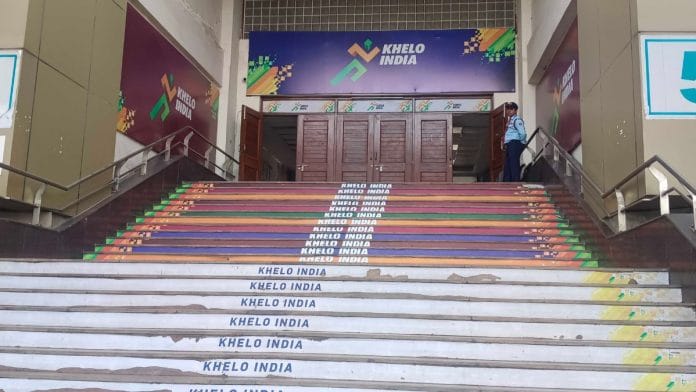



New Delhi: Twenty-two-year-old Bushra Khan Gauri had trained hard for months every morning despite an injury. But when she took her position at the Sawai Mansingh Stadium in Jaipur in the 5000-metre Khelo India University Games final in November last year she only had two people to compete against. A 18:15.27 second sprint won her a gold. But the achievement isn’t something she is proud of retelling.
Bushra had anticipated the Khelo India University Games to be a major sporting platform that would start her journey towards becoming a serious athlete. For her, it was no less than national games. But when her dreams dashed, there were barely any witnesses.
“There was not much audience, which we don’t usually expect as athletes in India. But what disappoints most is that there is no one to compete against,” said Khan, adding that athletes competing in categories such as women’s 400m and men’s 400m hurdle ended up running alone.
The Khelo India Programme, launched by the Modi government in 2018 aims to revive sports culture at the grassroots level by promoting mass participation, identifying young talent, and building a strong sporting ecosystem in India. While the initiative was launched with grand ambitions and Bollywood superstar Akshay Kumar became its face, it now appears to be struggling in several ways.
Universities are shy of sending athletes to the University Games and athletes are withdrawing from tournaments, often citing the presence of the National Anti-Doping Agency at Khelo India events and poor management. The games’ calendar has also come under question with some athletes accusing the organisers of conducting games in off season—when players practise for upcoming national and international competitions. Several Khelo India coaching centres operate within private institutions, limiting their accessibility. The scholarship scheme, once a major attraction of the programme, has also suffered from delays in disbursement, alleged players, coaches and institute owners. Lack of promotion of events has resulted in empty stands.
There was not much audience, which we don’t usually expect as athletes in India. But what disappoints most is that there was no one to compete against.
Bushra Khan Gauri
“Khelo India has not failed, but it is definitely underperforming. The main reasons are chronic funding issues and a lack of coordination between the Centre and the states. This leads to administrative delays, underinvestment, and poor long-term planning,” said a senior Sports Authority of India (SAI) official, speaking on the condition of anonymity.
SAI implements the Khelo India programme and organises the Khelo India Games in collaboration with the Ministry of Youth Affairs and Sports and other stakeholders like the state governments and National sports federations.
Also read: ‘Borewell boy’ Prince is now a 23-yr-old plumber. ‘Same urgency could have saved Noida techie’
The Jaipur fiasco
Several athletes who recently participated in the Rajasthan University Games expressed disappointment over the management of the event. Players and coaches complained about the poor quality of equipment provided, substandard food, and delays in meal timings. There were also no proper travel arrangements from hotels to the stadium for athletes.
“The management is getting worse day by day. At such a grand level of competition, we have seen the worst quality of equipment being used,” said a head coach who travelled from Delhi with his team to Rajasthan, requesting anonymity. “Where is the budget going, even though it has been increased compared to previous years?” he questioned.
Participation levels in the University Games have raised serious concerns, as athletes have been seen running alone and still winning gold medals. Manisha, in the women’s 400m, and Ruchit Mori, in the men’s 400m hurdles, both ran solo on the track.
“On the ground, there is weak integration with schools and inadequate monitoring, which together dilute the impact the programme was meant to have,” added the official quoted above.
In videos shared on social media, athletes can be seen travelling in auto-rickshaws from their accommodation or designated venues to the stadium.
Khelo India has not failed, but it is definitely underperforming. The main reasons are chronic funding issues and a lack of coordination between the Centre and the states. This leads to administrative delays, underinvestment, and poor long-term planning.
A senior Sports Authority of India official
“We were given the worst food, and there were no arrangements for players to travel from one place to another,” said Hitesh Dagar.
Manisha and several other athletes ThePrint spoke to also complained about the food arrangements. Meals were either served too early before lunchtime, when they were preparing for their games, or very late—sometimes after 4 pm.
Some athletes skipped Khelo India University Games as they were focusing on preparation for major international events such as the Asian Games or the Commonwealth Games. They preferred to train and peak for these competitions.
“This is the off-season for athletes. Training usually begins around this time, which is why many do not participate in new competitions, as they start preparing for events like the Commonwealth and Asian Games,” added Khan.
The Khelo India University Games (KIUG) have been held across different states in India since 2020. The 1st edition in 2020 took place in Odisha, primarily in Bhubaneswar and Cuttack.
“After the National Games, Khelo India is the biggest festival for athletes, but it is losing its essence due to the negligence of the authorities and the government’s lack of proper planning,” said an athlete from Chandigarh University who participated in the rugby event at the Jaipur edition.
The schedule of Khelo India Youth Games—meant to promote school talent—has also come under scrutiny. The event is usually held in the months of January and February, just before the Classes X and XII board exams.
“Khelo India is talked about only when it is inaugurated by well-known personalities. Otherwise, athletes—and even the public—often don’t know when it begins or ends,” said another athlete who plays football for Guru Nanak Dev University.
Funds for the programme, however, have risen. For FY26, the Government of India has allocated Rs 1,000 crore, up from Rs 800 crore in FY25.
This Rs 1,000 crore is part of the Rs 3,794.30 crore allocated to the Ministry of Youth Affairs & Sports in Union Budget 2025.
Khelo India is talked about only when it is inaugurated by well-known personalities. Otherwise, athletes—and even the public—often don’t know when it begins or ends.
Football player, Guru Nanak Dev University
Suma Shirur, India’s first woman Dronacharya Awardee, Olympian, and founder of the prominent Lakshya Shooting Club (LSC)—also a Khelo India-recognised training centre—said the initiative creates a bridge between raw potential and professional sporting pathways, especially for athletes from non-metro cities and modest backgrounds. However, she highlighted the need for improvement in increasing the pool of participation across sports.
“A lot of athletes would like to take advantage of the exposure this competition offers, but they are unable to do so because of the limited number of athletes allowed to participate in the Youth Games. If participation were expanded, it would showcase the entire Khelo India programme through a single competition,” said Shirur.
Also read: Jewar farmers are crorepatis now. They’re investing in stocks & mutual funds, not just land
The scholarship question
National steeplechase athlete Manisha won the silver medal in the women’s 3,000 metre steeplechase in Jaipur. The podium finish marked her third participation in the Games and her third medal, representing Rabindranath University, Bhopal. However, Manisha has decided not to compete in future editions.
Manisha has been trying to secure a place in the Khelo India Scholarship Scheme for over a year. Each time she applied or contacted the state authorities, she either received no response or was told that her documentation was incomplete—without ever receiving clear explanations.
Under the Khelo India Scholarship, formally known as the Khelo India Athlete Development Programme (KIADP), athletes are identified as “high-potential” based on performances at the Khelo India Games, National Championships, age-group rankings, and recommendations by expert committees
“It has been more than two years since I started applying for the scholarship, but I have never received any response from the authorities or seen my name on the list of selected athletes,” said Manisha.
Under the Khelo India Scholarship, formally known as the Khelo India Athlete Development Programme (KIADP), athletes are identified as “high-potential” based on performances at the Khelo India Games, National Championships, age-group rankings, and recommendations by expert committees. Each year, only a limited number of athletes per discipline are picked. Answering a question during a Rajya Sabha discussion, the Ministry of Youth Affairs and Sports stated that 2,808 Khelo India athletes received scholarships or financial assistance in 2025.
As a result, even consistent medal winners may be left out if the selection committee prioritises other athletes during a particular cycle.
Talented players identified in priority sports disciplines by the High-Powered Committee receive annual financial assistance of Rs five lakh for a period of eight years. However, in events such as the steeplechase, the number of scholarship slots is extremely limited. This often becomes a common issue and reflects not a lack of merit, but rather the restrictive and comparative nature of the selection process.
ThePrint reached out to officials from Khelo India and the Sports Authority of India via email, messages, and phone calls, but did not receive any response.
“Khelo India has made sports more accessible and aspirational across socio-economic backgrounds. However, what it truly needs is to match high-performance demands with rising inflation—the scholarship amounts should be increased,” said Shirur.
Athletes such as Hardik, 27, who plays football and Hitesh Dagar, 26, who plays for Delhi Hurricanes Rugby Club and has been a fixture in the Indian senior men’s team, have also raised concerns about the scholarship structure and eligibility criteria, stating that many players do not fully understand how the system works or fail to receive clarity even after approaching authorities such as the SAI or Khelo India officials.
Responding to questions regarding delays in scholarship disbursement and athletes not finding their names on the selection list despite applying for years, an official from the Khelo India said that all information and procedures are clearly mentioned on the official websites, and that officials remain in communication with athletes.
“Scholarships are often delayed when the budget allotment process takes longer than expected or gets held up due to formal approvals,” the official said.
Also read: ‘Borewell boy’ Prince is now a 23-yr-old plumber. ‘Same urgency could have saved Noida techie’
‘Where’s the fund’
Manisha and Hitesh allege they have been denied the basic facilities an athlete needs to strengthen their performance and prepare for future national and international tournaments.
Athletes selected under the Khelo India Athlete Development Programme (KIADP) are entitled to receive access to certified coaches, Khelo India-accredited training centres, and modern sports infrastructure, along with sports science support such as physiotherapy, injury management, and fitness testing.
The scheme also facilitates national and international competition exposure, supports equipment requirements, and monitors athletes’ progress through performance reviews. But many athletes find themselves out of the support reach.
Khelo India shows you a path and a dream, but it supports only a few throughout the journey, even when athletes need help in many ways.
Manisha, Khelo India athlete
Manisha lives in T.T. Nagar, Bhopal, and comes from a lower-middle-class family of five. She has two elder brothers and parents who have always supported her journey but have been unable to provide her with the best facilities due to financial constraints. Her elder brother is the sole breadwinner of the family, earning through private tuition.
Manisha often participates in district- and state-level competitions to win prize money, which she then spends on her training, equipment, and daily necessities. When she first participated in the Khelo India Games in 2022, her aim was not just to win a gold medal but also secure a place on the scholarship list to support her training.
“Khelo India shows you a path and a dream, but it supports only a few throughout the journey, even when athletes need help in many ways,” said Manisha.
During a 2024 Rajya Sabha session, Member of Parliament from Punjab Vikramjit Singh Sahney raised concerns over significant disparities in fund allocation under the Khelo India Scheme. He highlighted the challenges faced by states like Punjab in nurturing athletic talent due to disproportionate funding.
“The state received only Rs 78 crore under the Khelo India Scheme, which constitutes a mere 3.5 per cent of the total funding allocated,” he stated.
In August 2025, a Parliamentary Committee—which included cricketer and AAP Rajya Sabha MP Harbhajan Singh, BJP leaders Sambit Patra and Bansuri Swaraj, among others—expressed concern over staff shortages and low funding at SAI. The committee raised questions about SAI’s funding and the utilisation of funds. It also noted that significant portions of the allocated funds were diverted elsewhere or returned unspent.
“The practice of diverting funds from one central scheme to another is not a healthy one, as it reflects poor estimation, planning, and implementation on the part of the central scheme,” the committee observed.
Also read: ‘Goal Machine’ Anushka Kumari, 14, was taunted, stopped. Now she’s India’s rising football star
Fighting to be seen
The 5,000-metre race in which Bushra was supposed to compete with eight participants, ended up with just three athletes on the track. In several other finals, more than half of the lanes were unoccupied. Only three athletes competed in the men’s 100m. Other major finals with just three participants included the men’s decathlon, men’s 200m, women’s 200m, and women’s 400m hurdles.
The presence of the National Anti-Doping Agency (NADA) and sudden testing reportedly led some athletes to back out or skip the tests in Jaipur, said athletes and coaches.
Historically, doping has been an issue at Khelo India events. In the 2019 Khelo India Youth Games, six athletes across archery, track and field, wrestling, and weightlifting tested positive after NADA conducted tests in Pune. In the 2020 University Games, five athletes failed doping tests.
“There is a lack of awareness among athletes regarding NADA and doping. There should be more counselling and education at the grassroots level,” said S.K. Prasad, coach at the TT Nagar Sports Complex in Bhopal.
However, athletes and coaches insisted there were other reasons beyond doping tests and scheduling.
“Many universities don’t send their athletes to competitions due to expenses, lack of funding, or internal politics about which players should be sent,” said an athlete on the condition of anonymity.
University games are often held months or even a year before the Khelo India University Games. Athletes who perform well in university-level competitions are supposed to advance to Khelo India. However, in the intervening period, many shortlisted athletes either secure government jobs or participate in other tournaments. Consequently, authorities sometimes deny them participation in the games.
“The authorities, universities, and management teams need proper prior planning, which is lacking here. If an athlete gets a job before the university games are conducted, new athletes should be added to the list. This never happens, and that is why we sometimes see an athlete running alone on the track,” said Prasad.
Hardik expressed disappointment with the state of an initiative that was meant to uplift Indian sports but is now failing in many areas. He criticised the lack of effective coordination among states, federations, and independent monitoring bodies, saying athletes are bearing the consequences.
“Khelo India was meant to create champions. Today, many athletes are not even seen on the tracks or sports grounds on the biggest competition days.”
(Edited by Anurag Chaubey)