









War breaks out anywhere in the world, and Indian students are suddenly running. A meme currently making the rounds on X captures this, accompanied by a clip from Om Shanti Om where Shah Rukh Khan screams “Bhaago!” against the backdrop of a burning field. It’s hilarious because it’s true — and it’s equally distressing, also because it’s true. India’s aspiring doctors and engineers are so thoroughly scattered across the world that they now seem to be a fixture in every emerging conflict.
With the deadly protests in Iran, this is the third time in four years that Indian students have found themselves stranded in the middle of a historic crisis. In what has been dubbed the largest unrest since the 1979 revolution, as many as 5,000 people in Iran have reportedly died in the crackdown on anti-regime protesters. The internet has been suspended and commercial flights stand cancelled.
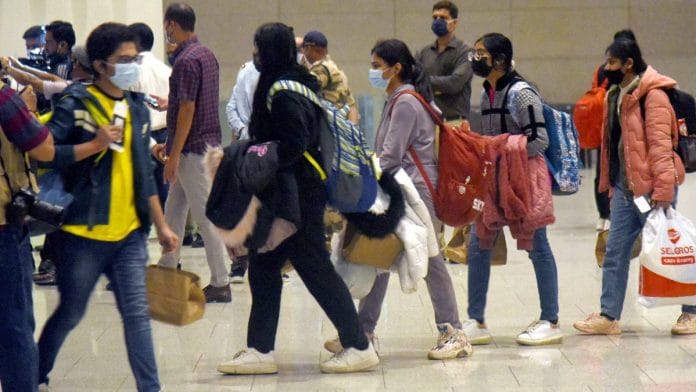
Several of the almost 10,000 Indians in Iran are medical students. A significant number are from Jammu & Kashmir, enrolled at universities in Tehran and Isfahan. Evacuations have now begun, with students from Golestan University, Shahid Beheshti University of Medical Sciences, and Tehran University of Medical Sciences forming the first groups to depart.
A similar scenario unfolded in February 2022 during the Russia-Ukraine war. Operation Ganga evacuated 23,000 Indian nationals, most of them studying MBBS, as Russian forces shelled Kharkiv and Kyiv. (That campaign also gave us the iconic tagline: “War rukwa di papa.”) The ongoing conflict in Ukraine left several MBBS students in a lurch, some of whom decided to give up the field entirely. In June 2025, it was the Iran-Israel conflict, when Operation Sindhu evacuated over 1,000 Indians, which included 285 students.
But Iran and Ukraine are just the most well-known crises. Indian students pursuing medicine and engineering are now spread across CIS countries you wouldn’t readily associate with those fields.
Also Read: Why Jammu’s Vaishno Devi medical college is state-of-the-art but empty today
The discount degree trap
While the US, UK, and Canada are still the gold standard, hundreds of thousands of students flock to Kazakhstan, whose Indian student population has grown to over 12,000, and Kyrgyzstan, with around 15,000. These are among the cheapest countries to study MBBS in, alongside China, Bangladesh, the Philippines, and Georgia.
The exodus makes financial sense. Degrees from these countries cost a fraction of what India’s private medical colleges, or those in the US and UK, charge. It also makes cultural sense. The “Dr” prefix remains the ultimate flex and sign of middle-class arrival, worth selling off ancestral land or drowning in education loans to secure. And it ought to make systemic sense. When 22 lakh students compete for 1 lakh MBBS seats every year, the remaining 21 lakh have to go somewhere.
Except none of that matters when they come back.
Despite the mushrooming of these degrees, the pass percentage of the Foreign Medical Graduate Examination (FMGE) — a screening test for graduates who want to practise medicine in India — ranges between an abysmal 10-25 per cent. Students are required to score at least 50 per cent in the exam. In 2014, that figure was as low as 4.93 per cent. Government data states that the pass percentage of students from Bangladesh and Nepal is “relatively better” than graduates from countries such as Armenia, Belarus, Georgia, and Kazakhstan.
According to a recent NDTV report, experts cited a lack of clinical exposure and substandard medical education as one of the reasons for the low pass percentage: “Unlike medical colleges in India, the colleges in the foreign countries do not have proper infrastructure. The students enrolled in these medical colleges are not trained in hospitals. On the other hand, medical students from India have to undergo a mandatory one-year internship to complete their MBBS degree.”
A senior doctor in Delhi told me in a recent conversation that while there’s a clamour, worldwide, to improve healthcare, there just aren’t enough doctors to go around.
“Healthcare is the one thing every government wants to give its people — it’s a political imperative. But the richer you are as a country, the better-skilled manpower you get, which means doctors with options want to practice in Dubai, the US, and the UK,” he said.
This creates a cascading shortage. India is desperately building capacity by setting up several AIIMS and allowing private medical colleges. But training doctors requires so much more, such as infrastructure, teaching staff, and hospital partnerships. CIS universities have spotted the arbitrage opportunity, because foreign students bring in money. But many of these colleges aren’t well-equipped. The Indian government routinely provides advisories to students to verify the validity of their degrees. And there are language barriers despite English-medium instruction.
“You can see it in the clinical interactions,” the senior doctor told me. “The impression among senior clinicians is clear: If you have a choice between an India-trained graduate and one from a CIS university, you choose the Indian.”
India’s FMGE was designed precisely to address this quality gap, much like the UK’s PLAB exam. Even the National Accreditation Board for Hospitals and Healthcare Providers has strict credentialing policies to prevent fraudulent degrees from slipping through. But all the checks and balances in the world won’t solve the dichotomy. We need more doctors, but do not have the capacity to train them. “The desperation to have a ‘Dr’ title will lead you anywhere,” the senior doctor concluded.
Also Read: Violent Indian men are now ideal lovers in Bollywood movies
Doctor, engineer, or nothing
Which brings us, yet again, to the same tired question that every middling 2010s web series tried to answer. Why are families still so obsessed with producing doctors and engineers?
One debilitating fear feeds this obsession, and that is the terror of slipping downward into a social class you’ve barely clawed your way out of. Over decades, that fear has calcified into only two acceptable insurance policies, doctor and engineer. Everything else flows from this.
The coaching factories of Kota and Sikar exist because families will spend Rs 1.5-3 lakh per year to avoid the social — and sometimes, actual — death of their child not becoming a doctor. When a student doesn’t make the cut after three years of coaching, the sunk cost fallacy kicks in. Going to a strip mall college in a country whose name you can barely pronounce becomes the only way to salvage the investment. Without the safety net of alternatives — which exist but are not deemed acceptable — families will send their children to war zones if that’s what it takes.
I hope the Indian students in Iran make it back home safe. They have suffered enough, at home and abroad. But a culture that can only accept two professions in 2026 will learn nothing from this. See you at the next evacuation.
Karanjeet Kaur is a journalist, former editor of Arré, and a partner at TWO Design. She tweets @Kaju_Katri. Views are personal.
(Edited by Asavari Singh)