





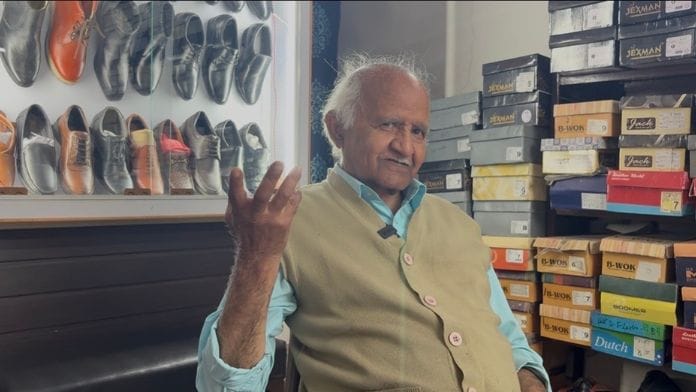



In the lanes of Hoshiarpur lives 77-year-old Dwarka Bharti, a rebellious cobbler who prefers to call himself an artisan. Every day, he sits at his shop where his two worlds collide. One half is dominated by leather and hand tools, the other half is stacked with Dalit literature, Buddhist texts, the writings of B. R. Ambedkar, and books he has authored.
“In this country, people tend to see my work through the lens of caste,” he said. “Had I been elsewhere, I would be recognised as an artisan, not just a cobbler.” Still, he refuses to see himself as a victim.
Bharti’s work has been incorporated into the IGNOU syllabus—his poem “Aaj Ka Eklavya” is part of the MA Hindi Dalit Literature curriculum. And scholars pursuing PhDs at Punjab University regularly cite his writings in research on Dalit literature.
Today, his name stands alongside prominent Dalit writers of Punjab, including Prem Gorkhi, Lal Singh Dil, L. R. Bali, and Balveer Madhopuri. For years, he has spoken passionately about Dalit literature on local Punjabi news channels.
Yet he prefers to stay far from the limelight. Fame and recognition mean little to him.
For him, writing is an act of rebellion–one that confronts caste hierarchies, questions nationalism, and imagines a more equal world. Making shoes is just as political. It is a way of breaking the traditional link between work and caste.
His motto is to change a culture that has long made life difficult for artisans like him. And he does all of this not under his birth name. He has abandoned his caste surname and replaced it with a neutral one—“Bharti,” meaning a resident of India.
“The name Bharti creates ambiguity,” he said. “You can’t tell what caste I come from. I am just an Indian.”
When customers notice the books lining his shop, they ask if he reads—but he rarely mentions that he is a writer as well. To most, he remains just a simple old man of the Hoshiarpur neighbourhood who makes shoes.
He worries about the diminishing identity of Dalit literature. Many Dalit writers remain unknown to most of the country, their works are rarely read or taught. The pioneers of Dalit literature—like Madara Chennaiah, the 11th-century cobbler-saint, and Dohara Kakkayya, the 12th-century Vachana poet and social reformer from Madhya Pradesh’s tanner (leather worker) community—are slowly fading from collective memory.
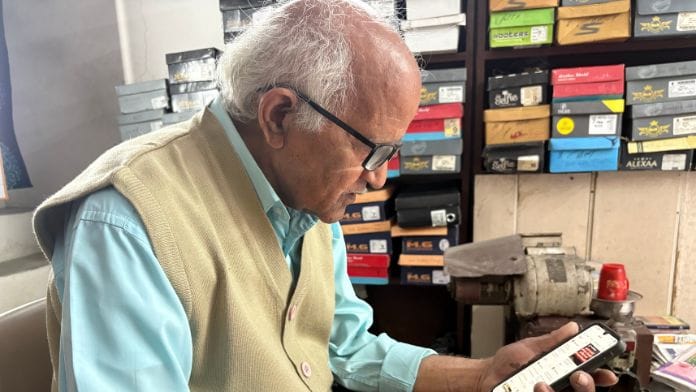
“When people come to my shop and see the books, they ask if I also sell scrap paper,” he said, shaking his head with a smile. “I’ve even told my family that after I’m gone, they should burn these books too—there’s no one left to read them anyway,” he added, laughing.
Also read: Almonds and walnuts were Kashmir’s pride. Now Indians get their fix from California, Chile
Between books and shoes
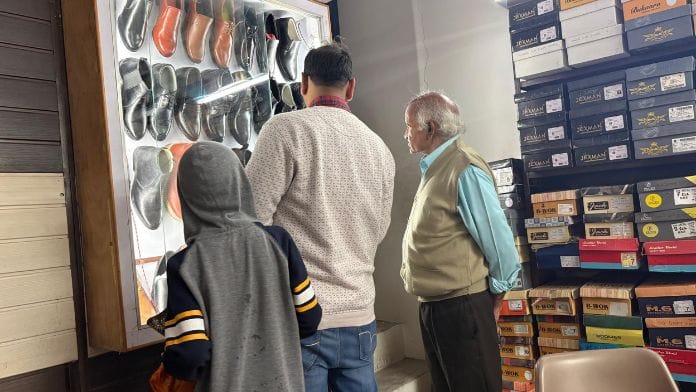
Bharti’s demeanour shifted the moment a customer entered, requesting a larger size of a shoe he had liked before.
He let the writer in him step aside.
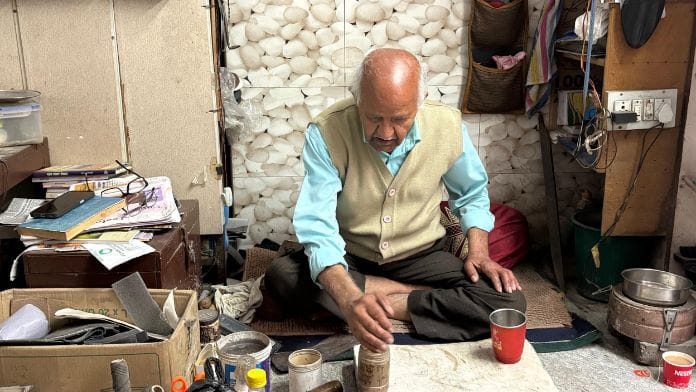
Setting aside the book he was holding, he gathered a plain sheet of paper, a pen, and a measuring tape. Sitting down, he placed the customer’s foot on the paper and traced its outline.
“I’ve only come here once or twice before, but I’ve heard you also write… and you’re quite famous,” the customer said. Bharti remained silent, focused entirely on jotting down the measurements in his notebook.
The customer, based on his two meetings with Bharti, praised him for three qualities: “Perfection in work, good behaviour, and creativity.”
Bharti had inherited this shop from his father, who had learned the skill in Lahore, and before that, his grandfather had been a cobbler too.
“My father learned shoemaking in Lahore. He spent years assisting a master cobbler, and was expected to do everything asked of him—from making tea to massaging feet,” Bharti said.
He said that there was a time when shoemaking was treated as a serious craft, demanding hard work, patience, and years of honing both skill and design.
His journey has taken him to places far removed from the cobbler’s bench.
In 1980, he lived in Iraq, surrounded by the smell of gunpowder and the chaos of the Iran-Iraq War. He worked as an electrician there. He saw Saddam Hussein once in Baghdad and witnessed the destruction of cities firsthand.
Saddam Hussein would come at least once a month for inspections, accompanied by a full staff, creating an atmosphere where workers like him could only observe from a distance.
“He was tall, fair, with reddish complexions and stern, almost regal expressions. Despite his intimidating demeanour, he found himself drawn to their presence, watching them closely during these visits,” said Bharti.
Amid all this, Bharti never let go of his love for books, reading whenever he could, and spent his free time talking with Pakistani and Bangladeshi workers.
“When I was in 7th grade, I read everything I could get my hands on—great writers like Premchand, Dutt Bharti, Krishan Chandra, and Manto. Whatever I found, whether good or bad, I read it all, even old newspapers I could get my hands on,” he said.
In 1982, he began working at his father’s shop. One of his brothers had gone to America to work in a medicine company, so he and the other brother took care of the shop.
Also read: The secret lives of young India in small-town gyms. Dumbbells, desire, freedom
The writings, inspiration
Bharti’s writing journey began around the 1980s, and it came from a very personal and social space. He recalled his time in Sundarnagar, Himachal Pradesh, where he worked in the Beas-Satluj Link Project. There, he witnessed and experienced caste-based discrimination. And it left a lasting impact on him.
It was during this period that he wrote his first poem. He was deeply influenced by the socio-political environment of the time, especially Kanshi Ram’s movement.
He said his first poem was about the migrant workers, particularly from Uttar Pradesh– how they lived transient, uncertain lives on railway platforms.
“Some would arrive, some would leave, some would get left behind or ignored, and some would simply remain there, lying on the ground, caught in a cycle of struggle,” he said.
He named this poem, “hum abhi thhake nhi (we are not tired yet).” And it was eventually published in a Punjabi newspaper.
But he never abandoned his ancestral work as a cobbler, nor did he ever feel the need to.
“To me, it’s just work, no different from any other. My writing was never about money; I never tried to sell it,” he said. For him, it’s a space where ideas can live freely
Forty years later, he is recognised for his pioneering work in helping collect and organise the works of Punjabi Dalit writers in the book Yuddharat Aam Aadmi: Punjabi Sahitya Mein Dalit-Kalam (“The Struggling Common Man: Dalit Writing in Punjabi Literature”).
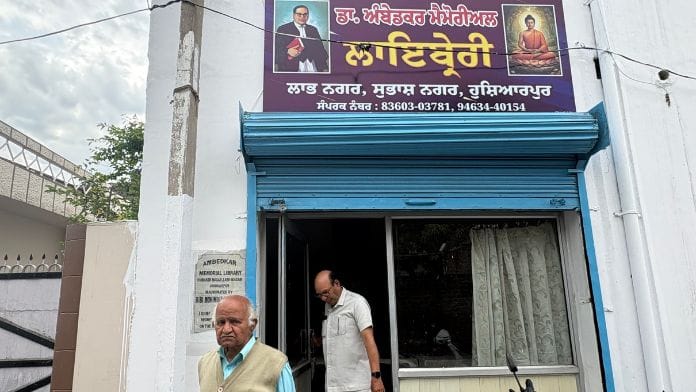
Alongside a few friends, he founded the Dr Ambedkar Memorial Library in 1984, just a few blocks from his shop in Hoshiarpur. Today, the library is run by his friend Preetam Ram Gomar, and it has more than 600 books, collected through donations and purchases over the years.
“The collection spans Punjabi, Hindi, and English, with an entire section dedicated solely to Dalit literature. The purpose of the library was to create a space devoted entirely to Dalit writers. Back then, it was the first of its kind in Hoshiarpur,” said Gomar.
Every day, about 18–20 students come to the library for tuition, and on weekends, they have their computer classes.
Around 1987, Bharti started a monthly magazine called Bodh Dharm Parcharak along with his two friends. One of the friends was Ramesh Sidhu, who took on the role of editor. Another was Krishan Kumar Bodhi, who ideated this whole project
Every issue features at least two essays and an editorial written by him.
“Writers from across the country send their essays to me by post or mail to get them published. The magazine hasn’t missed a single issue since 1987,” he said.
Also read: Punjab gangsters are shooting village sarpanches now. Moving on from NRIs and pop stars
A Rebellious Cobbler
Bharti opened the almirah in his shop and carefully pulled out the file where he keeps all his important documents. As he flipped through it, looking for a particular paper, he paused to read old letters—messages from institutions that once recognised his work or asked for his guidance.
Each letter brings back memories, like little treasures from the past.
Among them are the letters from IGNOU, inviting him to contribute to the development of M.A. courses on Dalit literature. One letter, dated 26 March 2002, details the university’s plan to create a module on “Indian Dalit Literature” for second-year students, highlighting his role in shaping a curriculum that brings together writings from multiple languages. Another letter, from 18 August 2003, again seeks his expertise, inviting him to a writers’ committee meeting to finalise course content and structure.
“All these papers had been scattered for a long time. Now I’ve started keeping them carefully,” he said.
In 2019, his autobiography Mochi: Ek Mochi Ka Adbi-Jindaginama was published by Navchetna Prakashan in Jalandhar’s Boot Mandi. It was later translated into English as A Rebellious Cobbler (2024).
The book traces nearly six decades of his life—shaped by caste, labour, and an unrelenting habit of reading. It reflects how Bharti’s identity and ideas were shaped by his experiences as a cobbler.
One reviewer on YouTube has called the autobiography a “revelation,” while academics such as Lovely Bhatia, a Ph.D. scholar, and Deepali Dhaul, Associate Professor at Himachal Pradesh University, have written a paper titled “Reclaiming Voice and Identity Through Translation: An Analysis of Dwarka Bharti’s A Rebellious Cobbler,” situating his life story within broader conversations on Dalit writing and translation.
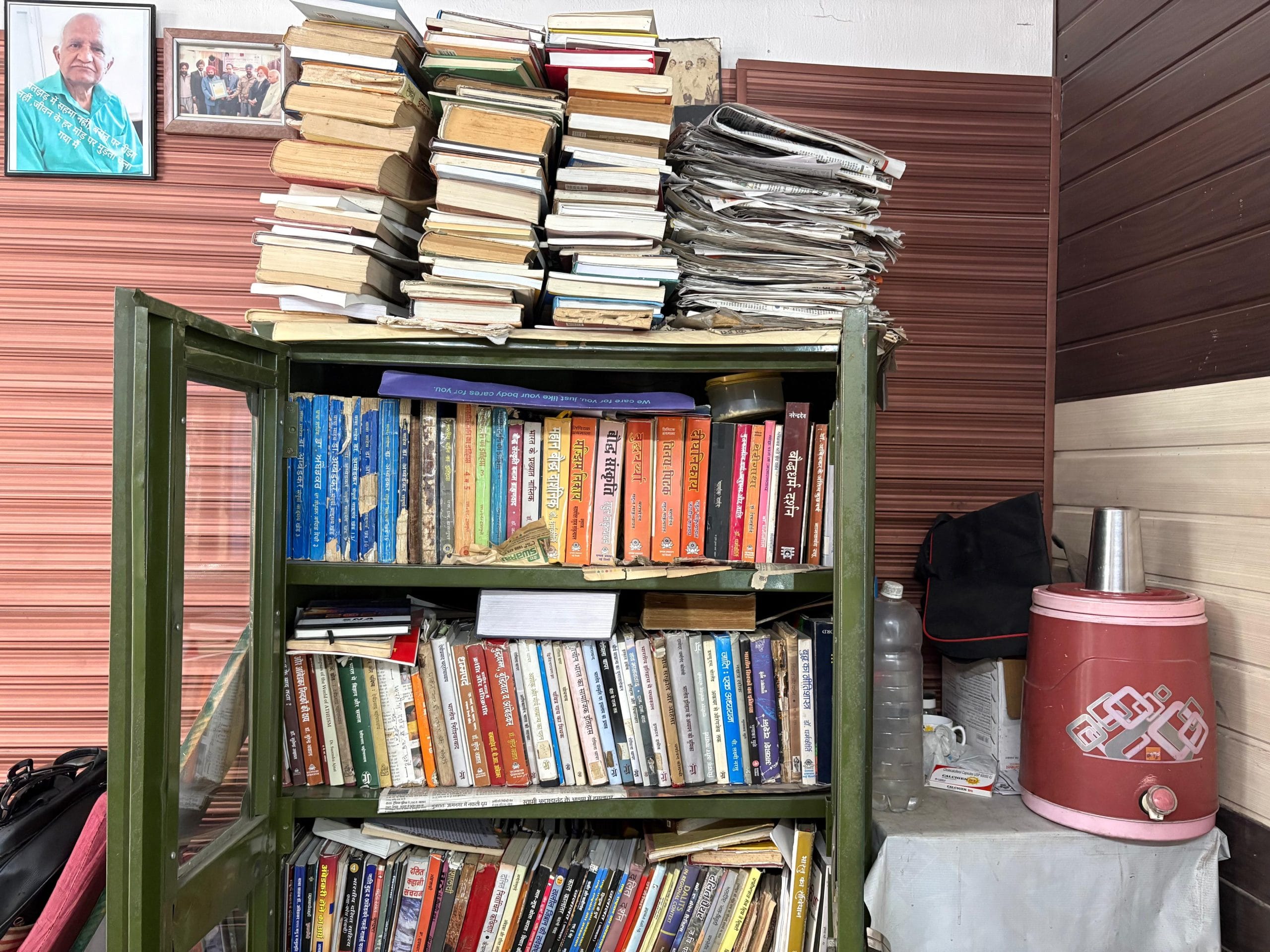
Beyond his own writings, Bharti has made significant contributions as a translator, too. He brought Omprakash Valmiki’s seminal autobiographical novel, Joothan: An Untouchable’s Life, to a Punjabi-speaking audience.
Alongside this translation, his own books—Dalit Darshan, Hindutva ke Durg, and Mashaalchi—have established him as a fearless voice.
Bharti writes mostly essays, which he carefully researches and develops on his own through extensive reading. One of his books, Rashtra, Rashtravad aur Ambedkarvaad, includes thought-provoking essays—“Is RSS Necessary?”, “Dalits in the Constitution,” “Ambedkar and Politics,” “Seven Years of Hindutva Violence,” and “Buddhism,” among others.
Apart from reading, writing, and shoe-making, he enjoys watching films. He recently watched Dhurandar and described it as a film that viewers should think deeply about, especially the politics behind it. He said that it was quite long—so much so that he had to watch it in three sittings.
He generally prefers South Indian cinema. One of his favourite actors is Vijay Sethupathi, whose acting he really admires.
Also read: ‘Krishna played cricket first’— Sanatan Premier League gives the game a Hindu makeover
The humiliation
Bharti remembered the day vividly. After an exam, his mathematics teacher called him out in front of the class. The teacher threw Bharti’s answer sheet onto the desk and asked about his father’s profession.
But he could not utter a single word. A classmate answered for him instead, ‘Sir, he makes shoes. He is a cobbler.’”
What happened after that was humiliating.
The teacher grabbed Bharti by the hair and pulled hard. But Bharti had oil in his hair that day, and the teacher’s grip slipped. Irritated, he wiped his oily hands on Bharti’s white shirt. “How much oil have you applied…Get lost! Go make shoes with your father. What will you do by studying?” he said, using a caste slur.
When Bharti looked into the teacher’s eyes, he saw a ‘lava of hatred’—not just directed at him, but at the community he belonged to. When he looked around the classroom, every student was staring at him.
“He had poured all that centuries-old hatred onto my innocent being in one go. The whole class was looking at me as if I was an intruder- for the first time,” he wrote in his memoir.
For a 77-year-old man, he is an atheist and a feminist who lives by Ambedkarite thought. He is a thinker who views marriage as an institution that often curtails a woman’s freedom.
“I feel a woman should question everything—or even be an atheist—rather than follow a religion blindly,” he said.
He had adopted a daughter, now 25, who works in Dubai. When she told him she didn’t want to marry, he never objected.
Yet Bharti is also self-aware about his own flaws. “I didn’t treat my wife well in the past; I caused her a lot of trouble. But reading feminist authors changed my perspective,” he admitted. “It doesn’t mean I don’t get angry now—I do—but I’ve learned to control it, not let it out.”
He recalled a moment while travelling on a bus when someone asked what he did.
“I told them I owned a shop,” he said. “Then they asked what kind of shop, and I said I sell shoes. It’s still a little difficult to admit that I’m a cobbler because people immediately look down on this profession.”
His respect for individuality naturally extends to how he views the nation and its politics. He calls himself an Indian, someone who loves his country, but he does not identify as a nationalist.
For Bharti, nationalism is a limiting label that enforces uniformity and leaves little room for new ideas or differences. This view is similar to Rabindranath Tagore’s, who in his 1917 book Nationalism described it as a force that stifles individuality and cultural diversity, putting state uniformity above human creativity.
He is in the leg of his life, yet when he speaks, his words carry the fire of a twenty-year-old revolutionary. His age shows clearly when he chews a roti—his eyes droop, his mouth puckers, and his face seems to shrink with every bite.
“I will write until the end of my life. The words must sting, must provoke, because only when they prick will anyone start thinking about a world without caste, where equality matters more than gender or social divisions,” he said.
(Edited by Anurag Chaubey)