





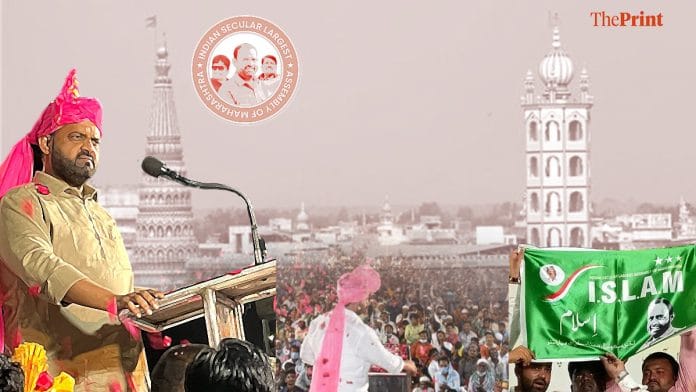



Mumbai: When former Congress MLA Asif Shaikh announced the formation of a new political party in Malegaon in October 2024, few expected it to alter the city’s political balance so quickly.
The party’s name—the Indian Secular Largest Assembly of Maharashtra, abbreviated as ISLAM—triggered immediate controversy, with critics dismissing it as deliberately provocative and politically unserious.
But earlier this month, the ISLAM party shrugged off this criticism as it emerged as the single largest party in the 15 January Malegaon Municipal Corporation election, having won 35 of the 84 seats in the corporation.
Branding itself as a secular alternative to Malegaon’s identity politics, it also came close to forming the city’s civic body in alliance with the Samajwadi Party, which secured five seats, taking the alliance to a total of 40, just three short of a clear majority.
For Shaikh, the decision to launch ISLAM was the culmination of years of political disillusionment and grassroots work in a city where Muslim voters form an overwhelming majority, but have long remained divided between national parties, regional formations and identity-driven politics.
“My family has been in politics for 40 years and majorly associated with the Congress. When we started the ISLAM party in 2024, I had over a thousand people working with me and supporting me,” Shaikh told ThePrint.
“But 90 percent of our party workers are our own base, and we continue this base. We have not brought people from somewhere else. They have not defected from elsewhere. I picked up local people. Only a few who were not happy where they were joined us by themselves,” he added.
As a new party, ISLAM tested political waters when it contested the the 2024 Assembly election from Malegaon Central. Shaikh said the party lost by merely 162 seats and got about 1,10,000 votes, “a major win at the time”.
Following its loss to the All India Majlis-e-Ittehadul Muslimeen (AIMIM) in this election, the ISLAM party focused on three main issues while campaigning for the municipal election: AIMIM’s inability to work for its people, the SIR (electoral roll revision) row that is likely to affect Muslims in Malegaon and overall development of the city, Shaikh said.
The alliance between ISLAM and the Samajwadi Party, called the Malegaon Secular Front, contested 65 seats. Of these, ISLAM party contested from 46 seats and the Samajwadi Party, 19.
“This was the foundation that later turned into the Malegaon Secular Front alliance for this election. People started believing that if we give the corporation to these people, then these issues on allegations of over 1,000 illegal Bangladeshi Rohingyas will be solved,” said the Samajwadi Party’s Malegaon President Mustaqueem Dignity.
For Shaikh, the Malegaon Municipal Corporation election was critical in establishing credibility beyond party lines.
“We lost the Assembly elections with merely 162 votes, which means that the people had already begun accepting us. What changed between then and now is the work that we did for the people who were subject to constant scrutiny,” Shaikh told ThePrint.
Shaikh pitched the ISLAM party as an alternative to the AIMIM in the municipal elections.
“AIMIM’s incompetence in the year since it won the constituency from Malegaon Central in 2024, a new Special Intensive Revision that is going to affect the Muslim minorities in Malegaon and the development of the city. This was our key focus,” said Shaikh.
Maharashtra Pradesh Congress Committee General Secretary Dhanajay Shinde argued that electoral success built on religious appeal ultimately failed to address the city’s most pressing concerns.
“The problems of Malegaon are poverty, food, clothing and housing. These are the real issues. Religious politics cannot give answers to these basic needs. Now, MIM is expected to support them,” he told ThePrint.
“Just like extremist Hindu politics, extremist Muslim politics also works through religious polarisation. That kind of politics creates divisions, not solutions,” he said.
Responding to criticism that the ISLAM party represents religious politics, Shaikh said, “The media is saying that we are a Muslim party, a casteist Islamic party. It’s not like that. Yes, we have a religious belief, but we are standing with a completely secular party ideology. It’s in our full name too.”
For political analyst Abhay Deshpande, the rise of ISLAM party “is a temporary phenomenon”.
Speaking to ThePrint, he said, “It does not look like this party will be here to stay. It might fizzle out. In Malegaon, given the demographics, there will be different faces and different parties. Not only the ISLAM party or MIM or the same party will dominate. Different permutations and combinations will keep emerging, driven by the interests of local leaders.”
He added, “If you look at history, some years back the Samajwadi Party had a similar rise in Maharashtra. But after that, it couldn’t survive. It tried to do politics beyond being a Muslim party, like in Uttar Pradesh, but it didn’t work out.”
On the Congress party losing its traditional voter base, Deshpande said, “Basically, because of majoritarian politics, even Congress at times tried to become a Hinduist party. Because of that, Muslims sometimes get the feeling that they are left out. They feel that parties are not openly supporting Muslims or are avoiding them. These are the consequences of majoritarian politics. Because of that feeling of being left out, they try to capitalise on it, or other parties come forward.”
Also Read: ‘Unreachable’ corporators, unusual alliances—how parties are scrambling to control urban Maharashtra
Malegaon’s fraught history
Malegaon’s political choices are inseparable from its demographic and communal history. According to the 2011 Census, Muslims constitute nearly 79 percent of the city’s population.
The city is physically divided by the Mausam river, with most Muslim neighbourhoods concentrated on the eastern bank and Hindu areas on the western side.
This spatial and social divide deepened after the 2006 and 2008 bomb blasts, which killed over 40 people and resulted in years of contested investigations. For the September 2006 blast, the Maharashtra Anti-Terrorism Squad (ATS) arrested nine Muslim men, charging them under the Maharashtra Control of Organised Crime Act (MCOCA).
In 2016, a special MCOCA court discharged all nine, citing a lack of evidence and serious procedural lapses by the prosecution. In 2017, after the National Investigation Agency (NIA) reviewed the case, it filed a chargesheet naming alleged Hindutva extremists in connection with the 2006 blasts.
For the September 2008 blast, an investigation led by then ATS chief Hemant Karkare pointed to the involvement of Hindu extremist groups. The ATS arrested Sadhvi Pragya Singh Thakur, Lt Col Prasad Shrikant Purohit, and five others for being key facilitators. Both Thakur and Purohit were granted bail later.
The NIA took over the case in 2011, dropped the MCOCA charges, but retained terror-related charges under the Unlawful Activities (Prevention) Act and the Arms Act. On 31 July 2025, a special NIA court in Mumbai acquitted all seven accused, citing the absence of reliable evidence to prove the case beyond a reasonable doubt.
The cumulative impact of these episodes left behind a politics marked by mistrust of institutions, identity consolidation and an enduring demand for representation that could protect civil rights while navigating the state machinery.
ISLAM’s pitch, according to Shaikh, was shaped by this reality. “It was less about symbolic assertion and more about everyday governance and especially about legal security against untoward assertions made on the people of Malegaon,” he said.
Breaking away
The Malegaon Central Assembly constituency is among the few in Maharashtra to have consistently elected Muslim MLAs since Independence. For decades, its politics revolved around two families–socialist leader Nihal Ahmed and Congress stalwart Rasheed Shaikh.
Shaikh was a two-time MLA from Malegaon Central with a Congress ticket, elected first in 1999 and again in 2004. He was instrumental in breaking the five-term streak of late Janata Dal leader Nihal Ahmed. Shaikh’s wife, Tahira, of the Congress party, became the first female mayor of Malegaon city in June 2012. In the 2017 municipal elections, Rasheed Shaikh was elected mayor of the city, succeeding his wife.
Asif, the couple’s son, became the MLA from Malegaon Central with a Congress ticket in 2014 but was defeated by AIMIM’s Mohammed Ismail Abdul Khaliq in 2019.
In 2021, he left the Congress and joined the undivided Nationalist Congress Party (NCP). He also became the NCP’s Malegaon unit president, but ahead of the 2024 Assembly elections, severed ties with the party and decided to contest elections independently.
“The leadership of the Congress party in Maharashtra completely weakened. The problems we have, the questions we have, because our leadership weakened, our development work, and the issues of our minority were not being resolved. Because of this, I resigned from the party,” Shaikh told ThePrint.
“After that, we joined the NCP, Sharad Pawar sahib. But when the two NCPs split, we made our own separate path,” he added.
Shaikh formed the ISLAM party right before the Maharashtra Assembly elections in 2024 and announced a plan to contest the polls against the Samajwadi Party’s candidate Shan-E-Hind, daughter of the late five-time MLA Nihal Ahmed.
At the time, the constituency was represented by the AIMIM’s Mufti Ismail, a cleric-turned-politician who gained prominence after the 2006 Malegaon bomb blasts.
Birth of ISLAM
On 2 January 2025, BJP Maharashtra Vice-President and MP Kirit Somaiya alleged that thousands of residents in Malegaon had fraudulently obtained birth certificates and were Bangladeshi Rohingya.
The allegations were followed by a Special Investigation Team (SIT) ordered by Chief Minister Devendra Fadnavis on 8 January 2025, triggering widespread fear among residents as thousands were called in for verification.
On 26 January 2025, Shaikh and the Malegaon President of the Samajwadi Party, Mustaqueem Dignity, formed the Minority Defence Committee (MDC), along with the Communist Party of India (CPI) and Rashtriya Janata Dal (RJD), to provide legal and administrative support to those facing enquiries.
“They (SIT) started an inquiry into those 3,411 people who were born in Malegaon. Along with that, the police, the IG department, the district SP, a huge team was set up for the investigation. We did not get anything else. So, we formed a committee and started working together,” said Mustaqueem.
“We did the legal work that they needed. We did the practical work in the inquiries,” he added.
Malegaon Central is the only seat held by the AIMIM in the Maharashtra Assembly. Shaikh hinted that this was a reason for the government targeting Malegaon.
“I think the allegations came in and the SIT was formed to counter the MIM that won the constituency here in 2024, and I don’t think they would be able to fight it,” Mustaqeem said.
Shaikh said that while the alliance formed the Minority Defence Committee, “AIMIM did not prove to be effective in protecting the locals, and the people observed this”.
“Projecting the group as a problem-solving collective rather than a protest platform, with ward-level discussions and programmes, was essential,” he added.
He argued that while AIMIM consolidated Muslim anger and visibility, it failed to translate that into municipal governance. “People wanted a party that could negotiate, administer and protect,” he said.
Post-poll alignments
With no party securing a majority in the Malegaon corporation election, post-poll political alignments remain fluid.
The results marked a sharp decline for traditional parties. Malegaon, located in Maharashtra’s Nashik district and once considered a Congress stronghold, saw the party reduced to just three seats. And the Bharatiya Janata Party (BJP), which has dominated civic bodies across much of the state, managed to win only two seats in the city.
The Asaduddin Owaisi-led AIMIM finished second, with 26 seats, underscoring the consolidation of Muslim votes in the city. Eknath Shinde’s Shiv Sena came in third, winning 18 seats under the leadership of local MLA Dadaji Bhuse.
On a possible alliance with AIMIM, Mustaqueem said, “We have told MIM that they can come with us without any conditions. Because the mayor is with us. It has been a long time since the last election. But they have not replied yet.”
“If the MIM, Shinde Sena, Congress and BJP come together, they will get 44 seats. If that happens, we are ready to sit directly in the opposition. This is a big victory for us,” he added.
But AIMIM MLA (Malegaon Central) Mufti Ismail told ThePrint that after AIMIM Maharashtra President Imtiaz Jaleel’s visit to Malegaon on 22 January, the party has received instructions to begin talks with the Secular Front to support them.
“Maharashtra Pradesh Head, Imtiaz Jalil sahib came and there were other party people with him. They said, ‘OK, talk to them.’ We have not spoken to them yet. But we have got permission from the leadership to talk to them,” Mufti Ismail said.
Maharashtra Pradesh Congress Committee General Secretary Dhanajay Shinde ruled out any post-poll understanding with the ISLAM party.
“The Congress has won a few (three) seats in Malegaon, but there is no inclination to form any alliance with this party. Politics based on religious discrimination cannot be acceptable to us. If they believe in our way of thinking, our ideology and our style of politics, then such decisions are taken by the leadership. But alliances cannot be based only on convenience,” Shinde told ThePrint.
“The real question is how they will govern Malegaon. Winning an election is one thing, but governing responsibly is another,” he added.
But Malegaon Congress party president Ejaz Baig claimed the party was now ready to support the Malegaon Secular Front to help them ryb the municipal body. Its support would take their total to 43.
“We have decided to back them. The mayor will be theirs and we will discuss any role we have to play out of the rest of the positions,” Baig told ThePrint.
Move beyond Malegaon?
For now, ISLAM’s leadership remains focused on consolidating power in the city rather than working on immediate expansion plans.
“The focus is currently on Malegaon, which will remain the party’s political centre,” the party chief said.
But Shaikh is also “thinking of expanding the party in Maharashtra”.
“There are different districts of Maharashtra. There is Mumbai, Bhiwandi, Nanded, Amravati, Aurangabad, Sholapur, Kolhapur, and Dhule. We have decided that we will work on this after the mayor elections,” he said.
Whether ISLAM is a flash in the pan or a permanent fixture of the politics of communally-sensitive Malegaon remains to be seen. But its rise has already altered the grammar of politics in the city.
This is an updated version of the report
(Edited by Sugita Katyal)
Also Read: Fading in the city it was born, Congress slips to its lowest total in Mumbai’s BMC polls
On the one hand they claim to be a secular party on the other and put the party name as ISLAM. I do not wonder the origin of it. Like congress backed front say INDIA. I remember the slogan of D K Baruah INDIA is Indira and INDIRA is india