





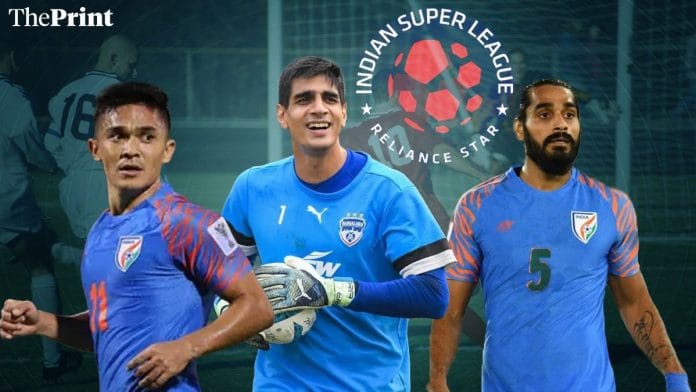



New Delhi: A day after football stars Sunil Chhetri, Gurpreet Singh Sandhu, and Sandesh Jhingan released a video urging FIFA to intervene to ensure that the delayed Indian Super League was held, the All India Football Federation (AIFF) on Saturday declared the 2025–26 ISL season.
Sports Minister Mansukh Mandaviya, later on Tuesday night, said that the ISL, featuring all 14 clubs, will start on 14 February. Also stuck till now, the I-League will be held “around the same time”, with all 11 clubs participating, he added.
The ISL was on pause because the AIFF failed to secure a commercial partner after the December 2025 collapse of its ‘Master Rights Agreement’ with Football Sports Development Ltd (FSDL).
In the now-viral video that has escalated the ISL 2025–26 announcements, Chhetri is heard saying, “Players, staff, owners, and the fans deserve clarity, protection, and, more importantly, a future.” Other players point out how Indian football governing bodies no longer fulfil their responsibilities, warning that the sport faces “permanent paralysis”.
“We just want to play football, please help us do it,” the players plead in the video.
The ISL and I-League announcements since then cannot, however, fully whitewash Indian football’s poor state of affairs and deterioration over recent years. The national team’s performance has suffered as a result. The last competitive match it won was in November 2023 against the Maldives. A winless 2024 season has followed.
Meanwhile, the AIFF has appeared paralysed.
Speaking to ThePrint, Indian national football team captain Gurpreet Singh says that the biggest problem for Indian football players is not getting opportunities to play the sport they love competitively. “We are professional footballers, and because of the current situation, we are not being able to do what we train for and dream of doing,” he says.
Captain Singh says Indian football players are now facing “uncertainty over their future” since their lives and their families depend on their chances of playing football professionally. “Many of us don’t have any other training or skills, so it is very unsettling,” Singh says.
He notes that players can only develop and progress in any sport if they compete against others. He fears the team will fall behind “while we wait around to find out when we can get back to the pitch,” and that the team will go on to fail in intense tournaments against other nations.
The collapse of the AIFF’s 15-year commercial agreement with FSDL, which governed the funding and operations of the ISL, has dealt a major blow to Indian football. The fallout has been compounded by long-standing power struggles between the ISL and the I-League—two competitions that have operated under fragmented and often competing administrative structures.
With the AIFF failing to finalise fresh commercial tenders, and simultaneously attempting to realign its constitution under the Supreme Court’s supervision, the sport finds itself caught in a perfect storm. The resulting administrative paralysis has stalled decision-making, disrupted league operations, and slowed the broader growth of football in India.
Meanwhile, the allocation of funds to promote the sport highlights a troubling imbalance. While football icon Lionel Messi’s ‘GOAT India Tour 2025’ reportedly involved an investment of Rs 100 crore, domestic players are left grappling with a shrinking competitive calendar and limited opportunities to play at elite levels. This underscores a deeper structural problem: Indian football prioritises spectacle and short-term visibility over sustainable investment in its own leagues, players, and development.
At an all-time low
Many believe that the appointment of politician Kalyan Chaubey as AIFF president is at the heart of the federation’s problems.
Notably, Chaubey contested the 2022 AIFF elections against veteran Indian footballer Bhaichung Bhutia, winning 33 votes to one.
Chaubey’s tenure has been marked by instability, with three coaches and three general secretaries replaced over the past three years. Club football has come to a standstill, and Chaubey has also been unable to secure a marketing partner.
“Indian football is at its all-time low. Things cannot get worse than this. Bhutia is still a legend. I say even a common man, having little knowledge of football, would do a better job than Chaubey. He is a complete disaster,” Jaydeep Basu, who has served as a media director at AIFF for three years before resigning in March 2025, tells ThePrint.
He doesn’t sympathise with the players either and calls the viral video a “social media stunt”. According to him, the players know that FIFA will not take into account just any viral video.
“They could have written directly to FIFA, given the high-profile names of Indian football involved. The governing body would certainly have taken note, and then FIFA would have reached out to the AIFF, compelling the federation to respond. That approach would have been far more effective and impactful than taking to social media.”
The footballers in the video are heard saying that the clip wasn’t political but instead their last-ditch effort to save Indian football. In most football-playing countries, this situation would make players seek opportunities elsewhere. In India, though, players are waiting for answers and administrative support that may never arrive.
Basu acknowledges the shortcomings of the federation but also highlights that the players, unfortunately, haven’t been able to prove themselves in the international arena and have failed repeatedly to prove their worth in the national colours.
He cites the example of Indian cricket’s turning point following the 1983 World Cup victory. Recalling that the Board of Control for Cricket in India (BCCI) didn’t even have money to felicitate the team, he notes that the win attracted money. “Since then, Indian cricket and the BCCI have never looked back,” Basu adds.
“You can’t simply sit back without putting in the work on the ground. We are aware that facilities are lacking, but if you truly love the sport, you must learn to create opportunities, even in difficult circumstances,” Basu says. “Only performances and victories can attract funding.”
FIFA’s warnings
Former Indian footballer Bhaichung Bhutia is having the ultimate “I told you so” moment now. Bhutia recalls warning everyone that the federation was going into the wrong hands before the AIFF elections. However, no one paid him any attention.
At this point, Chaubey’s report card isn’t just good or bad—it’s stuck between poor, very poor, and even worse.
Last year in August, FIFA threatened to suspend the AIFF altogether. This was because it had failed for years to finalise a constitution aligning with global football statutes, creating a “governance and operational crisis” that left domestic competitions and commercial partnerships in limbo.
Many eyebrows were raised when the Indian men’s national football team saw significant coaching changes in quick succession over the last few years. Igor Štimac was the head coach until mid-2024, followed by Manolo Márquez from mid-2024 to mid-2025, and now Khalid Jamil, who started in mid-2025.
“No experience, no commitment, and no leadership quality are the key words to describe the current times. And performance on the field has only backed this narrative,” Bhutia tells ThePrint.
How the federation went to Chaubey is also interesting. He succeeded Praful Patel, who, Basu agrees, was “good but not a benchmark”. After his elected term as AIFF chief ended in December 2020, Patel remained in office without conducting fresh elections. Despite clear constitutional limits on the chief’s tenure, the AIFF failed to kickstart a new electoral process. This situation allowed Patel and his executive committee to continue for nearly two more years, while this prolonged extension was widely criticised within Indian football circles.
The matter eventually reached the Supreme Court, which intervened in May 2022. The court removed Patel and his committee with immediate effect.
“It took away his credit and also gave him a reputation for not being democratic,” Basu says.
A Committee of Administrators (CoA) was thereafter appointed to manage the AIFF, reform its constitution, and oversee long-pending elections. This episode led to significant disruption, including a temporary suspension of the AIFF by FIFA over third-party interference, and it was lifted only after the electoral process was restored.
Elections were finally held in September 2022 under the supervision of the CoA. Chaubey contested the presidency and won, marking a leadership change after more than a decade.
Poor domestic structure
Apart from Chaubey’s governance, both Bhutia and Basu agree that Indian football is deeply unstructured, mismanaged, and out of sync, with grassroots development languishing as a result.
The rift between the AIFF and the state football associations has also become more public and hostile. More than 20 state associations recently prepared no-confidence motions against AIFF president Chaubey, accusing the federation of ethical breaches and poor decision-making.
While the AIFF occasionally touts long-term plans such as ‘Vision 2047’, critics argue that these are distant goals, lacking any present-day structure to support young players, coaches, or clubs.
An AIFF press release stating, “We dream of reviving the glory days of Indian football,” has remained just that—a dream. The grassroots system, meanwhile, has suffered from fragmented efforts, unreliable funding, and a lack of strategic foresight.
Bhutia explains that the state associations do not align with the AIFF because they are independent bodies run by politicians, bureaucrats, or businessmen. “Ninety percent don’t have any budget or ground to develop the sport or train athletes. Their priorities are personal—filling their own pockets,” Bhutia adds.
The consequences are visible at every level. The national team has hovered in the lower section of the FIFA rankings. Talents from youth tiers struggle to transition to senior football. Clubs operate in uncertainty. Genuine grassroots initiatives struggle to secure resources or support.
“The nurturing of talent at the grassroots level can change the face of Indian football, but who will do it?” Basu asks.
(Edited by Madhurita Goswami)
Also Read: ‘I met Messi’ was the headline of the GOAT tour. Football and fans were ignored