





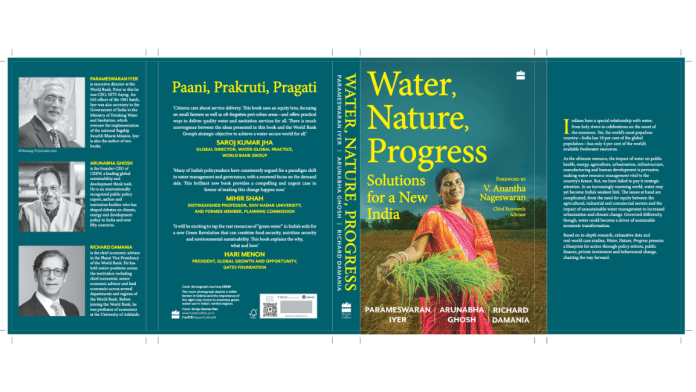



New Delhi: ‘Water, Nature, Progress: Solutions for a New India’ argues that water is India’s most precious but most mismanaged resource: it sustains farms, cities, industry and public health, yet the country faces scarcity, flooding, pollution and rising climate risk at the same time. The book says India’s challenge is not just too little water, but also too much, too polluted and too poorly stored, with demand rising while supply remains fixed by nature. It frames water as a macroeconomic issue, not merely an environmental one.
A central theme is that India’s past success in food production came at a cost. The Green Revolution secured food security through irrigated rice and wheat, but it also encouraged water- and energy-intensive farming, groundwater depletion, soil degradation and poorer nutrition. The book argues that India now needs a different agricultural model, one that values soil moisture, rainfed खेती, green water and more water-efficient crops such as millets and pulses.
The book widens the lens beyond agriculture to cities, wastewater, forests and governance. It calls for integrated water management that cuts across silos, with better pricing, financing, regulation and behavioural change. Its practical solutions include sponge cities, circular water use, peri-urban infrastructure, protection of forests and soils, and treating water as an economic asset that can drive resilience and growth rather than a free good to be depleted.
The book is authored by Parameswaran Iyer, Arunabha Ghosh and Richard Damania and will be launched online on Softcover. Their joint framing brings together policy, economics and sustainability, and the text presents their argument as a roadmap for making water central to India’s development strategy.
Also Read: New book traces life of Maya, tigress that became a national icon