





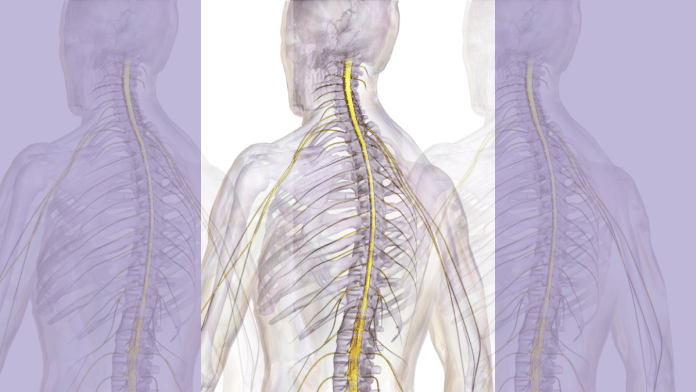



New Delhi: Researchers at the Cedars-Sinai Medical Centre in Los Angeles have identified a previously unknown repair mechanism in the spinal cord that could transform treatment for spinal injuries, strokes and neurological diseases, such as multiple sclerosis.
The discovery, published in the journal Nature on 17 December, centres on astrocytes—support cells in the brain and spinal cord—that actively drive tissue repair even when located far from the site of injury.
These “lesion-remote astrocytes” release a protein called CCN1 that signals immune cells to efficiently clear debris left behind by damaged nerve fibres, according to findings from mouse models. Without this crucial signal, inflammation spreads and recovery is significantly impaired.
Importantly, researchers found evidence of this mechanism in humans with spinal cord injury and multiple sclerosis tissue samples, highlighting astrocytes as an underappreciated target for therapies.
Also Read: Humans were ‘lit’ long before we thought & dark chocolate a day keeps ageing away
Renewable energy surpasses coal globally
The journal Science has named the worldwide growth of renewable energy as its ‘Breakthrough of the Year’, marking a historic turning point in global energy production.
For the first time since the Industrial Revolution, solar and wind energy generation exceeded fossil fuel-powered generation in 2025, after centuries of reliance mostly on coal and oil whose climate implications are well documented.
China led this transformation, scaling up solar panels, wind turbines and lithium battery storage to become a global clean-energy powerhouse. Its manufacturing dominance has lowered costs and enabled rooftop solar access across Europe, South Asia and other regions.
Existing renewables are already slowing emissions growth in China, signalling another potential turning point. Despite obstacles such as oil dependence and political resistance to renewables, the transition to clean energy is accelerating and increasingly unavoidable.
Another reason to exercise
Tiny particles in the blood called extracellular vesicles (EVs) help hormones travel through the body and reach the brain, with physical exercise significantly enhancing this process, according to new research.
A paper published in the journal Proceedings of the National Academy of Sciences (PNAS) on 16 December explains how these cell-free particles enable communication between cells by ferrying molecular cargo such as proteins, fats and genetic material, while also helping remove cellular waste.
Although EVs are abundant in blood and other body fluids, and are known to be involved in processes ranging from immunity to cancer, their relationship with hormones has remained poorly understood until now.
The study revealed that intense physical activity increases the amount of a particular hormone carried by EVs fourfold. Though further research is needed to understand its effects in the brain, the findings suggest EVs act as temporary hormone shuttles during exercise, with implications for energy balance, mental health, immune function, drug delivery, pain, metabolism, inflammation and stress.
Ancient vase traces suggest opium was common
Chemical traces found inside a 2,500-year-old alabaster vase suggest opium was widely used in ancient Egypt, potentially solving a long-standing mystery about the contents of jars found in Tutankhamun’s tomb.
Yale University researchers studying the preserved vase from the Yale Peabody Museum revealed clear biomarkers of opiates, including morphine and noscapine—the strongest evidence yet that opium was not a rare or accidental substance but part of everyday life in ancient Egypt, according to a paper in the Journal of Eastern Mediterranean Archaeology and Heritage Studies.
Crucially, the discovery raises the possibility that similar alabaster jars found in the tomb of pharaoh Tutankhamun, one of ancient Egypt’s most well-known rulers, also contained opium. King Tut’s exceptionally well-preserved tomb was amongst the first to give archaeologists insight into ancient Egyptian life, but the contents of certain alabaster jars found there remain undeciphered.
Previous analyses have shown fingerprints on the inside of these jars, indicating that the product inside was valuable enough to be looted. Rather than cosmetics or perfumes, as earlier thought, this new study raises the possibility that the jars were filled with opium.
Further testing of vessels from Tutankhamun’s tomb could shed light on how ancient societies used these psychoactive substances.
Also Read: Fever cannot break bird flu, and we may finally know what led to Indus Valley civilisation’s doom