





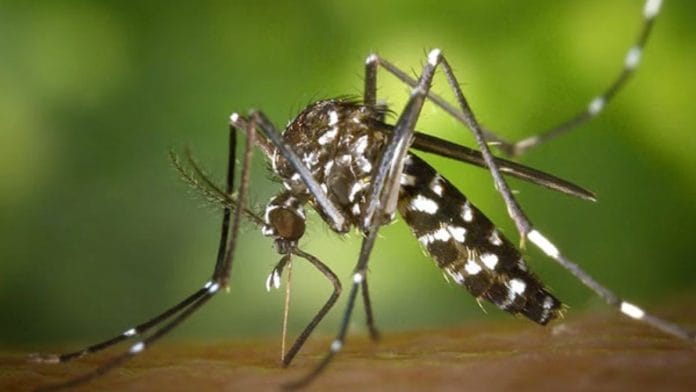



New Delhi: As forests in Brazil are disappearing at a growing rate, more and more mosquito species are getting used to human landscapes, and some now prefer human blood. A study published by Brazilian researchers in the ‘Frontiers in Ecology and Evolution’ journal on 15 January found that in the Atlantic forest, mosquitoes were feeding on humans as opposed to other animals.
The researchers set up traps along the forest, and captured over 1,700 mosquitoes from 52 species, and they were able to trace the food sources by analysing the blood carried by the female mosquitoes. Majorly, they found human blood in the mosquitoes, with a few feeding on amphibians and birds, and also mice.
The study explained that even though the Atlantic forest had a diversity of animal and bird species to feed on, over a third of the forest has been lost to deforestation. As wildlife is pushed to the fringes, mosquitoes become more accustomed to human settlements. Then, as they develop a preference for human blood, there is an increased risk of pathogen transfers of not just known deadly diseases like Zika, chikungunya and yellow fever, but also newer, more dangerous diseases from other animal species.
Young black holes
Scientists from Copenhagen may have solved one of the biggest mysteries in astronomical observation in their new paper in the Nature journal, published on 14 January. The study examines the red dots seen in images of the early universe taken by the James Webb Space Telescope (JWST). There have been many theories propounded by scientists since the JWST began functioning in 2021, including the idea that the dots are massive galaxies in their early form, powerful enough for their light to reach us across cosmic time.
But now, the new paper by scientists from the Niels Bohr Institute in Copenhagen says that the dots are actually young black holes. The black holes are rapidly growing, and they appear red because they’re surrounded by ionised gas, which they’re consuming to grow larger.
According to one of the authors of the study, in a press release, when gas falls toward a black hole, it spirals into a disk or funnel around it. As the gas accelerates and is compressed to extreme densities, it generates temperatures of millions of degrees and lights up brightly.
Also read: Scientists want to know how Brazilians live so long. Fish eggs depend on geometry for growth
Mummified cheetahs
A new study in ‘Communications Earth and Environment’, published on 15 January, talks about the chance discovery of mummified cheetahs and cheetah skeletons in Saudi Arabian caves, and how this could reignite conversations about a possible reintroduction of the species in the country. Just like in India, cheetahs went extinct in Saudi Arabia too, where they used to roam at least until a century ago.
Now, scientists from the National Centre of Wildlife in Riyadh came across seven naturally mummified cheetahs and 54 cheetah skeletal remains in some caves in the country. They used radiocarbon dating and genome sequencing to find that the remains dated as far back as 4,200 years to just over a century ago. But not all the cheetahs belonged to the same genetic subspecies.
While it was previously believed that Saudi Arabia, like India and Iran, was home only to the Asiatic cheetah subspecies, the mummies proved them wrong. There were also remains of West African cheetahs in the caves, indicating that there was a lot more genetic diversity in the Saudi Arabian cheetah population before extinction. This means, according to the scientists, that while thinking about reintroducing cheetahs to the country, they can look beyond the Asiatic cheetahs.
Racist pulse oximeters
A study by UK scientists published in The BMJ on 14 January found that fingertip pulse oximeters are less reliable on dark skin than on light skin. The study was conducted on over 900 patients across 24 National Health Service (NHS) units in the UK, using five different types of pulse oximeters.
These are machines designed to measure blood oxygen levels through fingertips, and were a common sight during the COVID-19 pandemic. The science of these machines is that they measure oxygen in the body using light; however, since dark skin absorbs more light, the machines were found to overestimate the blood oxygen level in darker skin tones.
All five machines consistently gave higher oxygen readings for darker skin tones compared to lighter ones at the same true oxygen level. On average, the readings were 0.5-1.5 per cent higher than normal levels, and this could mean that in case of actual emergencies, there is a chance that the machine could miss low blood oxygen levels in patients with a darker skin tone. The study cautioned against relying solely on these devices and advised that doctors need to take additional measures to ensure they’re getting correct readings for patients.
(Edited by Ratan Priya)