





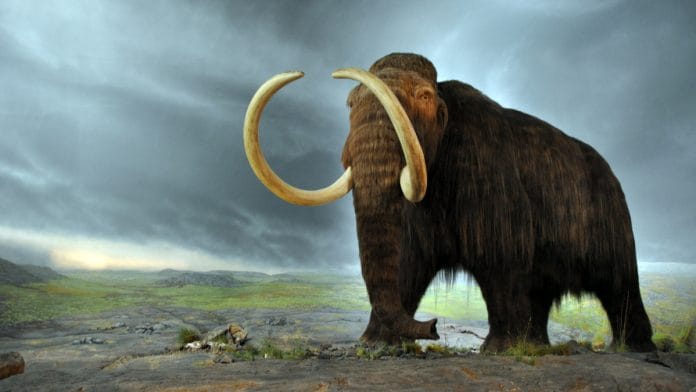



New Delhi: At the University of California, Santa Barbara, scientists have advanced a long-standing theory of what happened to the woolly mammoths, mastodons and other animals in the Ice Age—not the movie, but the real-life glacial event on Earth that occurred between 2.6 million years and 11,000 years ago. This was also the time when a range of megafauna roamed the Earth, and the Clovis prehistoric people populated North America.
However, around 13,000 years ago, most of this megafauna, as well as signs of the Clovis people, disappeared. One explanation for this extinction is that a comet struck the Earth and wiped out this era. Now, UC Santa Barbara researchers have found evidence of shocked quartz at Ice Age archaeological sites, adding to this theory. Their findings are described in a paper published in PLOS One journal.
Shocked quartz is basically sand that is altered and becomes quartz due to extreme heat and pressure, possibly from an exploding comet. In the paper, the researchers described their findings and how a comet exploding near the Earth’s atmosphere could have led to widespread fire, smoke and dust, which changed the Earth’s environment, and eventually led to the collapse of Clovis culture as well as Ice Age fauna.
Shocked quartz is the latest in a list of findings that include rare earth elements and nanodiamonds, all found near Clovis culture sites, and all indicative of a large, catastrophic event that changed this era in the Earth’s history.
Also Read: South Asians became lactose-tolerant by accident & asteroids may be gold mines of cosmic treasure
Scientists recreate human lungs on a chip using stem cells
Researchers from the Francis Crick Institute in London have managed to recreate human lungs on a chip. It is a tiny device made of plastic with real lung cells on it, and it simulates real human lung behaviour, like breathing through air sacs. In a paper published in the Science Advances journal on 1 January, the scientists described their innovation. An important quality is that this lung-on-a-chip is made entirely using stem cells from one individual, meaning it is effectively a tiny recreation of a person’s lungs.
Medical researchers can now use this chip for understanding how individual human lungs function, how disease develops, and whether drugs would work on certain bodies. By figuring out how to make a personalised lung model on a chip, the London scientists have advanced personalised drug testing to a whole new level—not to mention they’ve removed the need for animal models altogether.
This model was also tested by being infected with tuberculosis, and the scientists could see how the very early stages of the disease advanced in the model, and how the cells and TB bacteria interacted. This exposure is now possible for many other lung diseases, and will help both in diagnosis and treatment.
How moss can help solve crimes
An interesting study by US scientists in Forensic Sciences Research talks about the role that moss can play in solving crimes. You read it right! The study describes how moss and other types of bryophytes, which are extremely local plants that grow differently based on their surroundings, can serve as important indicators of crime locations.
The scientists in the paper describe a real-life case of a 2011 murder investigation, in which one of the authors helped solve a criminal case using moss. A missing body was discovered using moss fragments found on the suspect’s shoes. Scientists analysed the fragments and identified the moss. They then surveyed a broad, forested location, where the burial could have taken place, and then matched the qualities of the moss to the local habitat.
Moss is such a varied plant that different types of moss can grow even in the same forest, depending on which areas receive more water, sunlight, and nutrients. The scientists eventually narrowed down the location to 50 square feet, and it was confirmed as the burial spot.
The study concluded that there are wide varieties of moss which grow according to their specific habitat, and they can reveal information about location, timing and environmental conditions, which can aid criminal investigations.
Panama trees are growing longer roots in response to drought
The trees in Panama are responding to climate change and increased droughts with physical changes, such as growing longer roots. A new study by Colorado State University, published in the New Phytologist journal, tracked the growth of trees in a patch of the Panama rainforest over five years, where rainfall had reduced by over 70 percent.
Using soil samples and even underground cameras, the researchers found that trees began growing fine roots deeper underground to access moisture they could not find at the surface of the soil. This was a unique strategy that the scientists said was a “rescue” emergency measure by the tropical trees, but not all trees could manage to survive in this drought.
With climate change expected to drive up temperatures in the forest and bring on extreme droughts, the authors of the study cautioned that this survival strategy might still not be enough for the Panama rainforest.
(Edited by Mannat Chugh)
Also Read: Spinal cord relies on a ‘signal’ for healing and repair, and ‘EV’ shuttles in the human body