





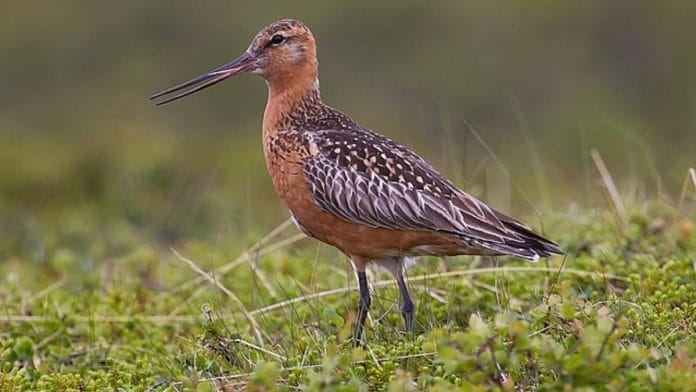



New Delhi: An inconspicuous grey-brown bird called the bar-tailed godwit holds the record for the world’s longest non-stop migratory flight. Stretching from Alaska to Australia, this wintertime flight is no ordinary feat. The bird changes its physiology to bear the harsh conditions of flying the length of the Pacific Ocean.
Every year in September and October, godwits leave the shores of Nome, Alaska to travel 12,000-13,000 km southward to their summer destinations of Australia and New Zealand. In 2022, the US Geological Survey, the Max Planck Institute, and the US Fish and Wildlife Service geotagged a juvenile bar-tailed godwit in Alaska to find out its exact migration path in the winter toward Tasmania, Australia. It set a record for the longest documented non-stop flight by any animal.
According to a 2021 paper by Dutch and American scientists, bar-tailed godwits undergo extreme physiomorphic transformations before their flights—almost like endurance athletes. By studying samples collected after the birds’ hatching and right before their migration, they discovered how godwits restructure their bodies to increase durability before the winter.
“Godwits would shrink the digestive organs used during fuel deposition and boost the size and capacity of exercise organs,” read the 2021 paper published in Frontiers in Ecology and Evolution. “This is what helps them endure the extreme migratory path.”
The birds rebuild their “metabolic machinery” upon arrival at their destination.
There are only about 8 lakh individual bar-tailed godwits left in the world, and they are classified as ‘Near Threatened’ under the IUCN’s Red List. Studies in the last few years have increased focus on the unique migration path, physiology, and stamina.
Bar-tailed godwits have also been the subject of a 2025 book by ornithologist Bruce Beehler, titled Flight of the Godwit. The book charts the migratory paths of seven North American shorebirds, including godwits, which breed on the shores of the US and Canada, and then spread across the world in search of warmer weather.
“For me, the great joy in life today is traveling across the face of North America out in nature,” said Beehler in an interview with Smithsonian. “And these birds, they do that to the max.”
Also read: Water from desert air? Nobel laureate Omar Yaghi can do it without electricity
How do godwits migrate?
The geotagging of B6, the juvenile godwit who flew from Nome to Tasmania in just 11 days, marked a breakthrough in scientists’ understanding of the birds’ migration speed and patterns. Bar-tailed godwits usually breed in the Northern Hemisphere in places such as Alaska, Scandinavia, and Northern Asia, and scientists knew that they are migratory in nature. But they were unaware of exactly when and for how long their migration flight lasted.
When returning to their northern breeding grounds from Australia in March, the birds usually rest at two or three stops on the way. The first stop is either the Chinese or Korean coasts, usually near the Yellow Sea. However, it is the journey from Alaska to Australia and New Zealand when their real stamina is visible.
Scientists have been studying this hidden stamina for almost three decades now. In a 1998 paper, scientists Theunis Piersma and Robert E Gill Jr proposed that bar-tailed godwits probably shrank their digestive system during long-haul flights since it was no use to them. Back then, there was no way to trace the actual path of these birds. Their annual flight from Alaska to New Zealand was only a ‘suspected’ theory based on their sightings in both locations, heavy fat reserves, and the lack of any viable stops in the Pacific Ocean.
The paper, which became seminal in godwit research in the future, was titled ‘Guts Don’t Fly’, indicative of the fact that digestive organs are shed before the birds migrate. In 2021, two decades after the study, scientists were finally able to inspect the insides of godwits and understand the actual physiomorphological changes.
Their efforts vindicated the 1998 study, proving that godwits’ guts don’t fly with them.
(Edited by Prasanna Bachchhav)
A great lesson for humans to keep their physical bodies in shape to too ! If not to migrate and fly away but to maximise their own living experience.
Amazing and profoundly insightful.