





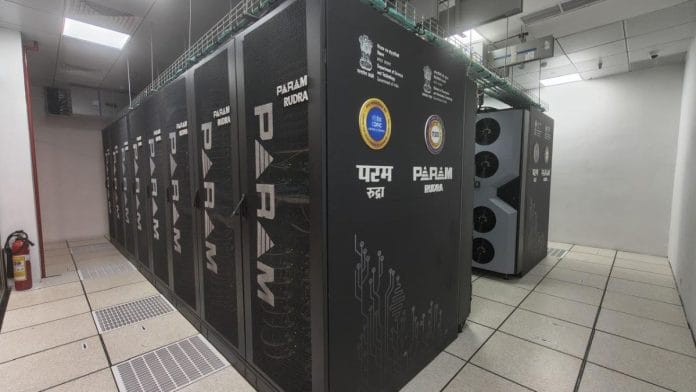



New Delhi: The computer centre in IIT Madras is now home to Param Shakti—one of the strongest indigenously built supercomputers in India’s academic institutions. It has a 3.1 petaflop capacity, meaning it is capable of performing 3.1 quadrillion calculations per second, and it is second only to the one installed in the Indian Institute of Science Bengaluru, which has a 3.3 petaflop capacity.
From cancer research to better pollution control technologies, to hypersonic vehicles designed for strategic purposes, this supercomputer, built by the Centre for Development of Advanced Computing (C-DAC), has broadened the horizons of Indian academia.
With the inauguration of PARAM Shakti on 3 January by S Krishnan, the secretary of the Ministry of Electronics and Information Technology (MeitY), the National Supercomputing Mission (NSM) also finished the first phase of supercomputer installations across the country’s institutes.
“What is unique about the PARAM Shakti is that the server — the brain of the computer — has not been imported and assembled in India, but rather it is indigenous,” G Phanikumar, Chairman, Computer Centre, IIT Madras, told ThePrint. “It was designed, developed and built entirely in India.”
The National Supercomputing Mission was launched in 2015 with the aim of building supercomputing capabilities in the country, both in terms of manufacturing and usage. While MeitY and C-DAC worked on developing indigenous supercomputer software and hardware, the NSM also planned to install 37 supercomputers across the country’s educational institutions, like IITs, NITs, IISER, and IISc for use by researchers.
PARAM Shakti in IIT Madras marked the 37th supercomputer installed, and its capacity is at par with the one in IIT Bombay and IIT Delhi. It is also the eighth in the RUDRA series of supercomputers, which are built indigenously in India and use Indian RUDRA servers and Indian software stacks in computing.
“With 37 supercomputers already installed across institutions nationwide and more in the pipeline, including the largest system planned for Bengaluru, these efforts are strengthening India’s research and innovation ecosystem,” said Krishnan in a press release.
Currently, the strongest supercomputer in the country is the PARAM Siddhi AI, which has a capacity of 5.2 petaflops and is housed in C-DAC, Pune. However, the computer is built on an NVIDIA DGX SuperPOD base, meaning it is a global design and not entirely indigenous.
But under the NSM, a 20 petaflop PARAM RUDRA supercomputer is being built in the C-DAC Bengaluru facility, which will be the largest and strongest supercomputer in the country, built entirely with indigenous capabilities.
Also read: The twist no one saw coming — comet 3I/ATLAS is older than the Sun
What is PARAM Shakti?
Supercomputers are huge, interconnected technological systems that can perform large calculations in a matter of seconds. They are extremely useful, especially in the fields of computational biology, climate modelling, astrophysics and big data analytics.
“A task that a laptop will take a year to complete can be finished within 2 hours in a supercomputer,” explained Phanikumar. “And it has 4,500 times the storage capacity of a laptop. Just imagine the scale of these computers!”
However, supercomputers are also made of multiple different components, including graphic processing units (GPUs), storage systems, servers, and operating systems — all of which have different global supply chains, and are produced in different parts of the world. This is the reason the NSM was launched to increase India’s indigenous capacity to design and manufacture supercomputers, instead of being open to global supply chain risks.
While inaugurating the first of the PARAM RUDRA supercomputers in September 2024, PM Modi too emphasised that the ability to build our own supercomputers is a matter of national credibility.
“With Param Rudra Supercomputers …. India takes a significant step towards self-reliance in computing,” he said in a video conference address. “In this era of digital revolution, computing capacity is becoming synonymous with national capability.”
Apart from the existing 37 supercomputers installed across India, there are three more systems being built right now — a 20 petaflop supercomputer in C-DAC Bengaluru, a 6 petaflop supercomputer in IIT Delhi, and an 838 teraflop supercomputer at IIT Jammu. They are all expected to be built on indigenous RUDRA servers and will further enhance India’s supercomputing capabilities.
(Edited by Saptak Datta)