





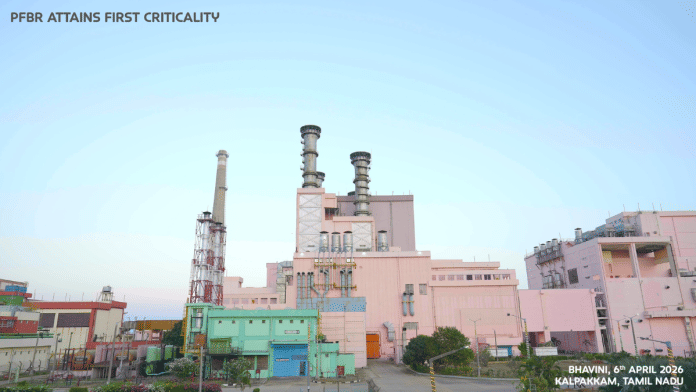



New Delhi: With India’s Prototype Fast Breeder Reactor in Tamil Nadu’s Kalpakkam attaining criticality on 6 April, the country has made a significant advancement in its three-stage nuclear programme. India is now only a step away from harnessing its vast thorium reserves, which has been the ultimate goal of the programme.
“With the achievement of criticality, India moves closer to realising the full potential of its three-stage nuclear power programme. We still need to scale up and bring the reactor to full capacity, but the tough job is done,” a senior official from the Centre’s Department of Atomic Energy told ThePrint on the condition of anonymity.
Thorirum is a weakly radioactive, silvery-white metal, which yields as a promising, highly abundant nuclear fuel alternative to uranium. India holds approximately 25 per cent of the world’s thorium reserves, primarily in Kerala and Odisha.
The PFBR, India’s first indigenously developed 500 MWe fast-breeder nuclear reactor, serves as a vital bridge between the operational fleet of pressurised heavy-water reactors (PHWRs) and the future thorium-based reactors. This will go on to leverage India’s abundant thorium reserves for long-term energy generation.
Top nuclear scientist and former chairperson of the Atomic Energy Commission Anil Kakodkar told ThePrint that after attaining criticality, there will be a few more tests needed for the PFBR, after which the reactor will be powered up and connected to a grid. This process will likely take a few months. However, after this, atomic energy agencies will also be experimenting with other technologies such as the fast-breeder reactor with metallic fuel as opposed to the mixed oxide fuel used in PFBR.
“It will be unfair to tie the programme to a timeline now. This is the begining of the second phase and there will be many different technologies that will come from it,” Kakodkar told ThePrint.
While experts globally applauded the feat, some also expressed skepticism. Many said that Thorium is many years away from entering the programme. India will need to produce enough Uranium-233–a Uranium isotope–before Thorium can be mixed with it in next-generation reactors.
Officials from DAE, however, are more hopeful.
“The government’s focus is centred on Thorium. It is not essential that the second phase needs to be completed before the third phase can come in with Thorium. At some stage, we will be able to run both phases simultaneously. We are also experimenting with global technologies, which will allow a faster introduction to Thorium,” an official said on the condition of anonymity.
ThePrint explains India’s three-stage nuclear programme, conceived by nuclear scientist and the father of India’s nuclear programme, Homi J Bhabha, to ultimately enable the reactors to run on thorium.
Stage one
During the first stage of the nuclear programme, India set up nearly 22 PHWRs between the late 1960s and the early 2000s. This includes the Rawatbhata Atomic Power Station, the Tarapur Atomic Power Station, Kaiga and the Kakrapar station.
Since this is the initial stage of the programme, the reactor uses natural uranium.
Uranium is a naturally occurring element, which primarily has three radioactive isotopes — U-238, U-235 and U-234. U238 is the most abundant isotope, but it is not fissile. It, however, absorbs neutrons and converts into plutonium-239 (Pu-239).
U235 is the only naturally fissile uranium isotope.
In the reactor, natural uranium is used as fuel and combined with heavy water — deuterium oxide (D2O), which is used as a coolant. The plutonium produced during this stage becomes the fuel in the second stage.
Also Read: PFBR’s criticality milestone at Kalpakkam makes India a firm contender in the global nuclear race
Second stage
Monday’s achievement marks the attainment of criticality in this stage. A nuclear reactor attaining criticality means it can sustain a controlled fission chain reaction, producing a constant power output.
PFBR is also an advanced reactor, capable of producing more fuel than it consumes.
This reactor uses a mixed oxide of plutonium, produced during the first stage, and uranium. This is called the Mixed Oxide Fuel (MOX).
Surrounding the reactor’s core is a blanket of U238. Liquid sodium is also used as a coolant in this reactor. While liquid sodium as a coolant in FBRs enables efficient heat transfer, it also raises safety concerns. Liquid sodium reacts violently with air and water, which demands highly specialised, leak-tight systems to prevent sodium fires.
Japan, which had also started work on FBRs in the 1980s, abandoned its project after a sodium leak caused a fire. Over the years, other countries, such as France and the United States, also abandoned the technology due to its complexity and shifting political priorities.
India is only the second country in the world to operate a fast breeder. Russia, however, is operating a fast-breeder reactor on a commercial scale.
Senior nuclear scientist RK Singh told ThePrint that with this achievement, India has stepped into an elite league of advanced nuclear powers.
“This is not just about 500 MWe. This is about 500 years of energy thinking. A nation that can breed its own fuel can secure its own future,” Singh said.
Stage three
Stage three of the programme will be the culmination of decades of planning and scientific work put into making India energy-efficient for future generations. It will also lead India towards utilising its vast thorium reserves instead of relying heavily on uranium as reactor fuel.
The third stage of the programme involves the development of the Advanced Heavy Water Reactors (AHWB), which is specifically designed to run the thorium fuel cycle. Since thorium is fertile, which means it is incapable of sustaining a chain reaction with thermal neutrons, it is mixed with U-233 as a driver fuel in the reactor.
The driver fuel undergoes fission and releases neutrons, which convert thorium (Th-232) into more U-233. This then becomes the main fissile fuel in the reactor. The eventual production of ample uranium will power India’s energy needs for years to come. The uranium produced in this process can also be enriched to weapons-grade for India’s defence programme.
(Edited by Insha Jalil Waziri)