





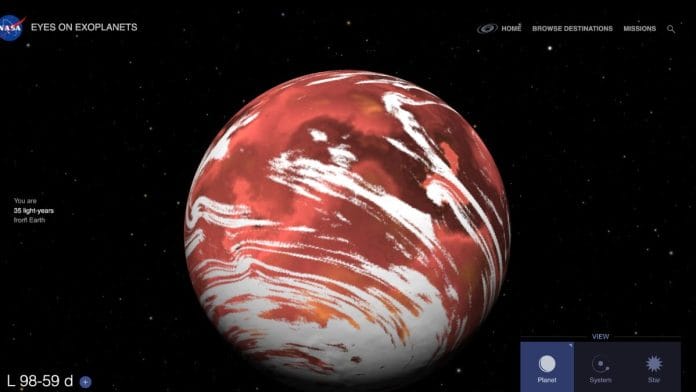



New Delhi: Astronomers say they may have identified an entirely new type of planet—one that does not fit into the familiar categories of rocky worlds or ocean planets, but instead exists as a churning, molten, mushy, molasses-like mass.
Until now, planets have been placed into one of two broad buckets: A rocky “gas-dwarf” with a hydrogen-rich atmosphere or a water world made up of deep oceans and ice. But new findings suggest that L 98-59 d fits neither description. Instead, it appears to belong to an entirely different class of planet, one that stores large amounts of sulphur within a permanent ocean of magma.
Located about 35 light-years away in the Vela constellation and roughly 1.6 times the size of Earth, L 98-59 d was long thought to be a water world. Earlier observations hinted at the possibility of vast oceans. But fresh data from the James Webb Space Telescope has upended that assumption.
Rather than water, astronomers now believe the planet is dominated by a global sea of molten rock–a “mushy” state where material is neither fully solid nor fully liquid. Surface temperatures are estimated to reach around 1,900 degrees Celsius, hot enough to keep rock flowing. Unlike Earth, which cooled over time to form a stable crust, L 98-59 d appears to have remained in this molten state for billions of years. Scientists think this may extend deep into the planet itself, possibly even to a still molten core.
Also read: Peak performance: Study finds red blood cells can reset diabetes maths in high altitude
A strange world
The study, led by researchers at the University of Oxford and published in the journal Nature Astronomy, used advanced computer simulations to reconstruct the planet’s history for the five billion-year period shortly after its formation to present day. Crucially, the team combined these simulations with observations from the James Webb Space Telescope. By linking telescope data with detailed models of planetary interiors and atmospheres, they were able to work backwards to infer what is likely happening beneath the surface.
Their conclusion: The planet is locked in a long-lived molten state, sustained in part by a thick, heat-trapping envelope of gases in its atmosphere. This includes heavy sulphur-bearing molecules such as hydrogen sulphide. This atmosphere likely acts as a heat trap, preventing the planet from cooling and helping maintain its magma ocean over time.
This combination, molten interior and sulphur-rich atmosphere, sets it apart from both rocky planets and water worlds, prompting scientists to suggest it may represent a new class altogether, one of long-lived “magma ocean worlds”.
The implications extend beyond a single discovery. The findings, which imply that molten planets may be quite common, suggest astronomers may need to be more cautious about designating exoplanets as potentially habitable. Planets previously thought to harbour oceans could instead be dominated by molten interiors and dense, heat-trapping atmospheres, making them far less hospitable than once believed.
The finding also raises questions about how planets evolve. Existing models struggle to explain how a planet can retain such a thick atmosphere for billions of years, while remaining molten. If confirmed, it suggests planetary formation and cooling may be far more complex than current theories assume.
As for life, the prospects are slim. With extreme heat, toxic gases, and no solid surface, L 98-59 d is unlikely to support life as we know it.
Still, the discovery points to something larger. As telescopes become more powerful and data more precise, the tidy labels used to describe planets are beginning to break down. Between rock and water, solid and liquid, there may exist a spectrum of worlds that defy easy classification. L 98-59 d may be the clearest sign yet that the universe is stranger and more diverse than we imagined.
(Edited by Theres Sudeep)