





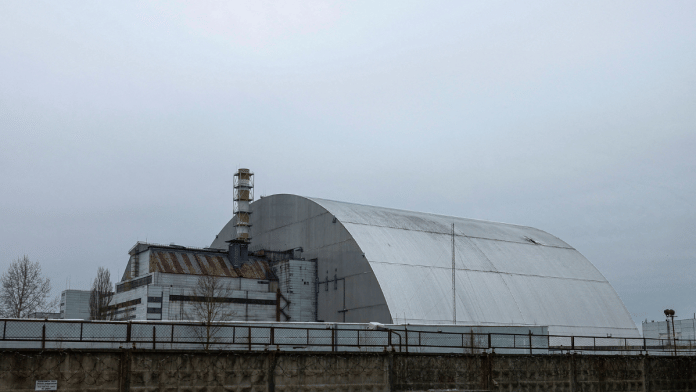



New Delhi: A protective shield at the Chernobyl nuclear plant in Ukraine can no longer perform its primary function of blocking radiation, the United Nations said last week after a safety inspection of the site.
The International Atomic Energy Agency (IAEA), the UN’s nuclear watchdog, said that a drone attack by Russia in February this year had significantly damaged the steel confinement, which was built to contain radioactive material after the 1986 disaster. While there was no “permanent damage” to load-bearing structures or monitoring systems, it had lost its primary safety functions—its confinement capability.
“Repairs had already been carried out, but comprehensive restoration remains essential to prevent further degradation and ensure long-term nuclear safety,” IAEA Director General Rafael Grossi said in a statement.
ThePrint explains the Chernobyl safety shield, how it contained radiation and the implications of the damage it sustained.
How was Chernonyl’s safety shield built?
Chernobyl’s ‘safety shield’ was built in 1986, after the nuclear disaster in the then Soviet Union. It was mainly designed to trap the radiation still leaking from Reactor No. 4.
This had to be done because when the reactor exploded, it didn’t just destroy the building it also blew the nuclear core, scattering toxic radioactive fuel and dust into the air.
Scientists and engineers decided to build a physical barrier over the wreckage, which led to two of the most ambitious engineering projects of modern times—the Sarcophagus, built after the disaster as a quick fix to control the leaks, and the New Safe Confinement, which was completed in 2019.
“The accident caused the largest uncontrolled radioactive release into the environment ever recorded for any civilian operation, and large quantities of radioactive substances were released into the air for about 10 days. This caused serious social and economic disruption for large populations in Belarus, Russia, and Ukraine,” the World Nuclear Association said on its website.
According to WNA, two radionuclides, the short-lived iodine-131 and the long-lived caesium-137, were particularly significant for the “radiation dose they delivered to members of the public,” making it imperative to contain the radiation.
The Sarcophagus, which had a 30-year lifespan, was a massive concrete-and-steel box-like structure, nearly 3-4 metres thick to absorb radiation. It was built over the reactor, which is still dangerously radioactive.
Steel beams and plates were welded together to close off the destroyed building from most angles. Some basic ventilation filters were also installed within the structure to prevent a buildup of pressure.
While the design sounded simple, building it was a challenge. Workers could not spend long hours inside the reactor, and the toxic radiation fumes damaged cranes and electronics.
As a result, the Soviet Union drafted the ‘Chernobyl liquidators,’ soldiers and workers who would place portions of concrete or steel in quick succession.
Also Read: How the US ended up with radioactive shrimp and sneakers
New Safe Confinement
Due to the Sarcophagus’s short lifespan, the New Safe Confinement was built to prevent the leakage of radiation. Unlike its earlier version, this structure was carefully planned to last.
Known as one of the largest movable structures ever built, it is a giant arch about 108 metres tall and 257 metres wide. The NSC was originally built half a km away from the site and then slid into place after construction.
A giant high-tech shell, the NSF is designed to seal off the old Sarcophagus safely.
It is airtight and lined with high-grade stainless steel on the inside, which holds radioactive dust from escaping. It also uses flexible membranes and engineered seals to prevent any air leaks. The inside is kept under slightly negative pressure, which means that while the air can flow, it cannot flow out.
To be doubly sure, any air that does leave the structure goes through powerful High-Efficiency Particulate Air and charcoal filters designed to trap radioactive particles.
The steel arch also creates a controlled micro-climate inside. Another reason for the Sarcophagus’s short lifespan was that it trapped moisture within its structure, which eventually led to rust.
The new structure keeps the inside dry and stable, preventing rust and reducing the risk of collapse. It is built to withstand tornado-level winds, heavy snow, and earthquakes.
The February attack
In February, a Russian drone with a high-explosive warhead struck the plant, causing a fire that damaged the protective clad around the facility.
Russia, however, has denied any responsibility.
It is not the first time that NSC, which was built by a collective contribution of nearly 2 billion euros by 45 donor countries and organisations under the Chernobyl Shelter Fund, has been at the centre of the Russia-Ukraine war.
In 2022, Russian forces captured the Chernobyl nuclear facility, allegedly holding staff hostage and disturbing contaminated soil that led to a spike in radiation levels. The control of the facility, however, was handed back to Ukraine within a month.
“Timely and comprehensive restoration (of the NSC) remains essential to prevent further degradation and ensure long-term nuclear safety,” Grossi said after the recent inspections.
(Edited by Insha Jalil Waziri)