








New Delhi: The uncrewed flight of India’s first human spaceflight, Gaganyaan, is expected to be delayed further. The Indian Space Research Organisation on Monday withdrew an application requesting support from the US’ ground station in Hawaii, according to which the flight was scheduled for 9 February.
The US Federal Communications Commission website shows that ISRO filed an application on 9 January requesting ground support for the Gaganyaan mission.
“By this application, SSC Space US dba USN request a 30-day STA to support Gaganyaan LEOP operations from its Hawaii station commencing Feb. 9th 2026,” the application read.
The application, however, was withdrawn three days later, on 12 January. Incidentally, it was the same day when ISRO’s PSLV-C62 (Polar Satellite Launch Vehicle-C62) mission failed, which was carrying 16 satellites — including Indian and foreign payloads. This was the second back-to-back failure of a PSLV mission, which otherwise has an over 90 per cent success rate.
Also read: ISRO’s 2026 launch was the first time it failed to launch a foreign satellite
‘No connection’
The withdrawal of the Gaganyaan uncrewed mission request, which coincided with the PSLV failure, has now led space enthusiasts and followers to assume a connection between the two.
“Gaganyaan-G1 delayed by PSLV-C62 failure? An FCC filing made by ISRO on 9 Jan, 2026 mentions that Gaganyaan-G1 was planned to lift off on Feb 10TH, 2026!! ISRO had requested ground station support from a Hawaii-based station for 30 days starting 9th Feb for Gaganyaan-G1,” ISRO Spaceflight, a space communication account on X, posted on 14 January.
The post has over 21,400 views.
The Indian space agency has denied a connection.
A senior ISRO official told ThePrint that the Gaganyaan test flight will be carried on a different launch vehicle — the Human-rated Launch Vehicle Mk3 (HLVM3) — which is a modified version of the space agency’s LVM3 rocket, but designed with enhanced reliability to meet human safety considerations.
“There is no connection between the two missions. G1 (the first Gaganyaan uncrewed flight) uses a completely different vehicle,” a top ISRO official said on the condition of anonymity.
The official, however, did not disclose the reason behind the withdrawal of the test flight application.
Gaganyaan, India’s first human spaceflight, now slated for 2027, will launch a crew of three into low Earth orbit at a distance of nearly 400 km from the ground for a three-day mission, then bring them back safely.
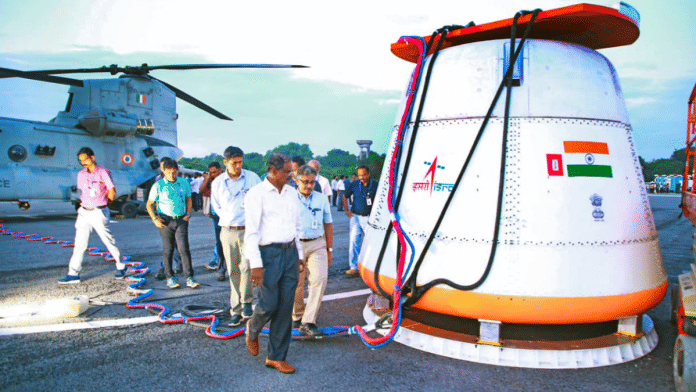
In the test flight, a humanoid, Vyomitra, will fly to space before the astronauts to demonstrate an end-to-end mission. In this flight, the aerodynamic characterisation of the human-rated launch vehicle, along with mission operations of the orbital module, re-entry, and recovery of the crew module, will be tested.
(Edited by Aamaan Alam Khan)