





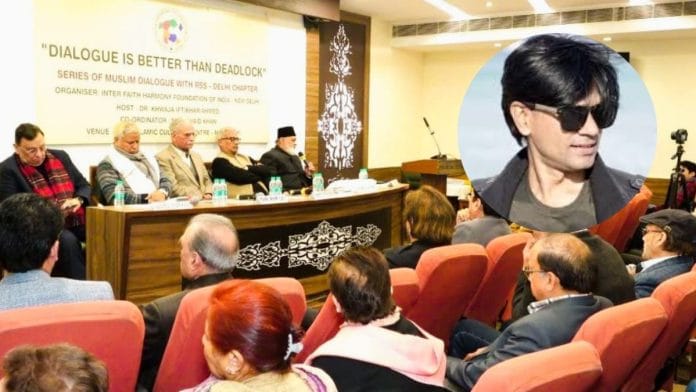



New Delhi: The charges against Alt News co-founder Mohammed Zubair were much more serious than those against Umar Khalid, RSS leader Ramlal said in an address Friday, adding that the Supreme Court still granted Zubair bail quickly.
Rashtriya Swayamsevak Sangh’s outreach wing head Ramlal was speaking at ‘Interfaith Dialogue’, a programme organised in Delhi on 16 January under the aegis of the Inter Faith Harmony Foundation of India.
“Don’t link everything to the Sangh and the government. If I speak about it, then it will become a debate. You discuss Umar Khalid [that he is not getting bail], but you don’t talk about Zubair, who got bail so quickly. Zubair’s crime is much more serious than Umar Khalid’s, and the SC granted him bail immediately,” Ramlal told Muslim community members Friday, adding that such matters don’t go unnoticed.
Former lieutenant governor Najeeb Jung had raised the issue of the recent denial of bail to Umar Khalid.
On 5 January, the Supreme Court denied bail to Umar Khalid and Sharjeel Imam in the 2020 Delhi riots “larger conspiracy” case, despite their five-year-long incarceration, ruling that prosecution material disclosed a prima facie case under the Unlawful Activities (Prevention) Act.
Ramlal, while rejecting insinuations that court judgments are coming under government pressure, said, “The same SC has also given judgments against the BJP. Treat the court as a court. Does the government also influence the court? It doesn’t happen like that.”
The conversation at the 4 January event was part of the series, ‘Dialogue is better than deadlock’. It brought senior RSS functionaries, Krishna Gopal and Ramlal, on the same platform with ex-lieutenant governor Najeeb Jung, ex-chief election commissioner S.Y. Quraishi, retired lieutenant general Zameeruddin Shah, and senior journalist Khwaja Iftikhar Ahmed, among others.
On 20 July 2022, the Supreme Court granted interim bail to Mohammed Zubair in eight criminal cases registered against him by the Uttar Pradesh Police in different districts on hate speech charges. A D.Y. Chandrachud-led bench said that the “machinery of criminal justice has been relentlessly employed against him” to the point that the process had turned into punishment.
Even now, Zubair continues to face legal challenges, including a more recent FIR from October 2024, charging him with endangering national sovereignty under the Bharatiya Nyaya Sanhita (BNS).
Commenting on speculations around the RSS running the government, he said it was not true. “The RSS doesn’t even decide on tickets [for elections]. We’ve been thinking for so long that this person [referring to a BJP spokesperson] should get a ticket, but they don’t give. They made him a spokesperson, but they didn’t give him a ticket.”
The Constitution drove the government, Ramlal said. “And, the Cabinet…The government runs through the bureaucracy. The government doesn’t run on anyone’s remote control, and we don’t want to run it that way either.”
Commenting on whether the RSS always supports the BJP, he said, “Mai Congress ke logon se milta hu or kehta hu jab tak aap Sangh ko gali dete rahoge, hum BJP ko support karte rahenge…aapko support kaise karein…aap support mango to sahi? Sangh ki majburi aapne BJP bana di hain (I meet Congress members and tell them that as long as you keep abusing the Sangh, we will continue to support the BJP… How can we support you when you are not seeking our support? You keep insulting us. You have made BJP a compulsion for the Sangh).”
Ramlal also condemned “selective narratives” that show RSS in a bad light, claiming that news of Bajrang Dal members vandalising churches spread fast, but that they were either suspended or terminated by the Sangh long before they committed the crime never made it to the news.
Ramlal also said that turning a few incidents into a “national crisis” is wrong. “They misuse our name….even when we clarify, we are criticised. You and RSS are on the same page. In your case, if one person does something bad, the entire community gets blamed. [It is the] same with Sangh. We are victims of the same narrative building,” he added.
Before his current role, Ramlal served as the BJP’s general secretary (organisation) and co-incharge of the RSS’s publicity and communications wing in 2019.
Also Read: India’s Chief of Information War during Op Sindoor night was fact-checker Mohammed Zubair
What the other speakers said
While speakers strongly underscored the need for unity, inclusion and peace, they touched upon issues such as the politics of hatred, the role of fringe elements, and the silence of top leadership.
Jung questioned the silence of Prime Minister Narendra Modi at crucial moments, saying that such silence was a matter of grave concern for democracy.
“You say that the PM cannot speak on every matter, I say, why? Why can’t the PM speak on every matter? How much bigger things he wants to speak about…hatred is being spewed upon us by Sudarshan TV every single day…we need your leadership to come out and speak, say that ‘we are equals’. That ‘no one is different in India’,” Jung said, expressing resentment at NSA Ajit Doval’s speech urging the youth in India to “avenge India’s history’.
He said that history was presented in a distorted and selective manner, holding today’s Muslims responsible for events of the distant past, and that it was unjust and illogical. “None of us is responsible for the Partition of India; we have grown up in Independent India and continue to serve this country,” he said.
Jung stressed that tolerance and respect were required from both sides, adding that cow slaughter was highly condemnable and should be discouraged, as should be the use of ‘kaafir’. On the other hand, the nationalist integrity of a Muslim should not be questioned, he added.
India’s real strength lies in its long tradition of dialogue and inclusiveness, as exemplified by the country’s first Prime Minister, Jawaharlal Nehru, said Krishna Gopal.
A year after Independence, Nehru, on 24 January 1948, urged the youth in a speech at Aligarh Muslim University to reflect on their own heritage, traditions, and national pride, while keeping nationalism above religion.
The path to uniting India, even today, lies in dialogue, mutual respect, and a shared national consciousness—not through fear, hatred and mistrust—he said.
(Edited by Madhurita Goswami)