





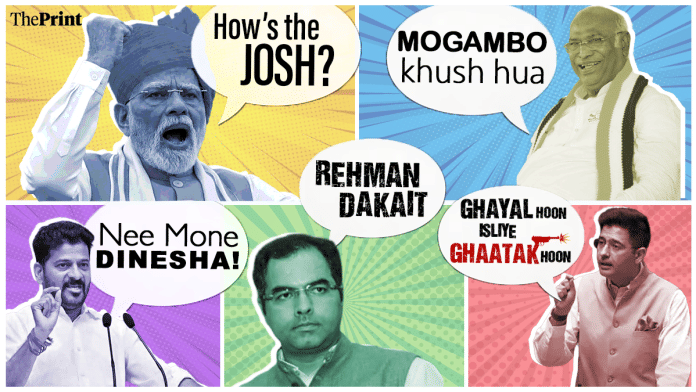



New Delhi: In run-up to the voting in the Kerala assembly elections on 9 April, Telangana Chief Minister Revanth Reddy launched a scathing attack on his Kerala counterpart and CPI(M) leader Pinarayi Vijayan, using an iconic dialogue from the popular Malayali film Narsimhan.
“Nee Po Mone Dinesha”, Reddy said in a campaign roadshow on April 1, a message that implied Vijayan’s time is over.
Across party lines, politicians are increasingly borrowing from cinema to land blows to rivals.
On April 4, Aam Aadmi Party (AAP) Rajya Sabha MP Raghav Chadha hit back at his own party using a dialogue from the movie Dhurandhar – “Ghayal hun isilye ghatak hun” (I am dangerous because I am hurt)—after the party removed him as its deputy leader in the Rajya Sabha.
Meanwhile, BJP leaders have taken their own creative liberties.
During a speech in the assembly on 26 March, Delhi minister Parvesh Verma likened Arvind Kejriwal to ‘Rehman Dakait’, an infamous docait character from Dhurandhar, to take a dig at Kejriwal’s ‘Sheesh Mahal’, a favourite campaign theme for the BJP during the 2025 Delhi elections.
The BJP ran its 2025 Delhi election campaign on the issue of corruption and often targeted Kejriwal with the ‘Sheeh Mahal’ jibe, alleging that when the AAP leader was the chief minister, he splurged public money on renovating his official residence
No one, however, does it quite like Prime Minister Narendra Modi, whether from the political stage or in Parliament.
From “picture abhi baaki hai” (from Om Shanti Om) to “How’s the josh?” (from Uri: The Surgical Strike), Modi has turned film dialogues into political catchphrases people connect instantly with.
He has even dipped into classics like Sholay and Sharaabi to take digs at the opposition.
During his reply to the Motion of Thanks on the President’s Address in the Lok Sabha in February 2020, Prime Minister Narendra Modi used the famous Sholay dialogue to target the opposition—mainly the Congress—after their repeated electoral defeats, including the 2014 and 2019 general elections, and several state polls. “Teesri baar toh hare hain, par mausi moral victory toh hai na.”
Earlier this year, in February, actor-politician Kamal Hassan used a Telugu dialogue “Jagannatha ratha chakralu tirugutunnay (wheels of Jagannath’s chariot are coming) from the film Kalki 2898 AD in his maiden speech in the Rajya Sabha, to symbolise unstoppable political change and democratic momentum in the country.
Not to be outdone, the Opposition has also used film dialogues to take a swipe at the ruling dispensation.
For instance, in January, criticising India’s response to aggressive tariffs imposed by US President Donald Trump, Congress president Mallikarjun Kharge said that “India didn’t elect you (PM Modi) to nod to whatever he (Trump) says.”
He then invoked popular dialogue ‘Mogambo Khush Hua’ from Mr. India to suggest the government appeared more keen to appease Trump than assert India’s position.
But this film turn isn’t accidental. Experts say it’s tactical, as light and fun movie dialogues connect faster with the public than policy jargon ever can.
“Cinema speaks to the gut before the brain. Politicians have long understood that a well-framed image or a borrowed cinematic line moves people faster than any statistic or policy brief. The screen has trained audiences to feel first and think later, and political messaging has simply followed that trend,” said Anant Mishra, Assistant Professor at Lakshmibai College, Delhi University.
Mishra also spoke about the public’s consumption patterns, stating that social media, television, and streaming platforms have turned politics into a visual performance. “Today, every debate, rally, and address is edited, framed, and consumed as content.”
Also Read: When Dharmendra used a Sholay dialogue in his 2004 election campaign
The meme ‘industry’
Apart from cinematic references, political parties often engage in meme wars, inspired by movie dialogues and scenes, on social media, which intensify during elections.
Tanveer Aeijaz, Associate Professor and political analyst at Ramjas College, said “there is a whole industry working on it”.
“In an election, we vote based on what we see on social media. They act as an instrument for talking about the opposition. There is a whole industry working on this. Political parties are hiring people to make creative memes for them,” Aeijaz told ThePrint.
The Aam Aadmi Party’s official Instagram handle is a case in point. It has a highlight segment named ‘memes’ where creative editing meets political orientation.
The meme collection is wide-ranging—a Jolly LLB-inspired edit targeting Union Finance Minister Nirmala Sitharaman’s handling of the rupee, a Sholay-inspired Gabbar Singh reference—“school theek karlo nahi toh Kejriwal aa jayega”.
On X, AAP’s handle has an edited poster of Kejriwal as Pushpa from the film ‘Pushpa’ stating ‘Kejriwal jhukega Nahi’.
Similarly, the BJP’s handles declare PM Modi as ‘Dhurandhar’. Last month, the BJP’s X handle posted an edited clip, presenting him as the OG or the original Dhurandhar. The party’s state unit also posted videos on their X handles, calling him the ‘Dhurandhar’.
The BJP’s state unit X handles have been particularly active, frequently deploying cinematic references, from lines like “kya se kya ho gaya dekhte dekhte” to edited posters of Bhagwant Mann and Arvind Kejriwal captioned “andher nagri, chaupat raja”
A research paper titled ‘Memes in Digital Era’ by academic Vignesh R says “memes serve as carriers of visual humour in the language that a common person speaks”.
The paper further states that satirical and political memes on social media are a way to engage citizens in the discourse. s”Such memes have recorded higher engagements.”
Aeijaz added that these memes not only influence people but also act as a marketing campaign tool. “The memes present on social media handles of politicians mostly cover sexuality, violence, and corruption,” he said.
A similar campaign style was seen in New York’s mayoral race, where candidate Zohran Mamdani engaged voters through references to Amitabh Bachchan and an internet-savvy tone, appealing especially to young voters and the South Asian diaspora.
Mishra said, “Politicians who master cinematic grammar—the pause, the close-up, the soundbite—dominate those who do not.”
When asked what to expect next, he added, “As power weaponises cinematic language, resistance will respond in kind. Satire, documentary, and grassroots visual storytelling have always punched back at authority”.
“The way to go forward is media literacy and knowing a frame is constructed, and this will be the most important civic skill that one can possess,” he added.
(Edited by Ajeet Tiwari)