





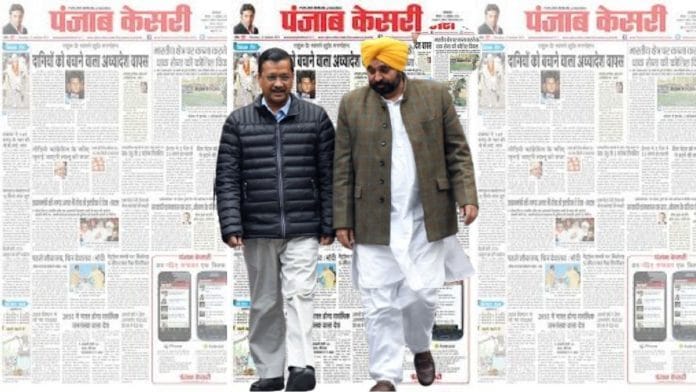



Chandigarh: Jalandhar-based Punjab Kesari media group has alleged “targeted witch-hunting” by the Aam Aadmi Party (AAP) government in Punjab after a series of raids were carried out at its on business establishments this week. The media group said the raids were payback for publishing an adverse story about AAP national convenor Arvind Kejriwal. The publication has now complained to the governor of “intimidation” by the government.
Vijay Chopra, the 93-year-old editor-in-chief of the Punjab Kesari Group, has alleged that the various agencies of the government are carrying out a witch-hunt against the Chopra family (which owns the Punjab Kesari group) through raids and issuing show cause notices to their other businesses in Punjab.
In a two-page letter to the governor, Chopra said it all began with a report published on 31 October 2025 on Kejriwal (not named in the letter). Sources in the newspaper told ThePrint that the report related to BJP alleging that Kejriwal had been “alloted” an official house near the secretariat in Chandigarh.
After Chopra’s letter, the Opposition has united in charging AAP with attacking press freedom. But the AAP government has defended the raids in an official communication, alleging the Punjab Kesari Group was violating a host of food, excise and pollution laws in the garb of running the newspaper and the actions against them had nothing to do with their journalism.
“In Punjab, laws apply equally to everyone. Editorial independence will be protected, but violations that endanger public health, workers or the environment will not be overlooked,” the Punjab government statement said rejecting allegations of a “targeted witch-hunt”.
This is not the first time the AAP government has faced allegations of muzzling the press in Punjab.
In early November, in an early morning operation, multiple vehicles carrying newspapers were stopped by the police, disrupting the supply of newspapers to several places in Punjab. While the Opposition had alleged that this was done to smother the news of Kejriwal being allotted an official house in Chandigarh, the police had claimed that vehicles carrying newspapers were checked after an intelligence input that they may be ferrying weapons and drugs.
Then again in early January, the AAP government had come under severe attack from the Opposition after an FIR on charges of spreading misinformation was registered at Ludhiana’s cybercrime police station against RTI activist Manik Goyal, journalists and social media influencers. The case was registered on the basis of a tweet in which Goyal had demanded to know the use of a state chopper in the absence of the chief minister who was on an official tour of Japan, alleging that AAP’s Delhi team had used it.
On Monday the Punjab and Haryana High Court stayed further investigation on a quashing petition moved by Goyal. Goyal claimed that his application under the Right to Information Act to seek information about the details of the use of the chopper had been denied by the government.
‘Targeted witch-hunt’
The Punjab Kesari group brings out the Punjab Kesari, Jagbani and Hind Samachar newspapers and has been running since 1949. The representation to the Punjab governor Gulab Chand Kataria is also signed by family members Avinash Chopra and Amit Chopra, besides Vijay Chopra.
“The events begin with the news story published on 31 October 2025 which was a very balanced and fair report regarding allegations by the Opposition pertaining to the national convener of the ruling party in Punjab. Thereafter, from 2 November 2025, all advertisements to Punjab Kesari group which published the widest circulated Hindi and Punjabi dailies in Punjab have been stopped by the government of Punjab,” the letter said.
“Despite this economic coercion on the press, we stood steadfast and continue (sic) our independent and free reporting. However, in the past few days a relentless campaign has been launched against Punjab Kesari and its promoters,” the letter added.
The letter has listed multiple raids carried out in the past few days by the food department, GST department, excise department, factory department and pollution control board at hotels run by the Chopra Group. The letter and they were issued a show cause notice by the excise department for cancellation of their liquor licence on 13 January, and the licences were cancelled the next day. The letter adds that electricity to their hotel in Jalandhar was cut on 14 January, and the next day the pollution control board raided their printing presses at Ludhiana and Jalandhar.
“Due to the actions it is feared that as on 15.1.2026, the operation of the press at various presses at Jalandhar, Ludhiana and Bathinda will be obstructed or stopped altogether,” stated the letter adding that there was a heavy deployment of police outside these presses.
“As you are aware, late Lala Jagat Narain founded the Hind Samachar in 1949 and Punjab Kesari started publication in 1965. Our commitment to the freedom of the press is well known, as both our revered Lala Jagat Narain and late Shri Romesh Chandra Chopra and 60 other people of staff, agents, hawkers, reporters lost their lives and several got injured due to fearless reporting during the days of insurgence/terrorism in Punjab. Despite this, the newspaper continued to report fearlessly without succumbing to any pressure or influence and shall continue to do so,” wrote Chopra.
“A targeted witch-hunt of this nature—where various departments with the predetermined intent, are disrupting our operations—clearly reflects an intent to intermediate… An attempt to interfere with freedom of the press would seriously undermine democracy in Punjab especially with the state going to elections soon,” said Chopra.
‘Law breakers’
Reacting to Chopra’s letter, the government rejected allegations of “targeted attack”, stating that the claim is “an attempt to deflect attention from serious, recorded violations of law uncovered by multiple statutory authorities acting strictly within their legal mandate”.
In a statement issued Friday, the government said, “The starting point of this entire issue is not journalism, advertisements or editorial opinion. The starting point is hard evidence placed on the official record.”
The Punjab government clarified that the excise action at the hotel in Jalandhar resulted in the seizure of over 800 bottles of liquor stored at unapproved locations, discovery of liquor bottles without mandatory excise holograms and QR codes, and documentary proof that expired draught beer was sold to customers for days after it had become unfit for human consumption.
“The excise authority explicitly recorded that ignorance cannot be accepted as a defence and that possession and sale of such bottles constitutes a serious violation,” added the note.
The government underlined that the suspension of liquor licences was ordered strictly after due process, and that portraying such action as vendetta would amount to suggesting that excise laws should not apply uniformly.
The government clarified that the action at the hotel was not confined to excise violations alone. Inspections conducted by the Punjab Pollution Control Board recorded grave environmental and public health breaches. “Throughout the hotel’s operations, chemicals used in laundry activities were discharged directly into the ground and into the sewer without any treatment, contaminating groundwater and polluting public sewerage system. The hotel, categorised as a large-scale red category unit, continued operations without valid consent to operate under the Water Act, 1974 and the Air Act, 1981, after both mandatory permissions expired on March 31, 2025,” added the note.
The government said these are not technical or procedural lapses, but violations that directly endanger public health, groundwater and the environment, and no responsible administration can ignore such findings.
“Inspections by the Labour and Factories department across multiple printing units linked to the same group revealed serious and repeated violations of labour laws, safety norms and statutory record-keeping requirements. At Punjab Kesari Printing Press, Unit-II, Jalandhar, officials documented 18 violations under the Occupational Safety, Health and Working Conditions Code, 2020, including blocked fire exits, expired fire extinguishers, unsafe electrical wiring, absence of protective equipment, empty first-aid boxes, poor hygiene and lighting, and failure to produce workers’ health examination records,” stated the government.
“Similarly, an inspection at Jagat Vijay Printers, Focal Point, Ludhiana, recorded widespread non-compliance, including non-production of gratuity and wage records, absence of muster rolls, failure to maintain labour welfare fund records, inadequate fire-fighting arrangements, missing safety guards on machinery, unsafe workspaces and blocked emergency exits,” added the government note.
The Punjab government said these inspection reports collectively reveal a pattern of regulatory neglect across excise, environmental and labour domains. “When multiple statutory authorities record violations in writing, with dates, sections and signatures, enforcement is not discretionary. It is a legal obligation,” the government said.
Responding to claims of harassment, the government said that enforcement of labour, safety and environmental laws cannot be suspended under the pretext of press freedom.
The Punjab government also rejected the claim of a “predetermined witch-hunt”. It said: “Simultaneous action by different departments only reflects how long violations had remained unaddressed earlier. Lawful enforcement, even if delayed, does not become motivated simply because it is finally undertaken.”
On the allegation regarding government advertisements, the Punjab government clarified that public advertising is not an entitlement and cannot be used as insulation against regulatory scrutiny.
(Edited by Viny Mishra)
Also read: Why Punjab’s AAP govt has scrapped the land pooling policy it was swearing by just a month ago