





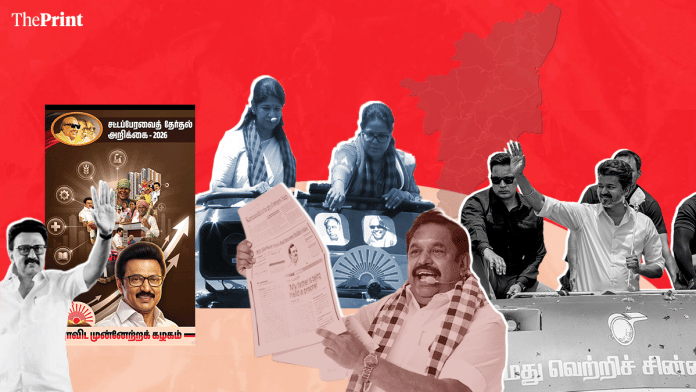



Chennai: The Dravidian leaders prefer to call them as ‘social investments’, or ‘personalised gifts’. But a familiar sight is back in poll: Dravida Munnetra Kazhagam (DMK), All India Anna Dravida Munnetra Kazhagam (AIADMK) and Tamilaga Vettri Kazhagam (TVK) are promising the biggest and best welfare schemes and programmes, or ‘freebies’, to the voters.
The ruling DMK is building up on the success of various welfare schemes in Tamil Nadu: it proposes to double women’s monthly assistance under the Kalaignar Magalir Urimai Thogai from Rs 1,000 to Rs 2,000.
There are plans to provide Rs 8,000 appliance coupons for mixies, grinders, fridges, and similar household items under the Illatharasi scheme. The DMK is extending the Chief Minister’s Breakfast Scheme, initially limited to Class 5 students, to Class 8 students.
On pensions and social security, the DMK talks about raising old-age pensions to Rs 2,000 and differently-abled assistance to Rs 2,500. The Vidiyal Payanam scheme, which already offers free bus travel for women, will continue.
Drawing on its legacy of ‘Amma’ welfare programmes, the AIADMK proposes to give a financial aid of Rs 2,000 per month to women under the Kula Vilakku scheme, treating cash support as a routine part of household income. It also plans to provide free refrigerators to all women who hold a rice ration card.
The manifesto promises three free LPG cylinders per household annually, and a one-time Rs 10,000 financial assistance to help households cope with sudden expenses. It also proposes to extend free bus travel to men, effectively turning a gender-specific scheme into a universal urban transport benefit.
On food security, the AIADMK proposes to distribute 1 kg of dal and 1 litre of oil along with rice under the Public Distribution System. The Amma Clinics will be revived to enable easily accessible primary healthcare, its manifesto says.
The TVK is not behind. It proposes a financial assistance of Rs 2,500 per month for women heads of families. Additionally, the Annapoorani Super Six scheme promises six free LPG cylinders annually per family. Keeping socio-cultural factors in mind, the fledgling party is offering an 8 gram gold coin and a silk saree for brides, plus a gold ring and a baby kit for newborns, if voted to power.
For education, it promises Rs 15,000 annual education support for school students. Though it opposes the DMK’s free bus ride scheme, the party promises free bus travel for women. The TVK proposes an unemployment allowance of Rs 4,000 for graduates and Rs 2,000–Rs 2,500 for diploma-holders above 29, alongside collateral-free education loans up to Rs 20 lakh and entrepreneurship incentives aimed at turning young job-seekers into job-creators.
Overall, some ‘offers’ by the political parties are almost standard: women’s cash aid in the Rs 2,000–Rs 2,500 range and LPG-linked relief for the families from the economically weaker sections. The assembly elections in Tamil Nadu will be held on 23 April.
The origin
Much before the ‘revdi’ culture spread across the country, Tamil Nadu saw its precursor way back in the 1950s-1960s. Former Chief Minister K. Kamaraj (1954 to 1963) introduced noon-meal schemes in government and panchayat schools, primarily to ensure children’s attendance and prevent dropouts.
The initiative was later expanded into the nutritious mid-day meal programme under M.G. Ramachandran (MGR) in the 1980s. “Mid-day meals were not political giveaways, they were deliberate investments in nutrition and education, addressing hunger so that children from poor families could stay in school and not drop out,” political analyst V.M.Sunil Kumar told ThePrint.
A defining moment came in 1967 when C.N. Annadurai promised subsidised rice at one rupee per padi (a traditional measure used in South India) to tackle extreme poverty and rising food prices. M. Karunanidhi then made rice available at Rs 1 per kg. “These early measures were responses to widespread deprivation and as an attempt to address food insecurity. They focused on basic survival needs and laid the foundation for structured welfare that eventually influenced national policies,” Sunil explained.
Under J. Jayalalithaa’s AIADMK rule, the ‘Amma’ brand became synonymous with tangible welfare after 2011, which included free mixies, grinders, table fans and other electric appliances, directly targeting household comfort. Amma Unavagam or subsidised canteens offered meals for Rs 1- Rs 5; Amma laptops were given to students.
The flagship Thalikkku Thangam provided 4 gm of gold plus cash for brides from poor families, easing the burden of marriage expenses. Free cell phones were given to women in self-help groups, linking welfare with financial inclusion. Subsidised scooters for women were seen as a tool for easy mobility and empowerment.
Freebie culture, its evolution
Political analyst A Ramasamy explained that ‘freebie culture’ evolved with political parties offering cash for people to travel to polling booths on election day. He says that the promises of laying roads or constructing temples, gradually changed to infrastructure development promises.
Over time, what began as campaign promises turned into formal welfare schemes by the government. For instance, Annadurai’s rice subsidy, Kamaraj’s noon-meal schemes, AIADMK’s Amma canteens (which the DMK later retained and expanded), and DMK’s breakfast scheme and cash transfers.
“Even schemes such as the CM Breakfast schemes existed even during Kamaraj’s time, when food was given to school children to keep them in school and prevent dropouts. Today, the government itself runs these schemes, and the public has accepted them. While one can debate whether it is democratic to turn promises into permanent schemes, it is clear that people have benefited, especially in the education and health sector,” he told ThePrint.
So, what has changed now? Analysts note a clear shift in the nature of promises, from foundational welfarism aimed at long-term human development to competitive freebies focused on immediate cash transfers and household appliances.
The freebies, according to welfare scheme critics, prioritise short-term voter loyalty over long-term development even though they strain state finances amid mounting debt.
“The freebie culture started to counter price hikes. When Annadurai promised cheap rice, it became a welfare scheme. People accepted these promises because they improved access to basic essentials,” political analyst Sunil Kumar told ThePrint.
“While the financial burden on the state increases, it also gives financial independence to the poor. Free cycles, grinders, food, laptops, low-price canteens—these are all reminders of leaders’ promises, but they also uplift those at the bottom of the economic ladder. This is how they have shaped voter behaviour.”
Both the DMK and the AIADMK built on the legacy of schemes launched by leaders such as Annadurai, Kamaraj, converting election promises into structured welfare schemes rather than one-off giveaways.
“These were not just schemes; they were personalised gifts from ‘Amma’, turning welfare into a symbol of care and affection and making the party’s image inseparable from the idea of a nurturing mother. People felt that emotional and personal bond with her and she believed that it would benefit the people,” an AIADMK functionary said.
The DMK has tried to institutionalise and expand some of these ideas as seen in the Chief Minister’s Breakfast Scheme, the Kalaignar Magalir Urimai Thogai (Rs 1,000 per month to women) and the Vidiyal Payanam (free bus travel for women).
The freebies and welfare schemes have had significant social effects: school enrollment and literacy rates have risen steadily, especially in rural and semi-urban areas, women’s workforce participation has increased, and online learning up among students. Tamil Nadu’s poverty rate remains among the lowest in India, a fact often cited by defenders of the welfare model.
The welfare schemes are also projected as engines of local demand. Take the case of the distribution of household gadgets, which also creates demand for small traders and manufacturers.
Poll bait, or social changers?
Economist Venkatesh Athreya pushed back against the term “freebie” when it comes to announcements, promises and schemes targeted for the poor. Giving the example of the mid-day meal scheme that was initially opposed as a ‘freebie’, he says it was accepted later and no one opposes it now.
He argued that when there was a tax break for corporates, it was said to encourage more investments. “There cannot be a general statement or narrative on anything and everything being done for the poor. The parties like the BJP which criticised the DMK’s freebies, were the first ones to offer financial aid in Bihar elections, which is similar to ‘cash for votes’,” Venkatesh said.
DMK MP Kanimozhi told the media after the party’s poll manifesto release that these are not ‘freebies’ but social investments. She cited the example of free-bus rides that lets women travel safely for jobs, training, and education, expanding their horizons beyond the immediate neighbourhood.
On the other end, political analyst Sumanth Raman pointed out that political parties in Tamil Nadu have gone overboard with freebies. It is not fiscally prudent to fulfill all of them, he added.
“The impact is getting neutralised because every party promises almost the same thing: Rs 2,000 for every woman, Rs 10,000 for a fridge, or an Rs 8000 coupon- no one is really differentiating,” he told ThePrint.
“Tamil Nadu’s debt has ballooned from Rs 4.9 lakh crore to about Rs 11 lakh crore in five years. The state is borrowing money to give it away as freebies. Some schemes may not be the most urgent priority of every individual, when we already have one of the lowest poverty rates.”
The people living below the poverty line, Raman said, should be targeted instead of using a random criterion for giving out the freebies.
Cultural critic and NTK leader Seeman was blunt in his criticism of the freebie culture. “They have transformed freebies into achievements. If you hold out your hand begging for freebies, your culture will perish,” he told the media.
Analyst Ramu Manivannan asserted that it’s the taxpayer’s money in the end. “Around elections, the debate turns into a circus: DMK promises free bus rides for women, AIADMK says free rides for men—but the logic is that it becomes free for everyone. The real question is: Can the state afford it? Promises must come with qualifying criteria and a clear plan. Big announcements should be made well in advance, so people can vote based on performance, not just slogans.”
Similarly, anthropologist M.K.Damodaran of Madras University warned that freebies ignore long-term infrastructure and sustainable development. “Education must be the priority, then healthcare. These are the foundations of lasting empowerment. Rural, semi-urban, and urban areas have different needs. Freebies should be balanced, not dumped on people blindly. Otherwise, public money is simply wasted,” he said.
(Edited by Tony Rai)
Leftists take offence when the doles are called ‘freebies’. According to them, the correct terminology is ‘welfare’.