





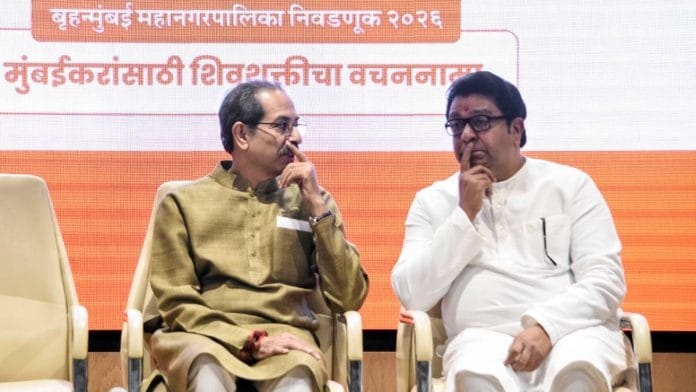



Mumbai: For Uddhav Thackeray and his party Shiv Sena (UBT), which faced its worst defeat in the 2024 Maharashtra elections—winning only 20 of 288 seats—the Brihanmumbai Municipal Corporation (BMC) polls were a litmus test, as the undivided Shiv Sena had held power in the corporation for 25 straight years.
Hoping to consolidate Marathi voters in the city, Uddhav joined hands with his once estranged cousin Raj Thackeray and his Maharashtra Navnirman Sena (MNS). As the results of Thursday’s BMC polls came out Friday, it was clear that the alliance did not yield much. Shiv Sena (UBT) secured 65 seats, while the MNS won six, falling far behind the majority mark in the 227-member corporation.
Talking to the media on Saturday, Shiv Sena (UBT) MP Sanjay Raut said, “Despite having no resources and odds stacked against us, we fought a good battle. We expected MNS to get at least 20 seats, even though we thought we would get 10-15 more, but that’s okay.”
“With Congress as well, our opposition is strong in the BMC. And there is no question of leaving the MNS alliance now,” he added.
Raj Thackeray took to his social media page and wrote, “…We couldn’t get the success that we had hoped for, but that should not disappoint us. Our fight is for the Marathi manoos—our language, culture, and Maharashtra. This is our pride and existence, and we know such battles go a long way…”
Political analyst Abhay Deshpande told ThePrint that the results were expected and that Marathi consolidation had occurred, perhaps more than anticipated. However, Uddhav Thackeray also managed to attract anti-BJP, non-Marathi votes—something Raj Thackeray failed to do.
He said, “Because Uddhav got Marathi plus non-Marathi votes, which was not the case with MNS, his strike rate was better than Raj Thackeray.”
This underscores that amid Mumbai’s changing demographics, the Thackerays cannot rely solely on the ‘Marathi manoos’.
“So Marathi sentiment is there, definitely—you cannot avoid that. But only Marathi sentiment is not enough to take you to power,” said Deshpande. “They will have to expand their arena, or else it will be impossible to cross the halfway mark. And the only way to do so is to go back to the original Uddhav Thackeray campaign—Me Mumbaikar.”
Marathi vote consolidation in areas such as Dadar, Mahim, Vikhroli, Sewri, and Worli gave the Thackerays a much-needed push. However, Muslim-dominated areas—such as Govandi, Byculla, Kurla, Mankhurd, Jogeshwari, Malad, and Mumbadevi—saw vote fragmentation, unlike the Lok Sabha and assembly polls, which were largely in favour of Uddhav.
One of the key reasons for this was the presence of Raj Thackeray in the alliance and the absence of the Congress.
This time, Muslims also voted for parties such as AIMIM, which performed better than the MNS, winning eight seats in Mumbai.
Deshpande said that even if Muslims do support Uddhav—as seen in some seats that Shiv Sena (UBT) won—with Raj Thackeray around, they would likely scout for another option.
However, the alliance appears to have worked reasonably well for a weakened Shiv Sena (UBT). In 2017, the undivided Shiv Sena had won 84 seats. Despite a large section of its former corporators defecting, Shiv Sena (UBT) managed a respectable tally this time.
While Uddhav Thackeray has repeatedly said that the cousins have come together to stay together, Raj Thackeray has so far avoided giving a similar assurance. For Uddhav, the option of joining hands with the Congress post-poll remains open, but the latter is unlikely to accept Raj as part of any such alliance.
For Uddhav’s party—which had been losing corporators to Eknath Shinde’s Shiv Sena even before the elections—keeping his flock together will be crucial.
The BMC poll results show that the Thackerays still retain significant control over Mumbai, a city once considered at the “beck and call” of Shiv Sena founder Bal Thackeray. At the same time, the outcome highlights the need to look beyond the Marathi manoos.
Since the Maha Vikas Aghadi (MVA) broke up and Uddhav decided to ally with Raj while parting ways with the Congress, the Congress has tied up with the Vanchit Bahujan Aaghadi (VBA), further denting opposition votes.
“If Congress were with Uddhav Thackeray, it would have been advantageous. If all three—including the MNS—had come together, it would have been a potent combination. But leaving Congress for MNS was a blunder for Shiv Sena (UBT),” Deshpande said.
In the coming days, “keeping his flock together will be a challenge for Uddhav Thackeray. Keeping the Marathi alliance intact and expanding his political arena will be equally difficult,” Deshpande added. “Though he fought a good battle in Mumbai, he has been wiped out in the rest of Maharashtra.”
(Edited by Nida Fatima Siddiqui)
Also Read: Uddhav-Raj reunion will have no impact, says Mumbai’s new BJP chief, lays out strategy for BMC polls