





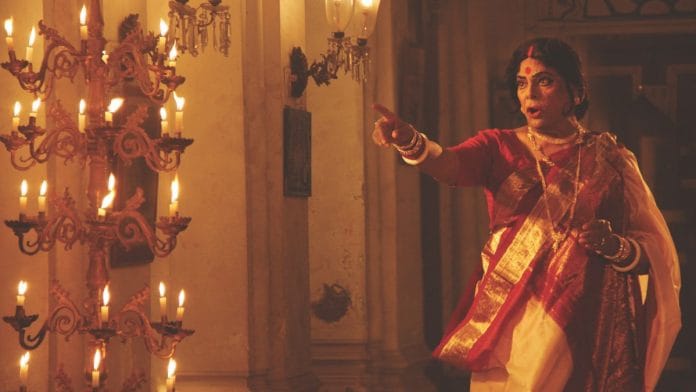



I was doing well at Natta but I was chafing from only playing Chhabi Rani’s hand-me-downs over and over again.
One day, Brajendra Kumar Dey, the playwright who had written some of Natta Company’s biggest hits, told Makhanbabu, ‘Tell Chapal to pay more attention to his acting. Since we have taken him on and he’s risen so fast in these last few years, I’m thinking the time has come for me to write a play centred on him.’
That play was Chand Bibi. The year was 1964.
I was elated. I had seen Ma act as Chand Bibi on stage. But that was in her later years. Kshirodaprosad Bidyabinode had written the original play. Chand Bibi was the fiery regent of Bijapur sultanate who rode into battle to defend her kingdom against the armies of the Mughal emperor Akbar in the sixteenth century. In Bidyabinode’s version, she is 50 years old, with a son named Ibrahim and a grandson named Bahadur. Brajen-babu kept me in mind and made his Chand Bibi younger, a widow of indeterminate age. He tweaked the other relationships as well: Ibrahim became her brother, Bahadur became her nephew, someone whom she had installed on the throne of Ahmednagar while she appointed herself as regent.
I could see myself as this Chand Bibi. I was tall, my voice was sweet yet powerful, as befitted a queen. In jatra parlance, I was well suited for what they called a ‘book heroine’.
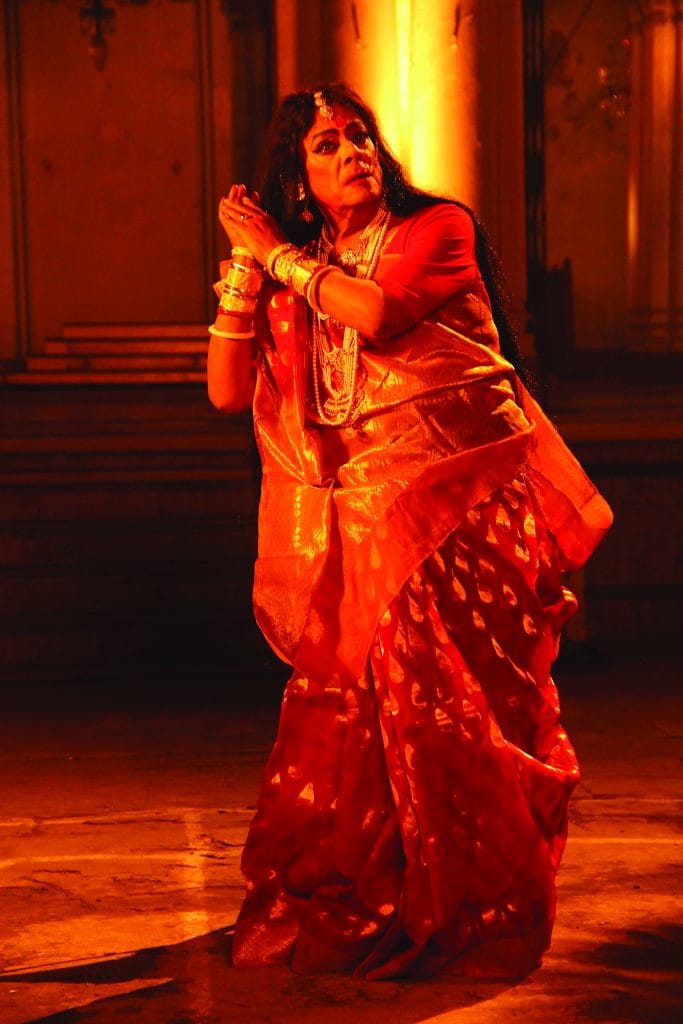
Singha | By special arrangement
I immediately started designing all of Chand Bibi’s costumes in my head. Makhan-babu showed me the usual outfits for warrior princesses that Natta Company had in its stock—spangled dresses made of heavy velvet.
‘No, no, this won’t do,’ I exclaimed, dismissing them all. ‘I want to wear what the real Chand Bibi might have worn.’ Surya-babu acquiesced.
I went off to New Market to find a jeweller who would make me gem-studded earrings. The funny thing is, I’ve never had my ears pierced despite playing women for so many years. I’ve always used clip-on earrings. In those days, you could get clip-on versions of almost everything, whether earrings or nose rings. And what I could not find, I would get shipped from Madras or Bombay, thanks to a shop in Kolkata who would happily source them for me. Now clip-ons are harder to find because everyone, man or woman, is getting their ears pierced. Luckily, my earringwearing days are over.
The main outfit for Chand Bibi was a dazzling white peshwaj, a short form-fitting waistcoat with gold brocade which I wore over a heavy satiny-white kurta. And diamond bangles with a long diamond necklace. The diamonds were actually glass, but they sparkled like real gems. At that time, they knew how to make imitation versions of everything—glass that looked like diamonds or lustrous pearls made out of wax and grains of rice. New Market was like an Alibaba’s cave for costume jewellery—you could get everything you wanted.
Also read: First review of Satyajit Ray’s Pather Panchali—moment for India to shake the world awake
The highlight of the costume was a diamond-studded crescent moon with a long feather attached to my turban. I went all over the city looking for the perfect crescent and eventually found it in a hole-in-the-wall shop in Bagri Market near Nakhoda Masjid in the crowded Muslim heart of the city, filled with stalls grilling beef kebabs and biryani shops and tailors. My moon was a little bigger than the crescent moon on Lord Shiva’s head. But how it glittered! It was so resplendent, I had no need for a crown.
The blouse was custom-made for me by my favourite tailor Qasim who had a shop behind New Market. They were master tailors, the kind you cannot find any more. I didn’t have to wear my artificial breasts when I went to give my measurements. They could just look at me and figure out the blouse size, such was their skill. They were great craftsmen, as were the wigmakers like Mehboob, Farhad, Abdul, all of whom also had shops near Nakhoda Masjid. My sister used them as well. I loved the wig she used in the play Anthony Kabiyal, so I told Farhad, ‘Please make me one as well.’ By then, Farhad was a legend among wigmakers.
He said, ‘These are very expensive. Will your Natta Company spend that much money?’
‘They will. I will tell Makhan-babu,’ I said confidently. ‘Take my measurements.’ He made me a beautiful wig, exactly like a young woman’s hair—with a middle part and waves on the side.
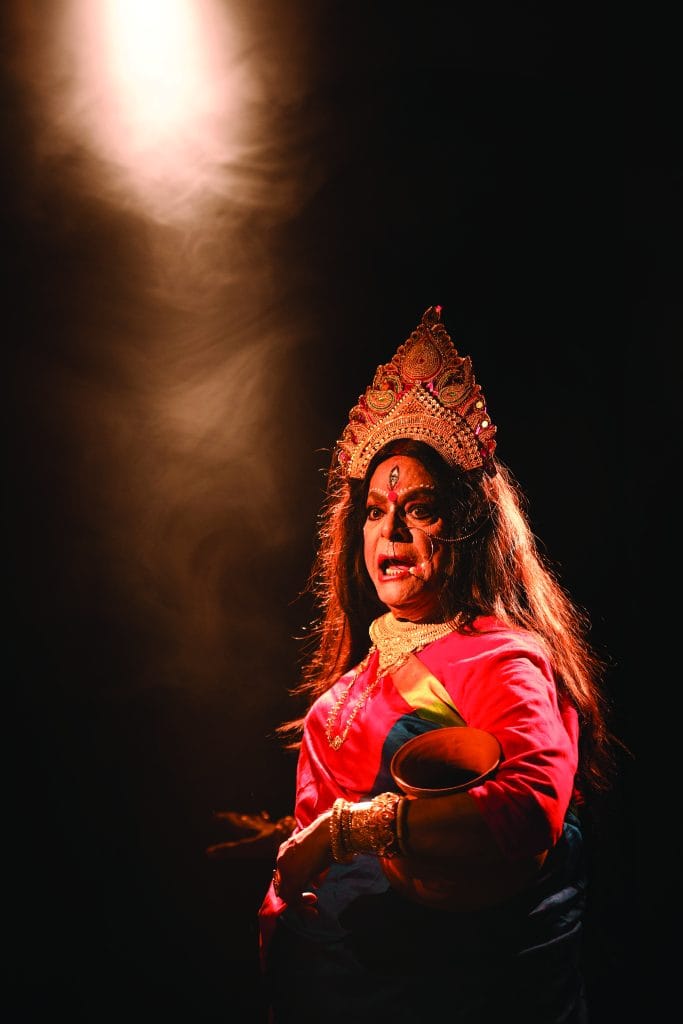
In the war scenes, Chand Bibi wore full leather armour. The breastplate was tied at the back with laces, the front had rows of silver discs while the arm and leg guards had patterns on them that looked like a filigree of iron. It made for a stunning ensemble when Chand Bibi strode onto the stage in full battle regalia.
There was one other outfit, the ‘Arabian’ one, and it was a black burkha. I purchased the black silk and Qasim cut it for me so that it flared like one of those classic gentlemen’s black umbrellas. The niqab or veil was made of sheer black georgette. When I cocked my head, the audience could see my eyes. Three outfits, each striking in its own way, and I had to change quickly from one to another.
Chand Bibi opened in Kolkata at S. C. Allen Market in North Kolkata. That market still exists, though now it’s been painted blue and white. In the middle of the market are concrete slabs where sellers set up mounds of vegetables or chop squawking chickens and big silvery fish on huge curved bontis.
In the morning, the hubbub is deafening and the place is awash in blood and fish scales and feathers. Little shops line the sides, selling all kinds of household goods, from sachets of detergent to brooms made of dried grass, loofahs made of gourds and shopping bags made from recycled sacks. That was our theatre. And the storage room, that was where we female performers did our make-up. Amid sacks of produce, we sat in the corner and transformed ourselves into queens and princesses. As Chand Bibi strode onto the stage, out of the corner of my eye I could see big jute sacks of potatoes and onions, piled in a corner, ready for next day’s business. even though the ‘stage’ had been washed and swept, it seemed to still smell of the day’s market, as if years of fish and vegetables and dried spices had seeped into the concrete itself.
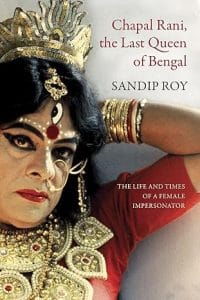 This excerpt from ‘Chapal Rani, the Last Queen of Bengal’ by Sandip Roy has been published with permission from Seagull Books.