






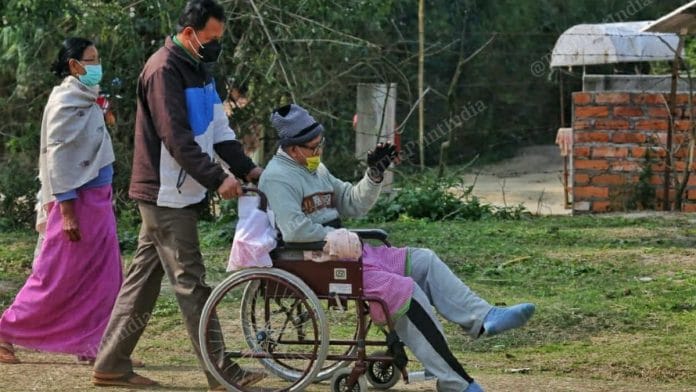



The Special Intensive Revision of electoral rolls, currently being conducted by the Election Commission of India in 12 States and Union Territories, SIR 2.0, has sparked significant political debate. Much of this discussion centres on feasibility, timing, and alleged political motives, particularly in Kerala, Tamil Nadu, and West Bengal, which are scheduled to hold elections next year. However, within the broader conversation about the disenfranchisement of vulnerable groups such as migrants and transgender persons, one critical constituency remains largely unnoticed: Persons with disabilities.
PwDs in India already face systemic barriers to political participation, from infrastructural inaccessibility to social stigma. The SIR, by design and by gaps in execution, risks exacerbating these barriers. With nearly half of all registered PwD voters residing in the 12 SIR states/UTs, the stakes of exclusion are extraordinarily high. I examine the multiple structural vulnerabilities that make the SIR an exclusionary exercise for this community, unless urgent corrective safeguards are put in place.
First, data on the number of registered voters with disabilities at the Parliamentary Constituency or Assembly Constituency level is not publicly available on the ECI website. This opacity makes it impossible to assess the baseline coverage of PwDs or track whether the SIR is improving or weakening their inclusion. Based on an RTI filed by the author before the 2024 General Election, the number and percentage of PwD voters in the States/UTs currently undergoing SIR are as follows:
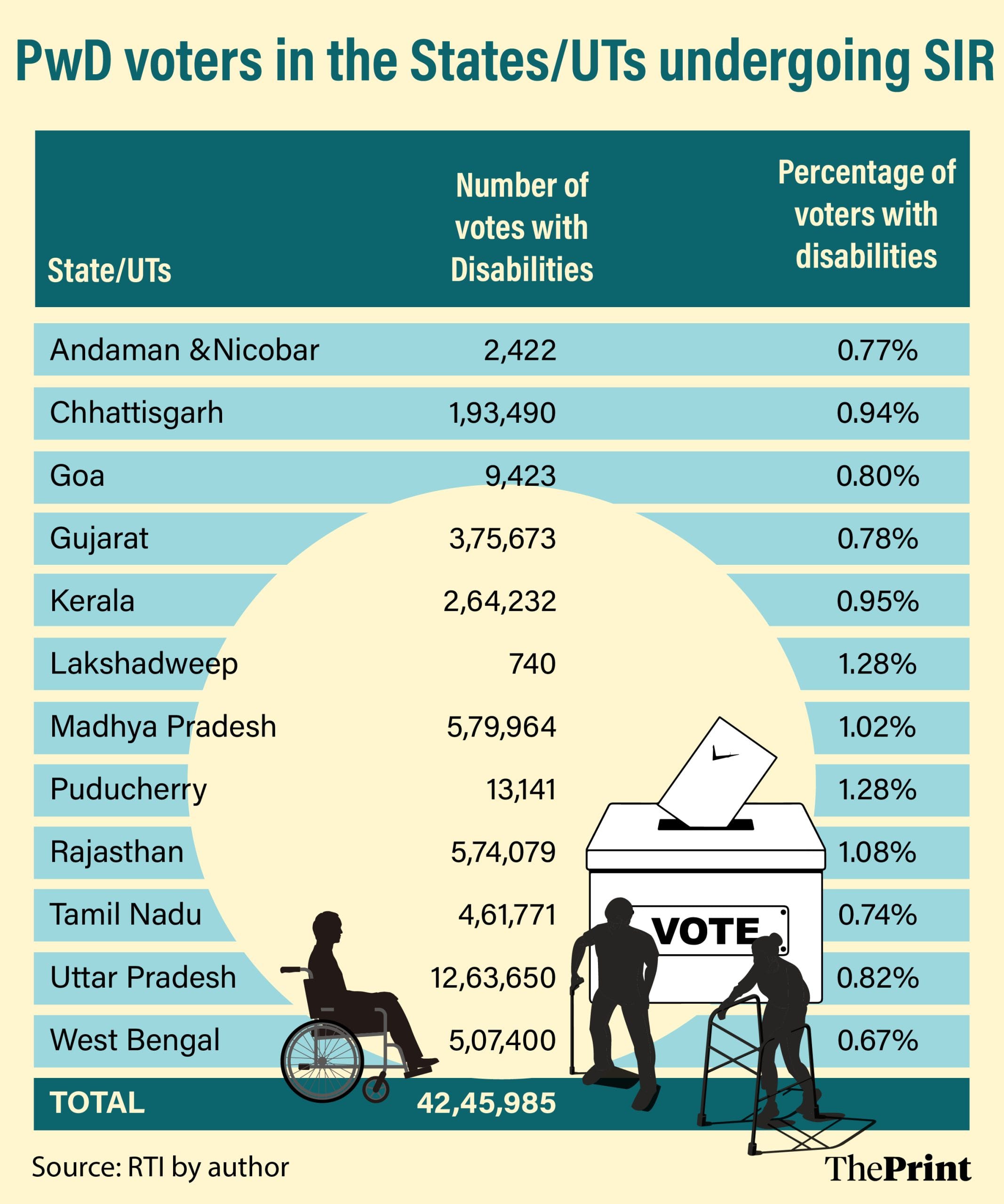
In the ongoing SIR 2.0 exercise, 42.5 lakh voters with disabilities were affected, accounting for 47 per cent of the 90.3 lakh voters with disabilities in India, as per the RTI data. According to the 2011 Census, which only recorded eight types of disabilities at the time, there are 1.89 crore Persons with Disabilities above the age of 20, i.e., eligible to vote. The preceding age group used in the census is 10 to 19, making it difficult to determine how many PwDs are actually in the 18 to 19-year-old age group. Therefore, for simplicity, we only consider the total number of PwDs aged 20 and above.
Based on this data, roughly 47% of the total eligible PwDs population, i.e., 90 lakhs out of 1.89 crore, are registered voters. This indicated that more than half of PwDs were not enrolled in the voter rolls until the last General Election. Without public data transparency, it is impossible to monitor whether the SIR 2.0 will bridge this gap or widen it.
Also read: Rahul Gandhi must stop with irresponsible SIR comments. There’s no ‘click’ to delete voters
Shortcomings of BLOs
Second, Booth Level Officers (BLOs) are the backbone of the entire SIR process. However, training modules do not adequately equip BLOs to communicate with or conduct household verification for PwDs, especially those with hearing, speech, intellectual, or psychosocial disabilities. The procedural requirement is that BLOs must return the enumeration forms within three visits. In practice, it was reported that BLOs were operating under severe time pressure and often prioritised “quick households” to meet their daily targets. Households where the head of the family is a PwD, or where the PwD resides without a present caregiver, may often be perceived as requiring more time or effort. This created an incentive for skipping, marking “locked/absent”, or prematurely categorising addresses as non-residential.
Third, the number of PwDs housed either in institutional households or in houseless households, according to the 2011 Census, in the 12 States/UTs, is 1,37,316 and 37,476, respectively, totalling 1.75 lakh. It is unclear how BLOs have been trained to distribute the enumeration form in such institutions, especially where people with mental or intellectual disabilities live.
The Election Registration Officers, after publishing the draft electoral roll, also have the discretion to preliminarily determine if a person is disqualified as a voter under constitutional or statutory provisions. One such provision is “unsoundness of mind,” which only applies after a court declaration. However, this provision may exclude people with mental or intellectual disabilities from the voter list without such a declaration, particularly in the absence of clear instructions from ECI. This ambiguity risks enabling discretionary exclusion rather than preventing it.
Also read: DPDP Act offers no special protection for disability data. It leaves PwDs vulnerable
Digital accessibility
Fourth, the heavy reliance on digital mechanisms within the SIR framework further disadvantages PwDs. The Voter Helpline App, online Form 6/7/8 services, and even the Garuda application used by BLOs have not been uniformly audited for accessibility. Many PwDs, including those using screen readers or requiring simplified or assisted formats, cannot meaningfully engage with these platforms. When physical verification fails, often because the BLO could not communicate effectively, the digital route becomes the only fallback, yet is inaccessible for a significant portion of PwDs. This results in a compounded risk of exclusion, first during field verification and again during self-correction or re-enrolment. The ECI’s own Accessible Elections guidelines emphasise barrier-free voter services, but the rollout of SIR has not demonstrated adherence to these standards.
The cumulative effect of these gaps is that the SIR, if conducted without disability-sensitive safeguards, risks becoming one of the largest disenfranchisement events for PwDs in recent electoral history. With nearly half of India’s PwD voters residing in the SIR states and UTs, any structural oversight automatically translates into large-scale exclusion.
The right to vote is not only a constitutional guarantee but also a measure of democratic inclusion. Ensuring that PwDs remain on the rolls requires more than routine enumeration; it demands proactive, accessible, and accountable processes.
Unless the ECI urgently strengthens training, clarifies legal standards, makes digital systems accessible, and publicly releases constituency-level PwD voter data, the SIR exercise may deepen, rather than rectify, the under-representation of persons with disabilities in India’s democratic framework.
Shashank Pandey is a lawyer and the Founder of Politics and Disability Forum. Views are personal.
(Edited by Theres Sudeep)