






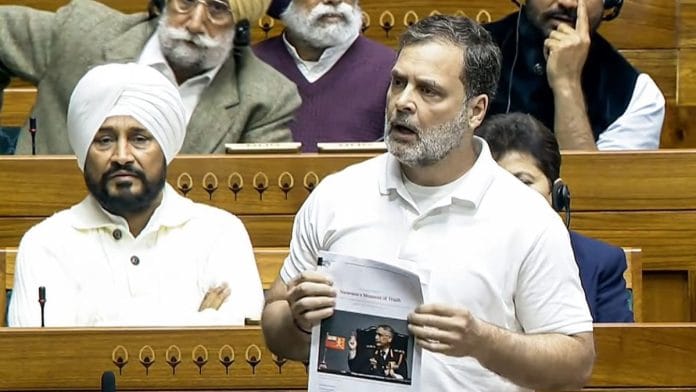



The Narendra Modi government’s fear became highly visible Monday when senior BJP ministers, including Defence Minister Rajnath Singh and Home Minister Amit Shah, prevented Leader of the Opposition Rahul Gandhi from reading out extracts from the unpublished memoir of former Chief of Army Staff General MM Naravane. The Speaker had to adjourn Parliament, preventing the debate from taking place.
So what got the Modi government’s knickers in such a twist?
In a nutshell, General Naravane’s memoir—Four Stars of Destiny—reveals that in 2020, he was left hanging by the political leadership for more than two hours as Chinese tanks drove towards Indian positions in the Kailash Range (south of Pangong Lake in eastern Ladakh), while Northern Army Commander Lieutenant General YK Joshi repeatedly asked for permission to fire artillery rounds on the advancing Chinese.
The problem was that Naravane had orders not to open fire “till clearance arrived from the very top”. He had been given no rules of engagement or told under what conditions he could fire on an advancing enemy. The only thing that had been decided was “that as a last resort, if our own physical security was at stake, that detachment and that detachment alone could open fire in self-defence.”
And what had Singh said to General Naravane at the absolute last minute? That the Prime Minister has said “Jo uchit samjho, woh karo”—do whatever you deem appropriate. The critical decision of whether India would go to war with China was left to the Chief of Army Staff. As Naravane wrote: “I had been handed a hot potato. With this carte blanche, the onus was now totally on me.”
This marked an unprecedented abdication of responsibility by the PM. Whether in Bangladesh (1971) or Kargil (1999), previous prime ministers remained firmly in charge of this decision of utmost national importance, where the lives of hundreds or thousands of soldiers were at stake. Here, an indecisive PM simply passed the buck to a besieged army chief.
Fortunately, General Naravane denied permission to fire and instead ordered General Joshi to outflank the light Chinese tanks by moving heavier Indian tanks to a dominant position at Rechin La pass. The Chinese eventually backed down and withdrew from the position.
And how did the Modi government reward General Naravane for this service to the country? By withholding permission for his book for close to two years. Meanwhile, clearance has been granted for several other books by journalists on various operations, including Sindoor, revealing all sorts of tactical details. Not to mention that operational details of actions in Rechin La and the nearby Kala Top were revealed to the media the very next day. The only operational details that seem off-limits are the ones that reveal the truth about the PM.
Also read: India’s bravest fought the battle of Rezang La in 1962—yet there’s no official record of it
Greatest territorial setback since 1962
Predictably, embedded sections of the media have rushed to the PM’s defence, arguing that this story actually shows how the PM was willing to devolve decision-making to the man on the ground. If that’s truly what the memoir reveals, why has it been blocked from publication for almost two years, and why was Gandhi prevented from reading a short published extract?
Another argument is that China has been “salami-slicing” territory for decades and that the Modi government was the first to stand up to it. Nothing could be further from the truth. It is widely known that the standard Indian response to Chinese intrusions has been to do a “quid pro quo” by making a counter-intrusion to incentivise the Chinese to withdraw. In 1967 (Nathu La and Cho La), 1986-87 (Sumdorong Chu), and 2013, the Indian government authorised the Army either to counter-attack, escalate, or—as in 2013—seize territory in Chumar in response to China’s Depsang incursion. In every case, the status quo ante was restored.
And Modi’s record? He acted directly in Doklam (2017) to block Chinese ingress into Bhutan’s tri-junction area. But he withdrew without firm guarantees, and China has cemented its control of the Doklam plateau since then—not what the same media outlets were telling you at the time, is it?
Who can forget PM Modi’s infamous clean chit to China, when he said, “Na koi hamari seema mein ghus aaya hai, na hi koi ghusa hua hai”, just four days after 20 soldiers were killed in Galwan, and several others were captured and beaten in Chinese custody before being released. The Indian Army was finally permitted to do a quid pro quo operation in August 2020—producing the confrontation that General Naravane wrote about. But guess what: even those gains were hastily given up only six months later in February 2021, under the partial Pangong Tso disengagement.
Chinese troops remained in control of Indian territory in Demchok and Depsang until the October 2024 agreement, and even today, “buffer zones” in Galwan, Hot Springs, and Pangong Tso lie predominantly within the Indian claim line, preventing our troops from accessing points to which they had unrestricted access before. This is nowhere close to the status quo demanded by the armed forces. It represents the greatest territorial setback to India since 1962.
The bottom line is this: General Naravane‘s memoir reveals that, when it comes to confronting China, Modi has been like a deer paralysed by the headlights of an oncoming car. These revelations expose his strongman image as the paid PR creation it is. At crucial moments for the nation, he has prioritised his election propaganda over the security of our northern border.
And if winning elections requires him to block publication of a book written by the man who saved the day in Rechin La, so be it.
Amitabh Dubey is a Congress member. He tweets @dubeyamitabh. Views are personal.
(Edited by Saptak Datta)
Pure deflection. The General says out right no action was taken by the BJP. And I thought Modi said nothing was lost? Didn’t the BJP president and RSS leadership meet with the Communist Party of China leaders last month in close door meetings? Meanwhile the Chinese continue to strengthen their border infrastructure and slowly creep into the Northeast.
When Congress was in power, they ignored repeated salami slicing by China. It was a regular feature.
The fact that Modi govt resisted and reacted to bunkers being built in no-man’s-land and even responding in Doklam, are a remarkable change in policy, that anyone can notice.
No amount of nitipicking on language nuances and twisting of words can’t hide, what Modi govt achieved.
One could never imagine the disengagement that happened under Modi govt, to happen under UPA. Maybe, you should ask why Rahul met the Chinese ambassador, while our soldiers were in standoff in Doklam.