






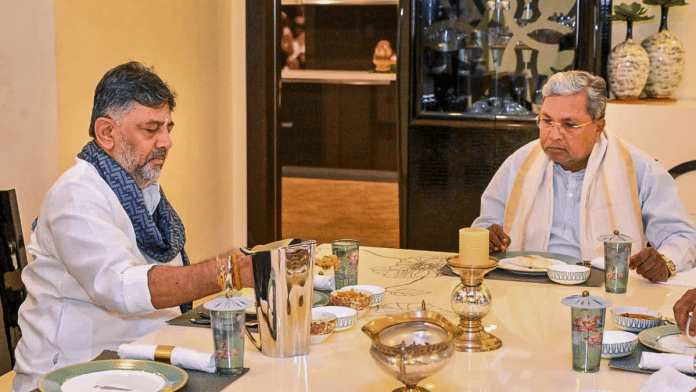



Only in India can a political crisis slip into the kitchen and come out dressed in symbolism. This week, Karnataka found itself arguing not over governance or public welfare, but over a bowl of nati koli saaru.
Chief Minister Siddaramaiah’s favourite dish appeared on the breakfast table at Deputy CM DK Shivakumar’s home, and suddenly the conversation shifted from a very real power-sharing tussle to a chicken curry doing diplomatic duty. And because the meeting happened to fall on Hanuman Jayanti, the BJP had something to say about the menu too.
Beneath the humour and the decoding games, the breakfast became a political statement. Who chose the menu, who it was meant to please, and what message it was supposedly sending—everything was up for interpretation. It is almost tragic that real struggles such as farmer distress, unemployment, and spiralling prices rarely get as much attention in political circles.
The meal itself was meant to signal harmony: each leader serving something that suited the other’s taste while still keeping local flavours on the table. But the script shifted the moment chicken was dished out.
The BJP stepped in with claims of religious hurt, and suddenly a simple breakfast became a full-blown political flare-up. Leader of the Opposition R Ashoka accused Siddaramaiah of “hurting the sentiments of Hanuman devotees” for eating chicken on a day when many were fasting and participating in temple rituals. In seconds, the politics of coalition balance became the politics of food purity.
It’s not even funny anymore—not because the politics is outrageous, but because it has become so painfully predictable. In India, even a meal can be weaponised if the moment demands it. Breakfast becomes a moral crisis, a menu becomes a battlefield, and suddenly we are debating chicken instead of the crises that actually shape people’s lives.
Also Read: As a Pasmanda Muslim woman, it pains me that India took 70 years to question talaq-e-hasan
Politics of plate-policing
When a BJP leader claims that a breakfast menu has “hurt sentiments,” it instantly takes me back to the politics I grew up watching — where every second thing was accused of hurting Muslim religious sentiments. It’s strange, and honestly sad, to realise how little we have evolved. Different parties, different communities, but the same recycled rhetoric. The same easy outrage. The same refusal to grow up.
While farmers struggle, prices climb, and jobs shrink, our politics somehow finds endless energy for these trivial flare-ups. It’s almost as if distraction has become the easiest currency in public life.
This isn’t about one side or the other; it’s about a political culture that has normalised this absurdity to the point that we barely even notice it anymore. I would have understood the outrage if this were a sacred Hindu occasion where non-veg is traditionally avoided. But what does a diplomatic breakfast between two leaders have to do with religious hurt? How does that become a matter of collective morality?
It reminds me of the same logic I find ridiculous in some Muslim-majority countries, where people are forced not to eat in public during Ramadan, as if faith needs state-enforced discipline. I have always argued that when politics starts policing plates, it’s rarely about devotion. It’s about control, and about how easily public emotion can be manipulated.
Also Read: Muslims use Halal, Hindus eat Sattvic food, Jains avoid meat. Where is terrorism in this?
The manipulation of public emotion is a political culture in India. We have normalised it, accepted it, even celebrated it as if outrage is a marker of identity and not a tool of control. India deserves better than this. We deserve better than this.
We deserve a politics that helps citizens understand policies, confront real social and economic issues, access verifiable information, and know our rights. We deserve leaders who are accountable, governments that are transparent, and a public culture that encourages thinking — not emotional puppeteering.
If this is the politics we reward, we will remain nothing more than pawns, moved around by whoever claims to speak for our “sentiments” or feeds our biases.
And honestly, why do Indians need a political party to “protect” religious sentiments in the first place? Faith is personal. Devotion is personal. No MLA or MP can pray on our behalf. What they can do, and what they are elected to do, is deliver governance, dignity, and a functioning democracy.
Our personal faith does not need political guardians. Our democracy does.
Amana Begam Ansari is a columnist and writer. She runs a weekly YouTube show called ‘India This Week by Amana and Khalid’. She tweets @Amana_Ansari. Views are personal.