






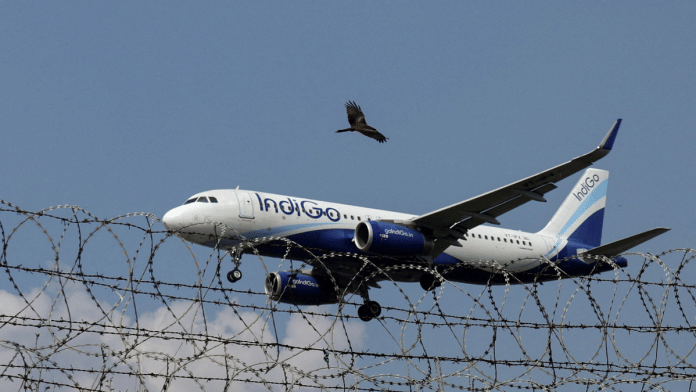



Who ordered the grounding of thousands of IndiGo flights? Why did the IndiGo flights not take off in the first week of December? A probe into these two questions will bring the cat out of the bag and clear the IndiGo mystery.
That this happened during Russian President Vladimir Putin’s planned visit to India is curious. The cascading collateral consequential damages to India’s economy and investment climate are immeasurable.
Could anyone plan such a massive operation with mathematical exactitude? This question rises above politics and goes into the domain of national security. No inquiry will answer these speculative questions, but IndiGo still stands on the dock. The Directorate General of Civil Aviation (DGCA) was found wanting and the Ministry of Civil Aviation (MOCA) caught napping.
The situation is nothing short of a threat to India’s stability. Could it be an experiment? Can this happen in any other crucial sector like power or railways? Those governing India need to fasten their belts and remember the adage: Eternal vigilance is the price of liberty.
It is facile to argue that the DGCA’s directive stipulating timelines is responsible for this situation. If IndiGo needed more time to comply, it could have moved the court and obtained relief. India’s constitutional courts are known for correcting the wrongs.
For instance, when pilots threatened a mass strike in the late 1990s, the Delhi High Court immediately passed an ex-parte order, after I mentioned before the judge at his residence, when I was representing the Airports Authority of India.
Therefore, it’s not correct to say that the DGCA circular is entirely responsible for such a massive fiasco. While the DGCA should have monitored the situation closely after issuing the directive, it clearly did not order the grounding of thousands of flights. The violation of its directive entails other penal consequences. Penalty should be slapped on IndiGo and not on the passengers.
Also read: IndiGo meltdown carries a warning for India’s defence sector
Finding the culprit
Let’s return to the initial question: Who ordered the grounding of flights? That person is the number one culprit. Someone somewhere may have winked to play havoc; otherwise such a massive error is implausible. It’s a humongous failure. Delay or cancellation of even one flight can play havoc, but thousands of flights? Unimaginable. This must be the first ever of its kind in world aviation history.
But can such an operation be engineered by more than one person to destabilise India? This is the question that needs answering.
India has witnessed crises in various sectors time and again. And every time, the country has seized a crisis into an opportunity to reform itself. On 15 April 1980, six banks were nationalised. Not many know but it followed after a massive crisis in forex trading in one of the six private banks that were nationalised.
The RBI became vigilant after the forex trading crisis. Over the years, it introduced pathbreaking reforms to keep a vigilant eye on the forex trading room.
Perhaps the DGCA should hive off a 24X7 monitoring room to keep a vigilant eye on each airline. Bankim Chandra Chattopadhyay’s legacy and “Vande Mataram” will surely rise above time. Time, however, seems ripe to focus on India’s security concerns.
Bishwajit Bhattacharyya is a senior advocate in the Supreme Court and former Additional Solicitor General of India. Views are personal.
(Edited by Theres Sudeep)