









Seven foreign nationals were taken into custody by the National Investigation Agency after a Delhi court granted the anti-terror body 11 days of custodial interrogation to probe an alleged conspiracy involving the training of ethnic armed groups in drone warfare in Myanmar. The arrests were carried out in Kolkata and Delhi, where the accused were reportedly operating prior to being detained.
American national Matthew VanDyke was arrested in Kolkata in what appears to be part of a wider coordinated security sweep. Simultaneously, three Ukrainian nationals were detained in Lucknow, while another three were picked up from Delhi, underscoring the multi-city scale of the operation. The arrests of Hurba Petro, Slyviak Taras, Ivan Sukmanovskyi, Stefankiv Marian, Honcharuk Maksim, and Kaminskyi Viktor point to a pattern that extends beyond isolated law enforcement action.
Since the 2021 coup in Myanmar, there has been a perceptible rise in reports of foreign nationals, and in some cases, alleged mercenaries appearing within its conflict zones. In October 2023, 12 foreign fighters were captured near Laukkaing in northern Myanmar. The group reportedly consisted largely of former members of the French Foreign Legion and at least two individuals allegedly still under active contract, with nationalities spanning Poland, Slovakia, and Brazil.
Reportedly, their role was not active combat on the frontlines but training. This points to a shift in the nature of the conflict—away from sheer numbers, toward skill, coordination, and tactical sophistication. The demand is no longer just for guns, but expertise. Equally revealing was how such expertise was mobilised. The presence of intermediary figures known only by aliases such as “Golden Fish” and “Mr Ling” suggested that these arrangements are not formal or transparent. What has emerged is a quieter but more consequential transformation. Conflicts like Myanmar’s are no longer insulated within national boundaries. In such an environment, the boundaries between mercenary, contractor, and criminal actor begin to dissolve.
Mercenaries, ideology, religion
The story of Alex Kliševits from Estonia adds another dimension to the story of foreigners in Myanmar’s conflict. After founding a private security firm and working in Ukraine, he took up a contract offering $4,500 a month, expecting routine security work. Only upon reaching Laukkaing did he realise the company Shadow Defense was reportedly run by Chinese nationals and staffed by Western veterans, many from the French Foreign Legion. In his case, recruitment was opaque.
Mercenaries such as Kliševits or the alleged French Foreign Legion fighters are individuals who participate in armed conflict primarily for financial gain rather than loyalty to a nation or ideology. They are not part of a country’s official military and are usually hired on contracts by governments, corporations, or non-state actors. Today, many operate through private military companies such as Wagner Group or Academi. Their roles vary from combat and training to security and intelligence support. Legally, they exist in a grey zone and are not fully protected under the Geneva Conventions, making their status in war ambiguous.
What makes the situation more complex is when mercenaries descend into a conflict zone with an ideology or religious affinity. For instance, the Free Burma Rangers (FBR) describe themselves as a Christian, multi-ethnic humanitarian network with a core mission to provide emergency medical aid, food, and shelter to internally displaced populations caught in cycles of violence. While rooted in Myanmar across conflict-hit regions such as Arakan, Chin, Kachin, Karen and Shan state, the FBR has steadily extended its footprint beyond national borders. Its operations now reach other war zones, including Sudan, Iraq, and Syria. Its founder, David Eubank, is a former US special forces officer who grew up in a missionary family. He has admitted that FBR is mostly about Jesus.
“My family and I are grateful to belong to Jesus and want to be part of His kingdom in Burma and anywhere He sends us. We want our team members to know and follow Jesus more than anything else,” Eubank said.
The FBR are also known to carry weapons, though they claim it’s for self-defence.
Mercenary activity becomes far more complex when religion enters the equation, because it blurs the line between profit and belief. What begins as transactional violence can quickly acquire ideological meaning. Fighters may no longer see themselves as hired actors but as defenders of a shared faith or community. This shift reshapes recruitment. Religious networks, charities, and diaspora linkages can act as informal mobilisation channels. These are far less visible than conventional pipelines and often operate under the cover of humanitarian or faith-based work. It also alters local perceptions. Such actors may be seen not as outsiders but as protectors, especially in identity-driven conflicts. This makes state response politically sensitive and operationally difficult. But most significantly, religious framing expands the conflict itself. It draws in attention, resources, and participants from beyond borders, embedding local wars within wider transnational narratives.
Also read: Delhi is keeping Dhaka’s security concerns in mind. Tarique Rahman should remember this
Western visitors to Mizoram
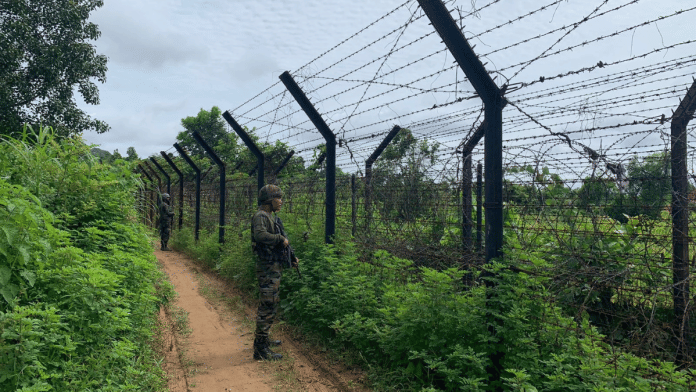
In Myanmar’s Chin State, which is predominantly Christian and bordering India’s Mizoram, the interception of VanDyke may not be much more than violating Indian laws and crossing over illegally to Myanmar. But VanDyke has admitted previously to “raising a Christian Army to fight ISIS” on behalf of the oppressed Assyrian Christians. Concern is already visible on the Indian side. Mizoram chief minister Lalduhoma has flagged an unusual rise in foreign arrivals. Nearly 2,000 Western visitors entered Mizoram between June and December 2024, yet few were visible in Aizawl. He also cited the case of British national Daniel Newey, arrested at Lengpui Airport in 2024 for carrying live ammunition. One must ask the question: Why are a majority of foreign mercenaries in Myanmar Western?
It is possible that some individuals entering conflict zones such as Myanmar do not fully grasp the consequences of their actions. Yet, it would be naïve to assume that most are driven by ignorance alone. Increasingly, motivations appear to extend beyond money, shaped by ideological conviction and religious zeal. This shift makes it essential to assess such activity through a broader lens.
When belief systems intersect with violence, mercenary roles cease to be purely transactional. They become embedded within political and social narratives that are far more difficult to untangle. Religion, in particular, transforms the nature of participation. It adds legitimacy in the eyes of some while complicating classification and response for states. What emerges is a form of engagement that is harder to define, regulate, and ultimately contain. India’s northeastern borders are porous, and the Myanmar conflict will continue indefinitely. While security has been hyper vigilant, the broader lens must prevail to prevent spillover.
Rami Niranjan Desai is a Distinguished Fellow at the India Foundation, New Delhi. She tweets @ramindesai. Views are personal.
(Edited by Prasanna Bachchhav)