









Why is New Delhi still not talking enough about its slipping grip in the Caucasus—a mountainous region between Europe and Asia? The situation on the ground is evolving rapidly, and if India is not at the table, it risks being on the menu.
US Vice President JD Vance and Usha Vance recently concluded a four-day visit to the Caucasus, pledging billions of dollars in investment in Armenia and signing a robust strategic partnership with Azerbaijan. Donald Trump—after a year of trying and erring on awry peace building, ceasefires that collapsed and entrenchment in distant wars despite Donroe-ism—can now claim that the ever-warring Caucasus has been “normalised.” That normalisation is precisely what Trump will sell under his peacemaker hat as the US heads into the midterm season.
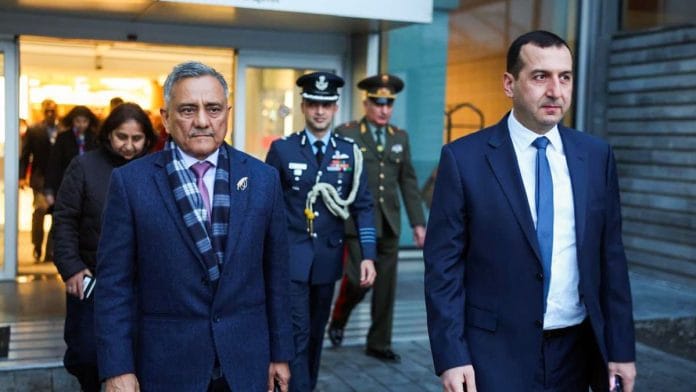
Earlier in February, India’s Chief of Defence Staff, General Anil Chauhan, also visited Yerevan. Why? By late 2024, India had emerged as the largest defence supplier to Armenia in its long-standing war against Azerbaijan. But the war did not last, and India’s hard-earned reputation and military presence could soon lose its steam.
Seething conflicts from frozen wars
Few expected Indian weapons to land in the mountainous highlands of the Karabakh region in the far-flung southern Caucasus—a place most Indians could not locate on a map, let alone grasp historically. Much of India, like the rest of the world, consumed by Covid-19, followed the 44-day conflict in 2020 between Armenia and Azerbaijan over Nagorno-Karabakh with technical curiosity at best.
The focus was narrow: how ‘drone warfare’ had transformed military planning and execution. Turkish Bayraktar TB-2 drones devastated Armenia, wrecking a small, landlocked country with limited resources that was depending on Russia for its security. Europe-watchers at the time explained it as one of the two frozen conflicts of Europe—other being the Balkans.
There was still no inkling of the war in Ukraine, and the world left the South Caucasus to its fate, largely a function of Russian management. Moscow played both sides (with Yerevan and Baku), brokered ceasefires and deployed peacekeepers, dominating the region’s security architecture and everything in between.
But the war was not over. Armenia lacked weapons and money to procure expensive Western systems while remaining officially dependent on Russia under the Collective Security Treaty Organization (CSTO) collective security guarantees.
The world moved on until Russia invaded Ukraine, and Europe’s security discourse changed forever. Few in India’s strategic community foresaw then how dramatically the region’s military balance would shift to India’s favour.
Also read: BNP win in Bangladesh is a chance to reset Delhi-Dhaka ties—India is willing to forget the past
New Delhi’s stakes in Yerevan’s war
Baku, emboldened by its 2020 victory and armed with Turkish and Israeli weaponry, exploited Putin’s Ukraine obsession. In late 2022, Azerbaijan imposed a months-long blockade of the Lachin Corridor under the guise of environmental protests. By September 2023, it launched another lightning 24-hour offensive against Armenia and seized full control of the disputed territory. And it succeeded again.
The Caucasus briefly returned to international attention—then faded again into the mist rising from the Kura River valley. However, this time around, not so for New Delhi.
Armenia, disillusioned with Russia’s attitude and its empty treaty promises, began looking outward. India emerged as a cost-effective, scalable solution. In a rare moment of strategic foresight, New Delhi seized the opportunity. By July 2023, Indian weapons began arriving: Pinaka multi-barrel rocket launchers, anti-tank missiles, ammunition, radars, and more. By November 2024, India shipped Akash air defence systems and signed agreements for more advanced platforms.
All this cooperation ran through Iran, bordering Armenia, the critical transit route. India, Armenia, and Iran already had a trilateral mechanism—one that came in handy at the time.
What stood out was the speed.
India’s typically sluggish bureaucracy recognised the opportunity of Armenia becoming a major defence importer of Indian weapons, just a stone’s throw from Europe. This was a chance to showcase India’s coming-of-age as a manufacturer of cost-effective, battle-tested, and scalable defence systems. The Indian embassy in Yerevan became unusually active, and a Tejas pilot was appointed India’s first military attaché in the Caucasus.
Armenia’s parallel military purchases—French Caesar 155 mm howitzers, Bastion APCs, Mistral short-range SAMs, and Thales GM 200 radars—were complementary. India and France share deep defence synergy and an ambitious roadmap for co-production and co-export. Armenia offered India something even more valuable: a real-world deployment window for its aspirations where Indian systems were not just sold, they were fielded.
India had arrived in the Caucasus as a serious defence exporter. Strategic discussions centred on potential exports of Tejas fighter jets to Armenia as confidence deepened.
Then came Trump, along with his personal peacemaking ambitions.
Trumpian toss
In January 2025, Trump returned to the White House. He boasted of ending wars in 24 hours and was obsessed with winning the Nobel Peace Prize. Ukraine, despite its best efforts, proved beyond his deal-making reach, but the Caucasus was different. It was manageable. Turkey’s unprecedented rise in regional influence, Russia’s retreat, and Trump’s personal rapport with Erdoğan aligned neatly and delivered results.
Armenia, fiercely nationalist but battered by a long-standing war, crushing defeat in both 2020 and then again in 2023, had little choice. Normalisation—however imperfect—became pragmatic survival.
From India’s perspective, three points stand out.
First, changing stakes. With Trump’s entry, New Delhi should have recalibrated its Caucasus narrative. If India had stakes in Armenia’s war, it needed stakes in Armenia’s peace. At the May 2025 Yerevan Dialogue—held with India’s MEA and ORF as partners—conversations on normalisation had already begun. These discussions were not unfamiliar to New Delhi.
Yet India stopped short of playing a larger role. There was no visible willingness to embed itself in the emerging Armenia-France-Greece-Cyprus strategic alignment, designed partly to balance Turkey and partly to play the long game.
French and Greek strategic circles openly discussed a resilience-building quadrilateral for Armenia, with India as the most acceptable external partner, even for Russia. However, India showed little willingness.
Second, in early August 2025, Trump unveiled a breakthrough agreement. Beaming alongside Armenian Prime Minister Nikol Pashinyan and Azerbaijani President Ilham Aliyev in the White House, he announced a peace framework that included exclusive rights to a strategic corridor through the South Caucasus.
Named the Trump Route for International Peace and Prosperity (TRIPP), the US-backed 43-kilometre rail-and-road corridor cuts through Armenia’s Syunik province, linking Azerbaijan to its Nakhchivan exclave. It bypasses Russia and Iran, creating a new east–west artery capable of changing the geopolitics and geo-economics of the Caucasus.
India’s response was characteristically passive, and the best we discussed was geography. The corridor sits precisely along the Armenia-Iran border—through Syunik, the province India uses to ship weapons via Iran. While nothing formally ‘blocks’ Indian transit, the implications of expanded US presence, Turkish leverage, and Azerbaijani influence remain uncertain and unanalysed.
On 31 August 2025, Armenia and Pakistan formally established diplomatic relations, ending decades of non-recognition. The move was backed by China and finalised in Tianjin.
Meanwhile, India continued discussing the International North-South Transport Corridor (INSTC)—a connectivity concept that looked promising until recently. New Delhi had planned to expand non-military cooperation with Armenia through the India-Iran-Armenia trilateral, leveraging its investments in Chabahar.
The idea was simple: link Chabahar to INSTC in Iran, then connect INSTC—traditionally routed via Baku—to Armenia.
Third, the Chabahar setback—those plans are now suspended. India’s exit from Chabahar and the tightening US noose on Iran have narrowed options. As argued earlier, every scenario involving Iran now has costs for India.
Today, New Delhi lacks a practical Plan B to consolidate the presence, credibility and stakes it had so carefully built in the Caucasus.
Also read: India-US trade deal is just like Union Budget. Sycophants are forced to praise both
Where now?
General Chauhan’s February 2026 visit focused on sustaining military cooperation, but no new orders are known. Existing deliveries will continue, but Armenia’s strategic outlook has shifted. There is no longer an emergency to stockpile weapons. With active US engagement, Western equipment—French, Greek, even Turkish—appears more attractive.
India still retains a reputational advantage. It stepped in when few others did, and it has industrial-scale, cost-effective solutions and battle-tested systems.
But unless India evolves from a weapons supplier into a stable, long-term resilience partner for Armenia, this moment will pass.
Swasti Rao is a Consulting Editor (International and Strategic Affairs) at ThePrint. She tweets @swasrao. Views are personal.
(Edited by Saptak Datta)
India should look for such quick sale opportunities elsewhere for defence equipment and establish the footprint before getting caught up in building strategic allies.
Lets get some hard cash for building in country capabilities
Just because Armenia did not further orders, the author assumes that it may buy weapons from USA, France, Greece and even Turkey. Turkey? What an absurd assumption! There is no report that India is not maintaining good relations with Armenia and Greece. The author has written some good articles in the past. But I doubt her mindset, her geopolitical approach as in many articles she sees bad omen for India.
This is perhaps the most brilliant, incisive and super spot-on analysis I’ve read in a long time. A region which is largely neglected in the Indian narrative but one that holds immense geostrategic potential, so lucidly explained with all the prop roots covered. Full marks to Dr. Rao and to The Print.
hey swati ,i am big admirer of your geo politcal analysis , but i would like to add something , its so nice that i dont find much mention of Turkey here , i feel as i have seen all your shows on print you seems to be infatuated with turkey its stratgey , tech , its involvement in indias neighbourhood . i think you provide too much weight to turkey even though it does not deserve that much vis a vis india , i am reminded what nsa doval said WHEN india puches , it punch below its weight , but those days has gone and now india play like a biig player in the leagues of us , russia , china if not above them then beside them , its just matter of perception that india has gained for all the wrong reasons for decades like some soft state with poverty and no capability and what not , but things are moving in postice direction . thats all i have to say , although i can be wrong , its just an opinion . AND THANKS FOR ALL THE GOOD WORK YOU ARE DOING IN INDIAS ACADEMIC GEO POLITICAL DISCUSSIONS .